


Listen to the article
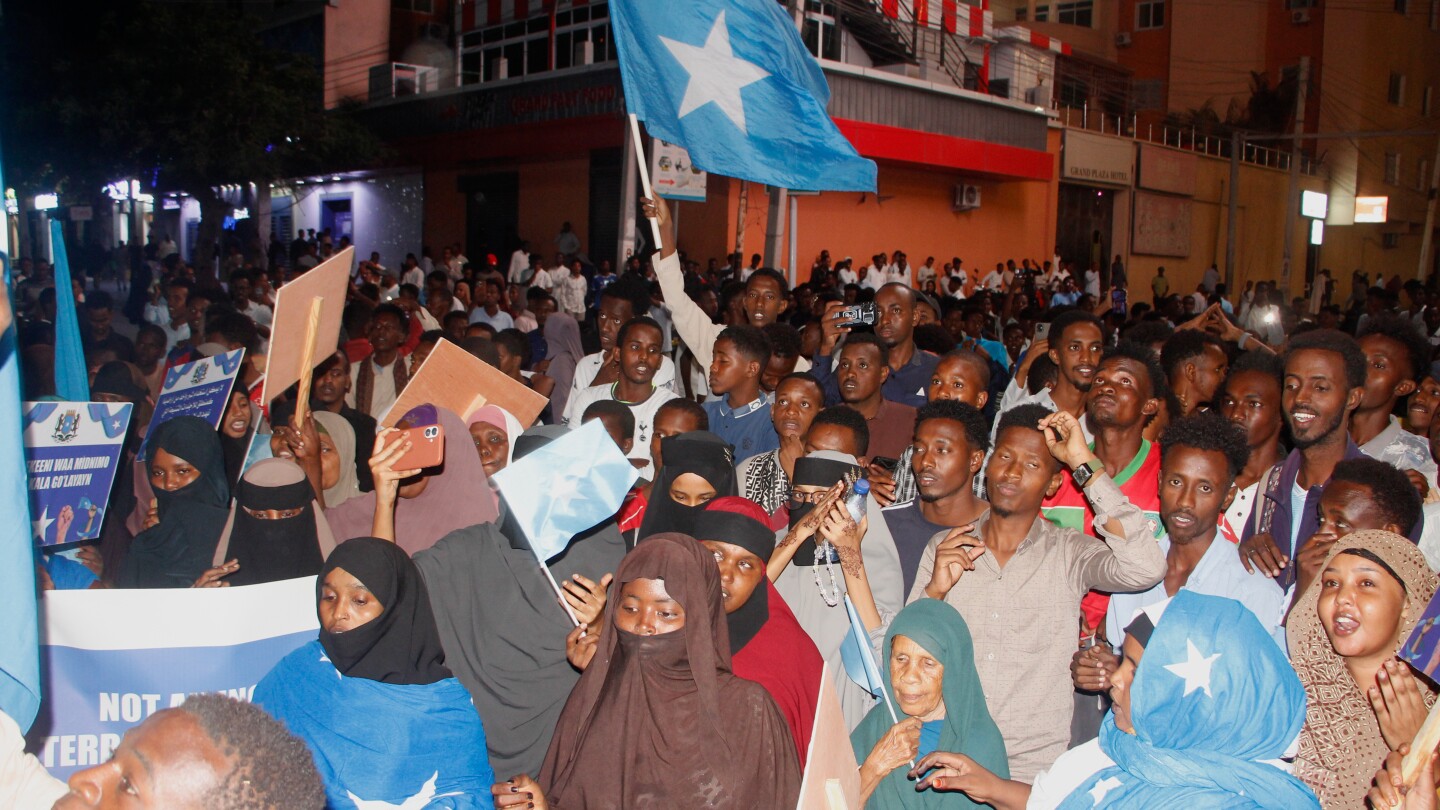
Hundreds of protesters gathered in downtown Mogadishu on Thursday night to demonstrate against Israel’s recent recognition of Somaliland as an independent state, a move that has escalated tensions in the Horn of Africa.
The demonstration at Taleh Square drew crowds waving Somali flags and chanting patriotic songs, with protesters carrying placards denouncing what they described as foreign interference in Somalia’s internal affairs. The rally marked the third such event since Israel’s controversial announcement on December 26.
“We are protesting against the division of our country,” said demonstrator Said Gedi. “This is against the sovereignty, independence and territorial integrity of Somalia, and we hope Somalia will stand united.”
The protest came just two days after Israeli Foreign Minister Gideon Saar visited Hargeisa, Somaliland’s capital, where he announced plans to open an embassy and appoint an ambassador. This diplomatic move has triggered widespread condemnation across Somalia and the broader region.
“Somalia cannot be divided,” protester Abdirahman Abdulkadir told reporters. “We are united by one religion, one culture and the same heritage.”
The timing of the demonstration coincided with a televised address by Somali President Hassan Sheikh Mohamud, who firmly rejected Israel’s decision and called for dialogue between Somaliland’s leadership and the federal government in Mogadishu.
“I want to make it clear once again that the Republic of Somalia is a sovereign and united country,” President Mohamud declared. “Its territory cannot be divided or ceded by any letter written by Israel or signed by [Israeli Prime Minister Benjamin] Netanyahu.”
In his address, Mohamud warned that the dispute could undermine Somalia’s fragile political stability and economic recovery if not handled carefully. He urged Somaliland’s leadership to pursue negotiations, noting that successful secessions historically occur through political agreements rather than unilateral declarations. The president specifically cited South Sudan’s 2011 independence from Sudan as an example.
Mohamud also emphasized that Israel has no historical, cultural, or economic ties with Somalia that would justify its intervention in the region’s affairs.
Somaliland, a former British protectorate in northwestern Somalia, unilaterally declared independence in 1991 following the collapse of Somalia’s central government. Despite maintaining its own government, currency, and security forces for over three decades, Somaliland had never received formal recognition from any United Nations member state until Israel’s announcement.
The international community has largely responded with concern to Israel’s move. More than 20 countries, primarily from the Middle East and Africa, along with the Organization of Islamic Cooperation, have rejected Israel’s recognition of Somaliland.
Egyptian Foreign Minister Badr Abdelatty voiced strong opposition on Tuesday, calling the recognition “a dangerous precedent that threatens regional and international peace and security.” This reflects growing concerns about the potential destabilization of the Horn of Africa, a region already facing significant security challenges.
Reports from last year indicated that Israel had approached Somaliland about potentially resettling Palestinians from Gaza as part of former U.S. President Donald Trump’s Middle East plans. Somalia’s foreign ministry has denied that such a proposal was ever seriously considered. The U.S. government has since abandoned this idea and continues to recognize Somalia’s territorial integrity, including Somaliland.
The dispute highlights the complex geopolitical dynamics in the Horn of Africa, where regional powers and international actors compete for influence. For Somalia, which continues to battle the al-Shabab insurgency and rebuild its institutions after decades of civil war, the territorial dispute with Somaliland represents yet another challenge to national unity and stability.
As tensions continue to simmer, regional organizations including the African Union and the Intergovernmental Authority on Development will likely face increased pressure to mediate between the parties and prevent further escalation in this strategically important region.
Fact Checker
Verify the accuracy of this article using The Disinformation Commission analysis and real-time sources.

14 Comments
This is a complex and sensitive issue that touches on fundamental questions of national identity, sovereignty, and self-determination. I’m interested to see how the international community responds and whether it can play a constructive role in facilitating dialogue.
While I understand the protesters’ concerns, I hope that all parties can approach this with nuance, empathy, and a genuine commitment to finding a peaceful resolution that respects the rights and aspirations of the Somali people.
The tensions between Somalia and Somaliland are complex and have deep historical roots. While I can understand the concerns about territorial integrity, it’s important to consider the perspectives of all sides involved.
Ultimately, any resolution will require nuanced diplomacy and a willingness to find a mutually acceptable solution. Protests alone are unlikely to resolve this long-standing dispute.
The protests in Mogadishu underscore the deep feelings that this issue evokes among many Somalis. However, I hope that the various parties can move beyond entrenched positions and explore creative solutions that address the concerns of all sides.
Ultimately, the goal should be to find a path forward that promotes stability, economic development, and the overall welfare of the Somali people, rather than further entrenching divisions.
This conflict highlights the ongoing challenges of balancing national unity with the aspirations of regional actors. I’ll be following this story closely to see how it unfolds and what implications it may have for the broader region.
It’s crucial that all stakeholders engage in good-faith negotiations and prioritize the well-being and self-determination of the Somali people, rather than pursuing narrow political agendas.
This is a delicate geopolitical issue with regional implications. I’m curious to learn more about the underlying drivers of the conflict and what potential pathways exist for a peaceful resolution.
It’s important that all parties approach this with an open mind and a commitment to finding a compromise that respects the interests and concerns of Somalis across the political spectrum.
The recognition of Somaliland’s independence by Israel is a significant development that is likely to further complicate an already tense situation. I hope the international community can play a constructive role in facilitating dialogue and de-escalation.
While the protesters’ concerns about territorial integrity are understandable, I wonder if there may be opportunities for greater autonomy or federal arrangements that could address some of the underlying issues.
The recognition of Somaliland by Israel is a significant geopolitical development that is likely to have far-reaching implications. I’m curious to learn more about the historical context and the various actors and interests involved in this conflict.
Ultimately, I hope that the Somali people can come together to find a solution that preserves their unity and territorial integrity, while also addressing the legitimate concerns and aspirations of all regions and communities.