


Listen to the article
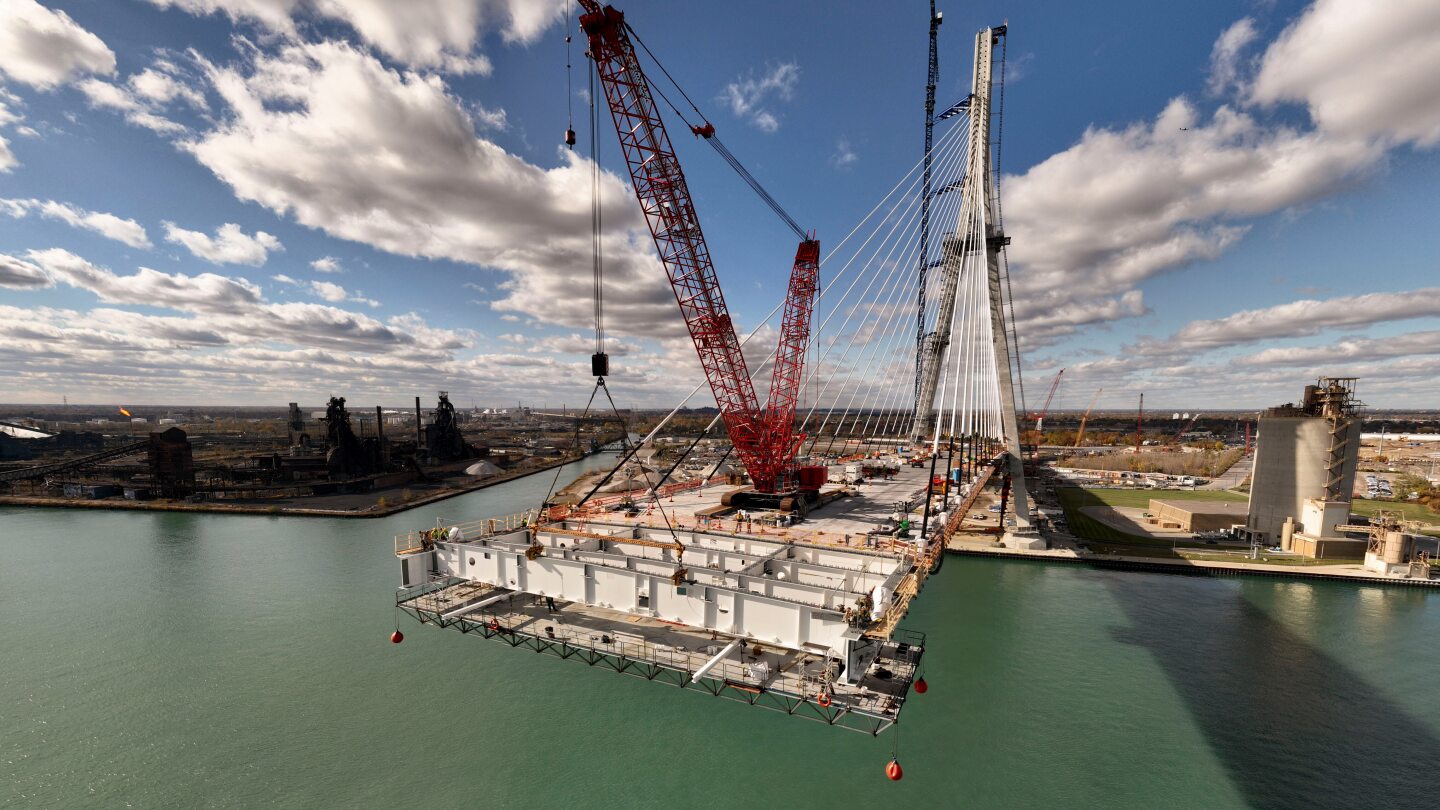
Detroit’s Gordie Howe International Bridge is poised to revolutionize cross-border travel between the United States and Canada when it opens in early 2026. For the first time in decades, pedestrians and cyclists will be able to cross the Detroit River alongside vehicles, marking a significant enhancement to international mobility in the region.
The $4.4 billion project, now 98% complete after construction began in 2018, will feature six lanes for vehicular traffic and dedicated paths for non-motorized travelers. This makes it the only bridge connecting Michigan to Canada that accommodates foot and bicycle traffic, joining just a handful of other U.S.-Canadian crossings with pedestrian access.
“People didn’t want us to lose a unique opportunity to design a new international crossing without considering the incorporation of a multiuse path for pedestrians and cyclists,” explained Heather Grondin, chief relations officer for the Gordie Howe International Bridge.
The new crossing is expected to significantly reduce congestion at existing border points, particularly the Detroit-Windsor Tunnel and the four-lane Ambassador Bridge, which has been the region’s primary crossing for decades. The Ambassador Bridge’s pedestrian walkway was closed after the September 11 attacks due to security concerns, eliminating non-vehicular crossing options in the area.
“This bridge, along with the adjacent infrastructure, will connect directly from Interstate 75 to the Ontario highway system, known as Highway 401, without trucks or cars having to stop at traffic lights along the way,” Grondin noted.
The project includes careful planning to minimize environmental impact and traffic disruption. Cars will be contained within the port of entry during backups to prevent congestion on I-75, and trucks will be required to turn off their engines during inspection to reduce noise and air pollution.
The bridge represents the culmination of more than two decades of planning. Studies in the early 2000s indicated that existing infrastructure would be insufficient to handle projected increases in cross-border traffic. In 2012, then-Michigan Governor Rick Snyder and Canada’s prime minister announced an agreement to build a publicly owned crossing.
Jeff Rightmer, professor of supply chain management at Wayne State University, highlighted the strategic importance of the project: “The Ambassador Bridge is basically privately owned and controlled by one family, and I think there was nervousness around that. The new bridge alleviates some of that monopoly that the Moroun family had.”
The bridge’s financing structure is notable, with the Canadian government funding the project through the Windsor-Detroit Bridge Authority. Canada will recoup its investment through toll revenue and receive ongoing payments for operating and maintaining the bridge for the next 36 years.
“I think it made it much more attractive to the U.S., specifically Michigan, for Canada to take on a lot of that debt,” Rightmer explained. “You can tell that Canada really wanted to get it done.”
The economic benefits for the region are expected to be substantial. The U.S.-Canada trade relationship is the largest bilateral trading partnership in the world, with much of that commerce flowing through Michigan-Ontario crossings. Additional capacity will support growing trade volumes and improve supply chain resilience.
“The ability to have more than the Ambassador Bridge, the tunnel and the Blue Water Bridge up in Port Huron is just huge for the region,” said Rightmer. “The ability to move more stuff back and forth is only going to benefit Michigan and Canada.”
For tourists and local residents, the bridge will create new recreational opportunities. Currently, the Peace Bridge and Rainbow Bridge over the Niagara River, and the Thousand Islands Bridge over the St. Lawrence River are the only nearby crossings that allow pedestrians.
“With all of the parks and the riverfront redevelopment, it gives the average Detroiter a lot more access to Canada and makes it a lot easier to get there,” Rightmer added.
Pedestrians and cyclists will enter through a separate port but will still need to present proper identification, such as a passport or enhanced license, to cross the international boundary.
Despite the new crossing, Detroit’s traditional International Marathon plans to maintain its current route, which takes runners over the Ambassador Bridge and back through the Detroit-Windsor Tunnel. Aaron Velthoven, the race’s executive producer, cited logistical challenges in changing the course: “The Gordie Howe Bridge is much further away from where we traditionally start and finish. To even entertain something like that, we would have to dramatically change where we start and finish.”
When completed, the Gordie Howe International Bridge will stand approximately 150 feet above the Detroit River at its highest point, creating not just a vital transportation link but also a new landmark on the international skyline.
Fact Checker
Verify the accuracy of this article using The Disinformation Commission analysis and real-time sources.

8 Comments
This new Gordie Howe Bridge sounds like a fantastic infrastructure project for Detroit and the broader region. Enabling pedestrian and bicycle access across the border is a great way to promote sustainable transportation and connectivity between the U.S. and Canada.
Agreed, this will make cross-border travel much more accessible and environmentally friendly. The dedicated paths for non-motorized traffic are a smart design choice.
I’m curious to see how the Gordie Howe Bridge’s multiuse path will impact local commuting and tourism between Detroit and Windsor. Providing this kind of pedestrian/bike access at an international border crossing is relatively unique.
Good point. This could spur more people to consider walking or cycling across the border, which would reduce vehicle congestion at the existing crossings.
The $4.4 billion price tag for the Gordie Howe Bridge project seems quite substantial, but the anticipated benefits of reduced congestion and increased multimodal connectivity likely justify the investment. It will be interesting to see how the bridge’s usage evolves over time.
Incorporating pedestrian and bicycle access into a major international bridge project like this is an admirable design choice. It shows a commitment to sustainable transportation and improving quality of life for communities on both sides of the border.
Agreed, this progressive approach aligns well with growing global emphasis on walkable, bikeable urban infrastructure. The Gordie Howe Bridge will set a positive example for future cross-border projects.
While the Gordie Howe Bridge’s multimodal capabilities are impressive, I wonder if there are any concerns around security or border control processes for pedestrians and cyclists compared to vehicular traffic. Ensuring a seamless and safe crossing experience will be crucial.