


Listen to the article
Gas Price Surge Widens Economic Divide as Lower-Income Americans Cut Consumption
Lower-income Americans drastically reduced their gas consumption following the outbreak of the Iran war, yet still ended up spending more at the pump due to soaring prices, according to new research released Wednesday by the Federal Reserve Bank of New York. The findings highlight growing economic disparities across income groups.
While poorer households cut their gas usage by 7% in March, they still spent 12% more on gasoline than before. In stark contrast, higher-income households barely reduced their consumption—cutting back just 1%—while increasing their overall spending on gas by 19%.
“We find that households had very different experiences with gasoline spending,” researchers at the New York Fed wrote. “With the sharp increases in gasoline prices in March, a K-shaped pattern in gasoline consumption emerged—showing faster consumption growth for high-income households relative to low-income households.”
The divergence in consumer behavior was more pronounced than during the 2022 gas price spike that followed Russia’s invasion of Ukraine. Back then, wealthier households made more substantial cuts to their gas consumption, while lower-income households benefited from government stimulus programs. Since that time, affluent Americans have seen significant increases in the value of their stock portfolios and real estate holdings, further widening the economic gap.
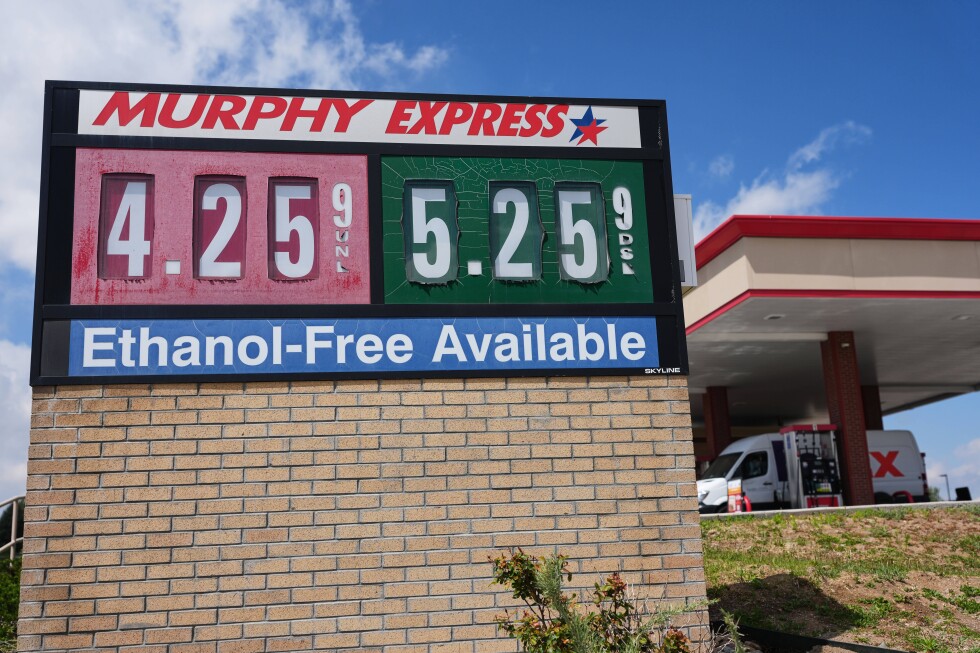
The Iran war began on February 28, and by the end of March, gas prices had climbed approximately 25%, according to government consumer price data. As of Tuesday, prices have surged a full 50% since the conflict started. Overall gas consumption nationwide declined by 3% in March.
The research suggests lower-income Americans—defined as those earning less than $40,000 annually—have been forced to alter their behaviors, likely resorting to carpooling, public transportation, or combining errands to reduce driving. Meanwhile, households earning $125,000 or more annually have made few if any adjustments to their lifestyle.
These findings help explain what economists have termed the “K-shaped economy,” where upper-income Americans continue to thrive while lower-income households struggle. This economic divide may account for widespread pessimism about the economy despite positive headline figures such as low unemployment rates and solid economic growth.
A separate report from the Bank of America Institute released last week reinforces these concerns. Among the poorest third of households, approximately 10% now spend a tenth of their income on gasoline—a significantly higher proportion than the 2.7% spent by higher-income households.
The gas price surge is also beginning to impact discretionary spending patterns. Bank of America’s data shows that annual growth in discretionary spending—defined as purchases outside necessities like groceries, gas, and utilities—slowed in March for lower-income households while continuing to rise for middle- and upper-income groups.
If sustained, the additional spending on gasoline—estimated by the New York Fed to have jumped 15% in March from the previous month—will divert money from other sectors of the economy. This redirection could potentially reduce overall inflation-adjusted spending and slow economic growth, though Americans today spend proportionally less on gas than in previous decades due to improved fuel efficiency in vehicles.
So far, the broader economic impact remains limited. Consumer spending adjusted for price changes increased by 0.2% in March, just slightly below February’s 0.3% gain, according to government data released last week.
However, for millions of Americans with lower incomes, the spike in gas prices represents a significant financial burden that exacerbates existing economic inequalities and creates additional pressure on already strained household budgets.
Fact Checker
Verify the accuracy of this article using The Disinformation Commission analysis and real-time sources.

33 Comments
The cost guidance is better than expected. If they deliver, the stock could rerate.
Good point. Watching costs and grades closely.
Good point. Watching costs and grades closely.
Nice to see insider buying—usually a good signal in this space.
Good point. Watching costs and grades closely.
Interesting update on Gas price shock deepens a ‘K-shaped’ divide as low-income drivers cut back but pay more. Curious how the grades will trend next quarter.
Good point. Watching costs and grades closely.
Good point. Watching costs and grades closely.
Interesting update on Gas price shock deepens a ‘K-shaped’ divide as low-income drivers cut back but pay more. Curious how the grades will trend next quarter.
Silver leverage is strong here; beta cuts both ways though.
Good point. Watching costs and grades closely.
Good point. Watching costs and grades closely.
Nice to see insider buying—usually a good signal in this space.
Good point. Watching costs and grades closely.
If AISC keeps dropping, this becomes investable for me.
Good point. Watching costs and grades closely.
Good point. Watching costs and grades closely.
Interesting update on Gas price shock deepens a ‘K-shaped’ divide as low-income drivers cut back but pay more. Curious how the grades will trend next quarter.
Good point. Watching costs and grades closely.
Good point. Watching costs and grades closely.
If AISC keeps dropping, this becomes investable for me.
Good point. Watching costs and grades closely.
Good point. Watching costs and grades closely.
Interesting update on Gas price shock deepens a ‘K-shaped’ divide as low-income drivers cut back but pay more. Curious how the grades will trend next quarter.
Good point. Watching costs and grades closely.
Interesting update on Gas price shock deepens a ‘K-shaped’ divide as low-income drivers cut back but pay more. Curious how the grades will trend next quarter.
Good point. Watching costs and grades closely.
Good point. Watching costs and grades closely.
The cost guidance is better than expected. If they deliver, the stock could rerate.
Silver leverage is strong here; beta cuts both ways though.
Exploration results look promising, but permitting will be the key risk.
Good point. Watching costs and grades closely.
Good point. Watching costs and grades closely.