


Listen to the article
European Farmers Block Roads in France, Greece to Protest EU-Mercosur Trade Deal
Angry farmers deployed hundreds of tractors across France and Greece on Thursday, blocking major highways and disrupting traffic to protest the European Union’s planned free trade agreement with five South American nations.
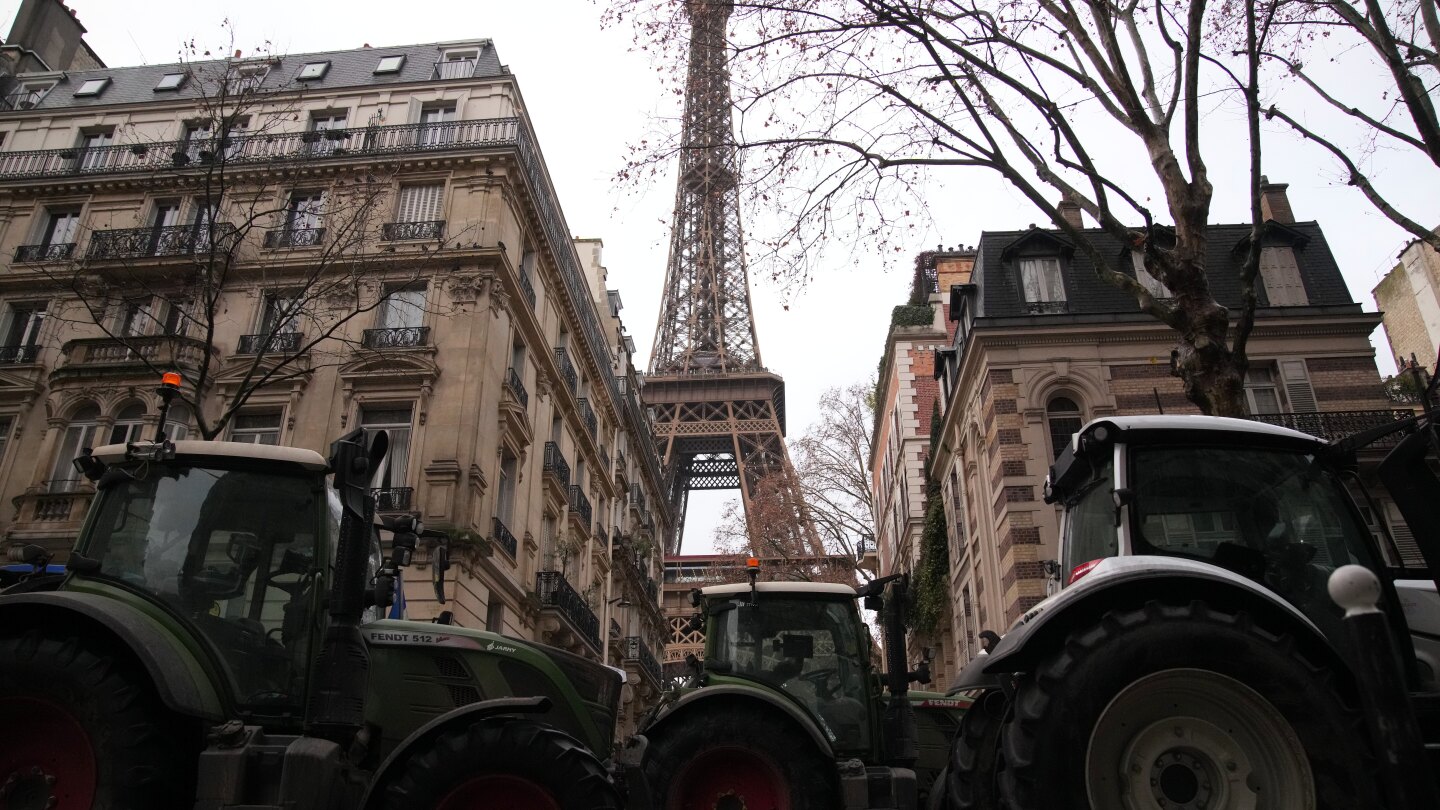
In Paris, approximately 100 tractors rumbled into the city center under heavy police surveillance, with some reaching iconic landmarks like the Arc de Triomphe and Eiffel Tower despite official bans. The main contingent gathered outside France’s National Assembly, the country’s influential lower house of parliament, to make their grievances known directly to lawmakers.
“The goal today is to come to Paris to express our demands closer to those who have the power,” said José Perez, President of the Rural Coordination union in southwestern France’s Lot-et-Garonne region. “It’s a strong symbol.”
Meanwhile in Greece, farmers escalated their months-long protests by launching a 48-hour blockade of major highways, junctions, and toll stations nationwide. Tractors lined strategic routes across the country, bringing traffic to a standstill except for emergency vehicles.
The widespread demonstrations target the contentious EU-Mercosur trade agreement between the European Union and the South American bloc comprising Brazil, Argentina, Bolivia, Paraguay, and Uruguay. European agricultural producers fear the deal would devastate their livelihoods by flooding European markets with cheaper imports produced under less stringent regulations.
“If this agreement goes through, Greek agriculture is finished,” warned Vangelis Roubis, a protest organizer in Greece. “Greece depends on agriculture and tourism. We don’t have heavy industry like Germany or France. Production costs here are 300% higher than in Latin America.”
Roubis cited potatoes as a prime example of the competitive disadvantage: Greek farmers need 35 to 40 cents per kilogram to break even, compared to roughly 10 cents in Brazil.
The timing of these protests is critical as the EU this week renewed internal negotiations over the trade agreement, with speculation mounting that a deal could be signed in Paraguay as early as January 12. The agreement’s supporters, led by Germany, may have enough backing to overcome objections from France and Poland.
France has been particularly vocal in its opposition. French Agriculture Minister Annie Genevard reaffirmed the country’s stance on Wednesday, arguing the deal threatens numerous agricultural sectors including beef, chicken, sugar, ethanol, and honey production.
Ludovic Dupeux, representing Rural Coordination in Corsica, traveled from the Mediterranean island to Paris by boat, tractor, and train to join the protests. He accused French President Emmanuel Macron of failing to adequately oppose the agreement.
“We want President Macron to stand by the side of farmers,” he said. “He needs to clearly tell it out loud and to impose it, too.”
In Greece, the protests have deeper roots, beginning in November over rising production costs. The situation has been exacerbated by multiple crises: a subsidy fraud scandal delaying legitimate payments and a sheep and goat pox outbreak devastating livestock.
“We’ve reached a breaking point,” said Yiannis Baritas, a cabbage farmer and father of five, at a roadblock in southern Greece. “We’ll stay here as long as it takes to support our families. They’ve pushed us to desperation.”
The Greek government attempted to quell protests on Wednesday by announcing concessions including cheaper electricity rates for farmers and fuel tax rebates, but demonstrators remained unsatisfied. While police directed traffic to alternative routes when possible, the government has warned it won’t tolerate extended blockades.
The EU-Mercosur trade deal, which would create one of the world’s largest free trade zones, has faced fierce opposition from agricultural interests since negotiations began. Farmers across Europe argue they cannot compete with South American producers who operate under different environmental standards, labor costs, and regulatory frameworks.
The current wave of protests underscores the complex balance European policymakers must strike between pursuing global trade objectives and protecting vulnerable domestic sectors like agriculture, which holds both economic and cultural significance across the continent.
Fact Checker
Verify the accuracy of this article using The Disinformation Commission analysis and real-time sources.

16 Comments
While the farmers’ tactics may be disruptive, their underlying concerns about protecting domestic agricultural industries seem legitimate. Trade liberalization can bring both benefits and challenges, so policymakers will need to carefully weigh the tradeoffs.
Absolutely. Balancing the interests of different economic sectors is always a delicate task for governments when negotiating trade deals. Hearing out the farmers’ perspective is important, even if their methods are provocative.
I’m curious to learn more about the potential economic impacts of this EU-Mercosur deal on European farmers. What commodities or products are most at risk, and how significant could the disruption be to their businesses?
That’s a good line of inquiry. Understanding the specific vulnerabilities of European farmers in this context would help provide more context around their protest actions.
The agricultural sector is notoriously sensitive to trade policy shifts, so it’s not surprising to see such a strong reaction from these farmers. Their livelihoods are on the line, which makes their protest understandable even if the approach is confrontational.
That’s a fair point. Farmers are often among the most directly impacted by changes to trade rules, so their concerns deserve to be taken seriously by policymakers.
While I sympathize with the farmers’ desire to protect their livelihoods, I also wonder about the broader economic implications of blocking trade deals. There may be other industries or consumers who stand to benefit from increased access to South American markets.
That’s a fair counterpoint. Trade policy often involves difficult tradeoffs between different sectors and stakeholders. Policymakers will need to carefully weigh the various pros and cons to find an optimal solution.
While I understand the farmers’ concerns about potential impacts on their businesses, I’m curious to hear more about the specifics of the EU-Mercosur deal they are protesting. What are the key provisions that have them so up in arms?
That’s a good question. The details of trade agreements can be complex, so it would be helpful to get a clearer picture of the farmers’ main objections to this particular deal.
It will be interesting to see if these protests across France and Greece sway EU policymakers to reconsider or renegotiate certain aspects of the EU-Mercosur deal. Ultimately, a compromise that addresses the farmers’ core concerns may be necessary.
Good point. The strength and visibility of these demonstrations suggest the farmers have significant political clout that could compel EU leaders to revisit the terms of the trade agreement.
Farmers blocking roads and landmarks is certainly an attention-grabbing tactic, but I hope they are also engaging in more constructive dialogue with policymakers. Productive negotiations will be key to addressing their concerns in a balanced way.
Agreed. While disruptive protests may grab headlines, it will ultimately take reasoned discussions between all stakeholders to find a mutually acceptable solution.
Farmers protesting free trade deals is nothing new, but the scale of these demonstrations across France and Greece is quite remarkable. It speaks to the strong feelings these trade agreements can evoke among agricultural communities who fear for their livelihoods.
You’re right, the use of tractors to block highways is a powerful visual statement. These farmers are clearly willing to take disruptive action to make their voices heard on this issue.