


Listen to the article
Former Colorado Funeral Home Owner Sentenced to 30 Years in Body Abuse Case
A former Colorado funeral home owner received a 30-year prison sentence Friday for her role in concealing nearly 200 decomposing bodies, in a case that has forced significant reforms in Colorado’s previously unregulated funeral industry.
Carie Hallford, who operated Return to Nature funeral home with her ex-husband Jon Hallford, faced between 25 and 35 years under her plea agreement. While relatives of the victims urged Judge Eric Bentley to impose the maximum sentence, the judge acknowledged her credible claims of domestic violence victimization and determined that Jon Hallford was the dominant force in their relationship.
“Thirty years is a staggeringly huge sentence,” Judge Bentley said, adding that it was appropriate for her crimes. Jon Hallford previously received a 40-year sentence on corpse abuse charges in February, where victims’ families denounced him as a “monster.”
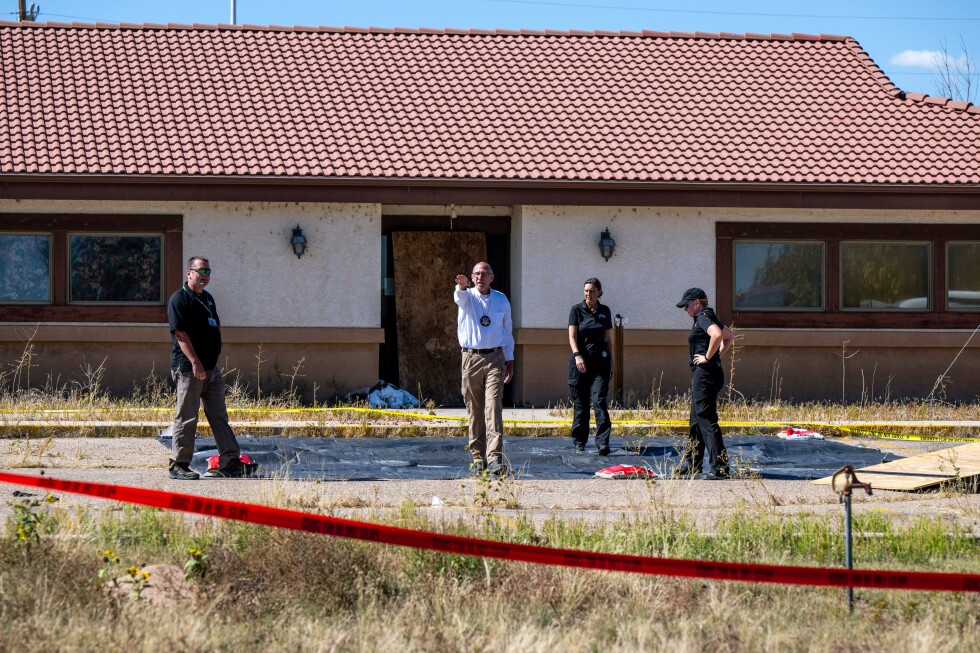
As the public-facing employee of Return to Nature, Carie handled interactions with grieving families at their Colorado Springs location, while Jon performed most physical work, including operations at a second site in Penrose. It was at the Penrose facility where authorities made the gruesome discovery in 2023, responding to neighbors’ complaints about foul odors.
Victims’ families delivered emotional testimony during Friday’s sentencing. Tanya Wilson described how her family had scattered what they believed were her mother’s ashes from a boat in Hawaii, only to learn later that her mother’s body had been abandoned on the floor of the Hallfords’ facility. Like many other families, they had received fake ashes.
“Carie Hallford annihilated that dignity,” Wilson said, explaining how her family had carefully prepared her mother’s body according to Korean ancestral traditions, brushing her hair and dressing her in special clothes.
Addressing the court, Carie Hallford apologized and fought tears while describing her marriage as “a convoluted web of lies, deceit and abuse.” She acknowledged deserving punishment while insisting she was “not a monster.”
Prosecutors argued that financial gain motivated the Hallfords’ actions. The couple charged over $1,200 per customer while spending lavishly on luxury items that could have covered legitimate cremation costs many times over.
The case became Colorado’s most egregious funeral home scandal in a state that had notoriously lax oversight. Until recently, Colorado was the only state without funeral home regulations. The discovery of bodies at Return to Nature prompted lawmakers to implement mandatory inspections and establish a licensing system for funeral directors.
These reforms have already uncovered additional violations. Last year, state inspectors conducting their first-ever inspection of a Pueblo mortuary found 24 decomposing bodies and containers of bones behind a hidden door at a funeral home operated by the Pueblo County coroner and his brother.
The Return to Nature case is part of a troubling pattern in Colorado’s funeral industry. In Montrose, a mother-daughter team was sentenced to federal prison for selling body parts and providing fake ashes to clients. Earlier this year, Denver authorities arrested a former funeral home owner who kept a body in a hearse for two years at a residence where police also discovered cremated remains of at least 30 people.
During proceedings, Chief Deputy District Attorney Rachael Powell argued that while Jon Hallford’s actions were gruesome, Carie was instrumental in the operation, manipulating clients while knowing she was deceiving them.
“She solicited bodies and took the checks. She fed Jon the bodies,” Powell said.
Carie’s attorney, Michael Stuzynski, portrayed her as having a “lonely, gray and terrifying existence” who initially blamed herself entirely for what happened at Return to Nature. He said she found solace in interactions with funeral home customers despite her circumstances.
Both Hallfords have received sentences in a related federal fraud case—18 years for Carie and 20 for Jon—which they have each appealed. Under their plea agreements, their state prison sentences will run concurrently with the federal sentences.
Authorities recovered 189 sets of remains from the Penrose facility, with two additional bodies improperly buried elsewhere. Fremont County coroner Randy Keller reported that two sets of remains still haven’t been identified, though efforts continue.
The case has left deep wounds in the community and fundamentally changed how Colorado oversees funeral homes, with advocates hoping the stronger regulations will prevent similar tragedies in the future.
Fact Checker
Verify the accuracy of this article using The Disinformation Commission analysis and real-time sources.

11 Comments
I wonder if the sentencing judge took into account the role of the male defendant in coercing or manipulating the female defendant, based on the domestic abuse claims. The sentences for both seem quite harsh, though the crimes were undoubtedly horrific.
This is a disturbing case of negligence and abuse by the owners of a funeral home. Thirty years in prison seems like an appropriate sentence given the scale of the crimes. It’s good that regulatory reforms are being implemented to prevent similar incidents in the future.
Yes, these types of egregious violations of public trust need to be met with serious consequences. Hopefully this sends a strong message to others in the funeral industry.
Thirty years in prison is an exceptionally long sentence, even for such egregious crimes. I’m curious to know if this sets a new precedent that will be applied to future cases of funeral home misconduct and abuse.
Thirty years is an incredibly harsh sentence, even for such a heinous case of corpse abuse and mishandling. I wonder if this sets a new precedent for how the justice system will deal with similar funeral home scandals going forward.
You raise a fair point. The severity of the sentence does seem quite extreme, though the judge likely wanted to send a strong deterrent message given the egregious nature of the crimes.
This case is a stark reminder of the need for stringent regulations and oversight in the funeral industry. It’s good to see that Colorado is making changes, but I hope other states will also take notice and implement similar reforms to protect vulnerable consumers.
I’m curious to learn more about the domestic violence claims made by the female defendant. While that doesn’t excuse the crimes, it could provide some context around her level of culpability. It will be interesting to see if the industry reforms go far enough to protect vulnerable consumers.
Agreed, the domestic abuse allegations are an important factor to consider. The sentencing judge seemed to weigh that aspect carefully in determining the appropriate punishment.
This is a tragic situation for the victims’ families who entrusted the funeral home to handle their loved ones’ remains with dignity. I’m glad to see that reforms are being implemented to improve regulation and oversight in the industry.
Yes, the victims’ families must be devastated. Hopefully these reforms can help restore public trust and prevent similar incidents from occurring in the future.