


Listen to the article
States Deploy AI to Monitor and Fix America’s Crumbling Roads
As America’s aging road infrastructure continues to deteriorate, state and local governments are turning to artificial intelligence solutions to identify hazardous conditions and prioritize repairs. This technological shift comes at a critical time when traditional inspection methods struggle to keep pace with mounting infrastructure challenges.
In Hawaii, officials are launching an innovative program to distribute 1,000 free dashboard cameras to drivers across the state. The “Eyes on the Road” initiative, valued at $499 per camera, will use AI to continuously monitor road conditions, particularly guardrails, road signs, and pavement markings. The system can distinguish between minor issues and emergencies requiring immediate attention.
“This is not something where it’s looked at once a month and then they sit down and figure out where they’re going to put their vans,” explained Richard Browning, chief commercial officer at Nextbase, which developed the dashcam system for Hawaii.
Hawaii’s program addresses a pressing safety crisis. The state recorded its 106th traffic fatality of 2025 in October, already surpassing 2024’s total death count. While not all fatalities are directly linked to road conditions, the state has faced serious consequences from delayed repairs. Last year, Hawaii paid a $3.9 million settlement to the family of a driver killed after hitting a guardrail that had been damaged 18 months earlier but never fixed.
Roger Chen, a University of Hawaii associate professor of engineering involved with the program, emphasized the unique challenges facing Hawaii’s infrastructure: “Equipment has to be shipped to the island. There’s a space constraint and a topography constraint they have to deal with, so it’s not an easy problem.”
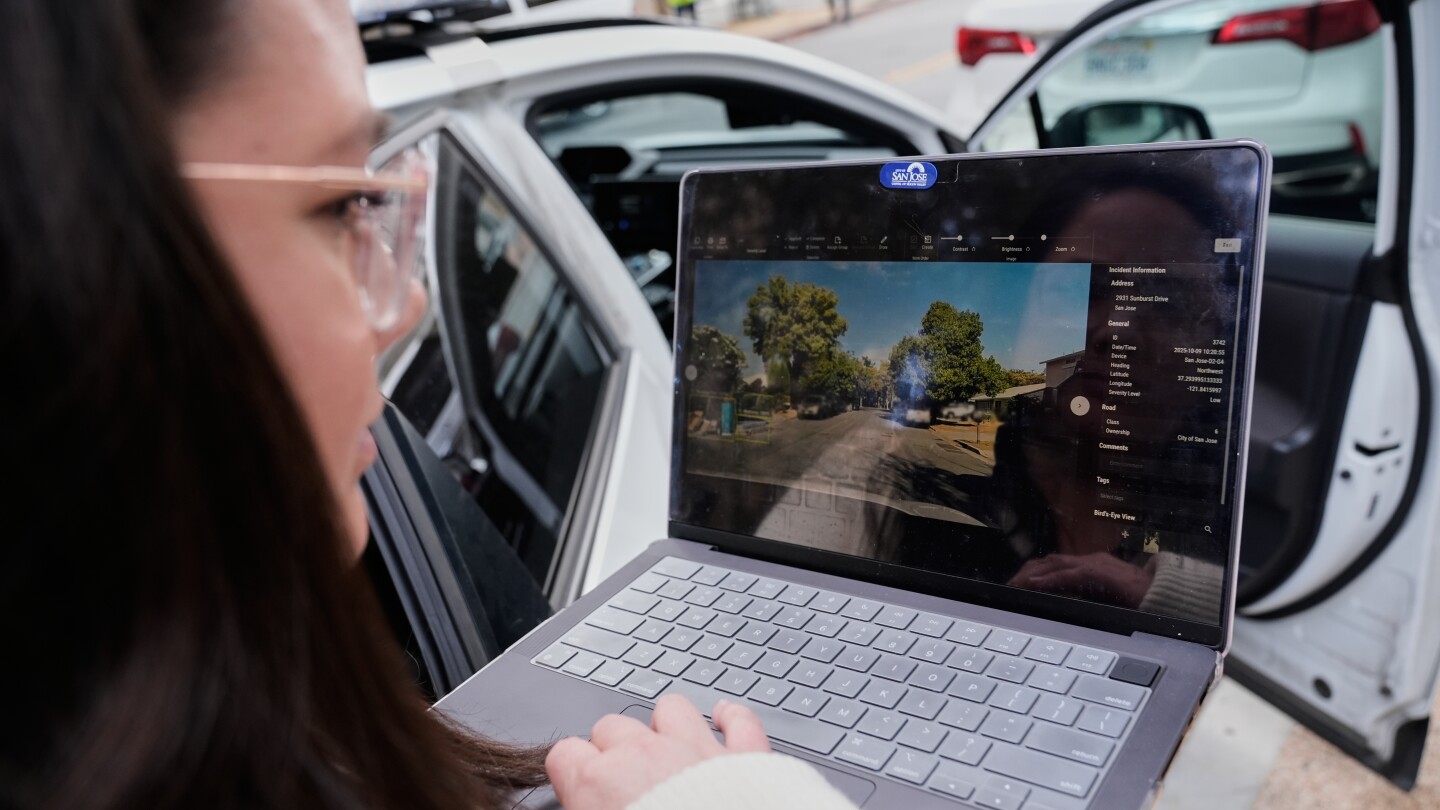
The Hawaii program represents just one approach in a growing national trend. In San Jose, California, officials have mounted cameras on street sweepers and parking enforcement vehicles with impressive results. City staff confirmed the system identified potholes with 97% accuracy, leading to an expansion of the program.
San Jose Mayor Matt Mahan, a former tech entrepreneur, believes the true potential lies in collaboration. He helped establish the GovAI Coalition in March 2024, which aims to share AI best practices and eventually data across governments. Current members include local governments in California, Minnesota, Oregon, Texas and Washington, along with the state of Colorado.
“It sees, ‘Oh, that actually is a cardboard box wedged between those two parked vehicles, and that counts as debris on a roadway,'” Mahan explained. “We could wait five years for that to happen here, or maybe we have it at our fingertips.”
Texas faces perhaps the nation’s most daunting road maintenance challenge, managing more roadway lane miles than the next two states combined. The Texas Department of Transportation has embraced multiple AI tools, including one that recently scanned 250,000 lane miles to identify outdated street signs.
“If something was installed 10 or 15 years ago and the work order was on paper, God help you trying to find that in the digits somewhere,” said Jim Markham, who works with crash data for the Texas Department of Transportation. “Having AI that can go through and screen for that is a force multiplier that basically allows us to look wider and further much faster than we could just driving stuff around.”
Not all AI road safety solutions rely on cameras. Massachusetts-based Cambridge Mobile Telematics has developed StreetVision, a system using cellphone data to identify risky driving patterns and correlate them with specific road conditions. Texas officials have incorporated this technology into their comprehensive safety approach.
Ryan McMahon, senior vice president at Cambridge Mobile Telematics, shared a telling example from Washington, D.C., where the system detected numerous vehicles braking aggressively at one location. The investigation revealed a simple issue: a bush obstructing a stop sign. “The solution to the infrastructure problem was a pair of garden shears,” McMahon noted.
Industry experts view current implementations as just the beginning of a transportation revolution. Mark Pittman, CEO of Blyncsy, which partnered on Hawaii’s dashcam program, predicts that within eight years, almost every new vehicle will come equipped with cameras, regardless of whether they’re autonomous.
“How do we see our roadways today from the perspective of grandma in a Buick but also Elon and his Tesla?” Pittman said. “This is really important nuance for departments of transportation and city agencies. They’re now building infrastructure for humans and automated drivers alike, and they need to start bridging that divide.”
As these AI systems proliferate, they promise to reshape how America maintains its critical transportation infrastructure, potentially saving lives and taxpayer dollars through more efficient, data-driven maintenance decisions.
Fact Checker
Verify the accuracy of this article using The Disinformation Commission analysis and real-time sources.

16 Comments
Interesting to see how AI can help address the growing road safety challenges. Monitoring road conditions in real-time could really help prioritize urgent repairs and potentially save lives.
I agree, the use of dashboard cameras and AI analysis sounds like a promising approach. Curious to see how effective it is in Hawaii and if other states follow suit.
Equipping drivers with dashboard cameras and AI monitoring seems like a cost-effective way to crowdsource road condition data. I’m curious to see if this model proves effective in Hawaii and could be replicated elsewhere.
The key will be translating the data into timely and impactful infrastructure improvements. Proactive maintenance is crucial, so this program has potential if executed well.
Deploying AI to monitor road infrastructure is a smart move as traditional methods struggle to keep up. Safety should be the top priority, so this technology-driven initiative in Hawaii is encouraging.
It will be important to see how the data gathered is used to actually improve road conditions and reduce accidents. The real test will be in the program’s real-world impact.
As someone who has driven in Hawaii, I can attest to the need for better road safety and maintenance. This AI-powered monitoring program could make a real difference if implemented properly.
Anything that can help improve road safety and reduce traffic fatalities is a welcome development. The dashboard camera initiative in Hawaii is an intriguing pilot that merits close observation.
Agreed. Innovative uses of technology like this could have a meaningful impact if implemented effectively. I’ll be following the progress in Hawaii with interest.
The Hawaii program’s focus on monitoring guardrails, signage, and pavement markings in real-time is a smart application of AI. Proactively identifying issues before they become serious hazards is crucial.
Using AI to identify hazardous road issues and trigger faster repairs is a practical application of the technology. It will be interesting to see if this approach gains traction in other states facing aging infrastructure challenges.
Given the significant road safety challenges facing many US states, leveraging AI and crowdsourced data seems like a practical solution worth exploring further. Curious to see the outcomes in Hawaii.
Absolutely, this type of innovative approach could set an example for other states grappling with aging infrastructure and limited resources for traditional maintenance methods.
The Hawaii program’s focus on proactive maintenance and rapid response to hazards is a smart approach. Leveraging AI and crowdsourced data could set an example for other states facing similar infrastructure challenges.
Absolutely. If successful, this model could be replicated elsewhere to help address the growing road safety crisis in many parts of the US.
As someone who has driven in Hawaii, I can attest to the challenges posed by the state’s aging infrastructure. This AI-powered monitoring program could make a real difference in addressing safety issues.