


Listen to the article
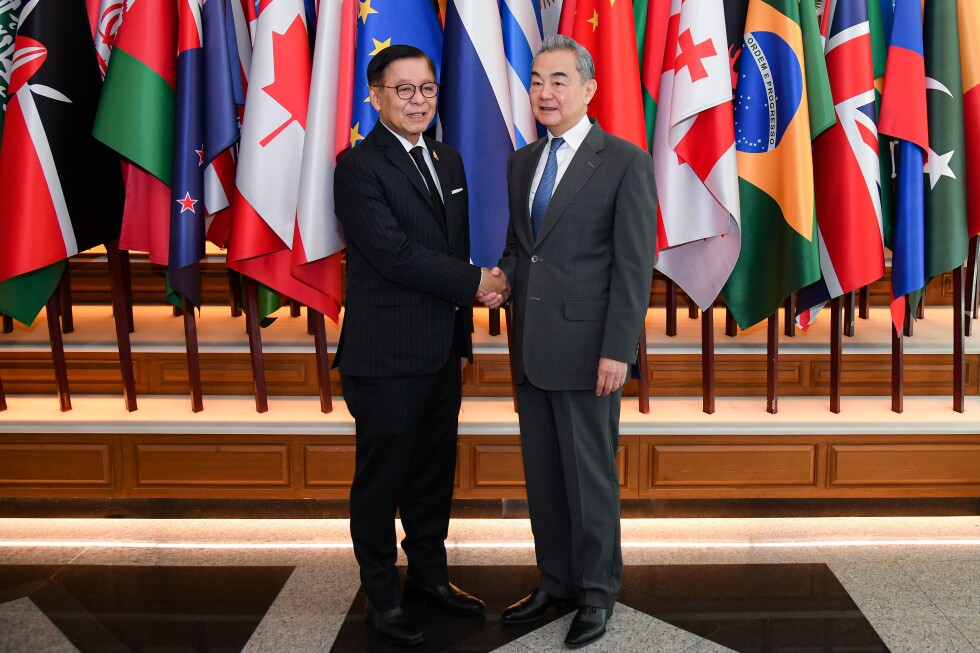
Chinese Foreign Minister Wang Yi visited Thailand on Friday to meet with Prime Minister Anutin Charnvirakul, in a diplomatic effort aimed at strengthening the strategic partnership between the two Asian nations.
During the meeting at Bangkok’s Government House, the two leaders agreed to enhance collaboration in several areas, including combating transnational crime and cyberscams, according to Thai government spokesperson Rachada Dhnadirek.
The talks reflected the increasingly close ties between Thailand and China, with Anutin expressing gratitude for China’s continued support. Wang, in turn, congratulated the Thai prime minister on maintaining his position following recent elections and expressed confidence in the future of bilateral relations.
Prior to meeting Anutin, Wang also held discussions with Thailand’s Foreign Minister Sihasak Phuangketkeow, though details of their conversation were not immediately disclosed by officials.
Wang’s three-day visit to Thailand began Thursday and follows meetings with government ministers in neighboring Cambodia, where discussions centered on strengthening political and security ties. According to the Chinese Foreign Ministry, Wang will next travel to Myanmar as part of his regional diplomatic tour.
The high-level visit underscores China’s continuing efforts to deepen its influence in Southeast Asia, a region of growing strategic importance. For Thailand, maintaining strong relations with Beijing has become increasingly vital as China’s economic and political footprint in the region expands.
Last year marked the 50th anniversary of diplomatic relations between Thailand and China, a milestone celebrated by both nations. The relationship reached a historic high point in November when Thai King Maha Vajiralongkorn made the first-ever visit to China by a reigning Thai monarch, signaling the importance Thailand places on its relationship with Beijing.
Economic ties form the backbone of the relationship, with China standing as Thailand’s largest trading partner. Bilateral trade has grown substantially over the past decade, providing crucial economic benefits for both nations. Thailand has positioned itself as an attractive destination for Chinese investment, particularly as manufacturing companies seek alternatives to mainland China production bases.
Chinese investment in Thailand has accelerated notably in recent years, driven partly by companies relocating production facilities to Southeast Asia to circumvent U.S. tariffs imposed during trade tensions between Washington and Beijing. This manufacturing shift has brought significant capital flows into Thailand’s industrial sector, creating jobs and technological transfer opportunities.
The relationship also extends beyond economics. Both countries have expanded cooperation in areas including infrastructure development, with China investing in Thailand’s transportation network as part of its broader Belt and Road Initiative. Tourism represents another important dimension, with Chinese visitors traditionally comprising the largest group of international arrivals in Thailand before the COVID-19 pandemic.
The timing of Wang’s visit is significant as Thailand navigates its position amid increasing U.S.-China competition in the Indo-Pacific region. As a traditional U.S. ally that has grown increasingly close to China, Thailand exemplifies the delicate balancing act many Southeast Asian nations face in their foreign relations.
Analysts note that Wang’s regional tour reflects Beijing’s priority to maintain strong relationships with its southern neighbors, particularly as geopolitical tensions rise elsewhere. For Thailand, the visit reaffirms its importance in China’s diplomatic calculations and provides opportunities to secure continued economic cooperation and investment.
As regional dynamics continue to evolve, the strengthened partnership between Thailand and China represents a significant development in Southeast Asian international relations, with potential implications for regional security architecture and economic integration.
Fact Checker
Verify the accuracy of this article using The Disinformation Commission analysis and real-time sources.

6 Comments
Glad to see China and Thailand discussing ways to combat transnational crime and cyberscams. Strengthening security ties is important for the region’s stability and prosperity.
Absolutely. Cybersecurity is a critical area where countries need to work together closely.
Interesting to see Thailand and China strengthening their partnership. Cybercrime is a growing global issue that will require increased cooperation between nations to address effectively.
China and Thailand are important partners, so it’s good to see them discussing issues of mutual concern like transnational crime and cybersecurity. Continued dialogue and cooperation will be key.
Curious to learn more about the specific initiatives China and Thailand plan to pursue to address cybercrime and other transnational challenges. Strengthening regional security cooperation is crucial.
This visit reflects the deepening relationship between China and Thailand. It will be important to see what concrete steps they agree on to enhance collaboration in areas like combating cybercrime.