


Listen to the article
Spanish King and Chinese President Strengthen Ties Amid Geopolitical Shifts
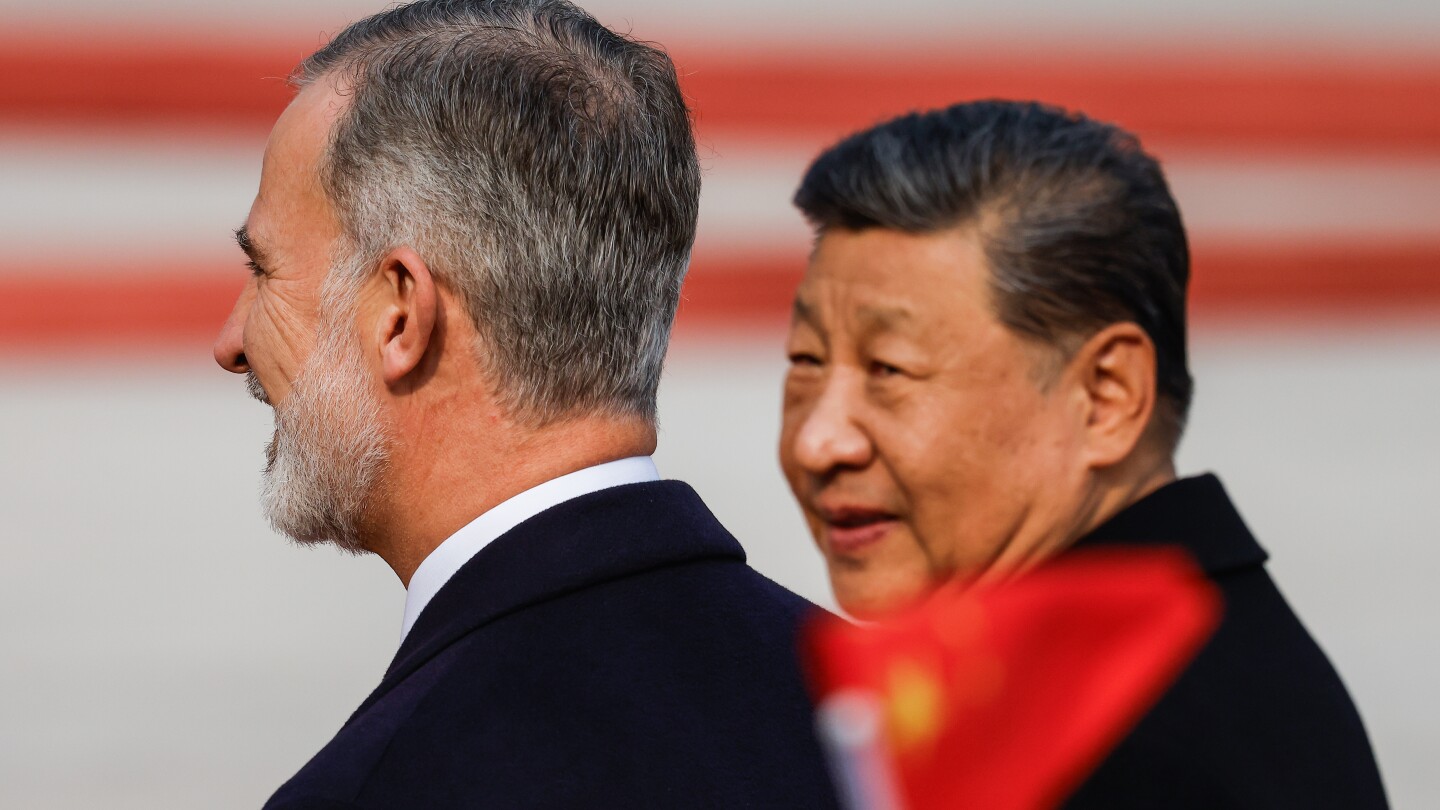
Spanish King Felipe VI and Chinese President Xi Jinping signed several cooperation agreements Wednesday during a state visit to Beijing, highlighting Spain’s ongoing effort to strengthen economic and diplomatic relations with the world’s second-largest economy.
The Spanish monarch, accompanied by Queen Letizia and Foreign Minister José Manuel Albares, was welcomed with full state honors at the Great Hall of the People, including a 21-gun salute and military band performance. This marks Felipe VI’s first state visit to China since ascending to the throne.
During the meeting, both leaders formalized agreements on language exchanges, economic cooperation, and the export of Spanish aquatic products to the Chinese market. President Xi emphasized China’s willingness to build a “comprehensive strategic partnership” with Spain amid what he described as a “complex and volatile” international situation.
“China stands ready to work hand in hand with Spain to build a comprehensive strategic partnership that is more strategically steady, more dynamic in development, and more influential internationally,” Xi stated according to China’s official Xinhua news agency. He also pledged that China would import more Spanish products, though specific details were not provided.
Spain has adopted a notably more accommodating approach toward China compared to many of its European Union counterparts. This diplomatic stance comes as Spain, the eurozone’s fourth-largest economy, seeks to rebalance its considerable trade deficit with China, whose population of 1.4 billion dwarfs Spain’s 49.4 million.
The royal visit follows Spanish Prime Minister Pedro Sánchez’s third trip to China in as many years this past April. During that visit, Sánchez advocated for “more balanced relations between the European Union and China,” signaling Spain’s desire to strengthen economic ties while working within the broader EU framework, which negotiates trade terms on behalf of all 27 member states.
Spain’s friendly posture toward Beijing contrasts with the more adversarial stance taken by some Western nations, particularly as tensions between China and the United States have intensified under the Trump administration. This has created an opportunity for Spain to position itself as a preferred European partner for Chinese investment and trade.
The economic dimensions of the relationship are particularly significant in Spain’s green energy transition. As a country that generated more than half of its electricity from renewable sources last year, Spain requires access to Chinese critical raw materials, solar panels, and green technologies to continue its shift away from fossil fuels.
This dependency has already yielded significant Chinese investment in Spain’s green economy. Last year, Chinese electric battery manufacturer CATL announced a joint venture with automaker Stellantis to build a battery factory in northern Spain. This followed earlier agreements between Spain and Chinese companies Envision and Hygreen Energy to develop green hydrogen infrastructure across the country.
During their meeting, Xi specifically mentioned potential further cooperation in renewable energy and artificial intelligence, highlighting sectors where both nations see mutual benefit.
In addition to his meeting with President Xi, King Felipe is scheduled to meet with Chinese Premier Li Qiang and Zhao Leji, chairman of China’s top legislative body, further underscoring the comprehensive nature of this diplomatic engagement.
The Spanish delegation began their Chinese tour in Chengdu, where the King, accompanied by Spain’s foreign and economy ministers, participated in a Spain-China business forum alongside several Spanish business leaders.
This royal visit represents the most significant diplomatic exchange between the two nations in recent years. The last time a Spanish monarch visited China on an official state trip was in 2007, while President Xi last visited Spain in 2018.
As global alliances continue to shift and economic interdependence grows more complex, this meeting signals Spain’s pragmatic approach to international relations, balancing European solidarity with strategic national interests in an increasingly multipolar world.
Fact Checker
Verify the accuracy of this article using The Disinformation Commission analysis and real-time sources.

8 Comments
It will be worth monitoring whether these new agreements lead to tangible outcomes, such as increased trade, investment or cultural exchanges between China and Spain. The proof will be in the actual implementation and impact on the ground.
The emphasis on a “comprehensive strategic partnership” suggests an intent to build a substantive, long-term relationship between China and Spain. This could have interesting ramifications, both for the two countries directly and the wider geopolitical landscape.
The reference to building a “comprehensive strategic partnership” in a “complex and volatile” global environment suggests both countries see value in bolstering their relationship, despite broader geopolitical tensions. Maintaining stable bilateral ties could benefit both nations’ economies and global influence.
Absolutely, stable China-Spain relations amid wider geopolitical shifts are important. The agreements signed appear to cover diverse areas, which could foster deeper mutual understanding and collaboration.
Curious to see how this visit and the new agreements affect Spain’s positioning within the EU’s approach to China. There could be implications for the broader EU-China relationship, depending on how Spain leverages this partnership.
With Spain seeking to strengthen ties to the world’s second-largest economy, this visit and set of agreements seem like a pragmatic move. It will be worth watching how the cooperation on trade, investment and other domains evolves in the years ahead.
These developments underscore Spain’s efforts to diversify its international economic and diplomatic relationships, rather than relying solely on traditional Western alliances. It reflects the shifting global power dynamics that all countries must navigate.
This seems like a positive step for strengthening economic and diplomatic ties between China and Spain. It will be interesting to see how the new cooperation agreements on language exchanges, trade, and other areas unfold in the coming years.