


Listen to the article
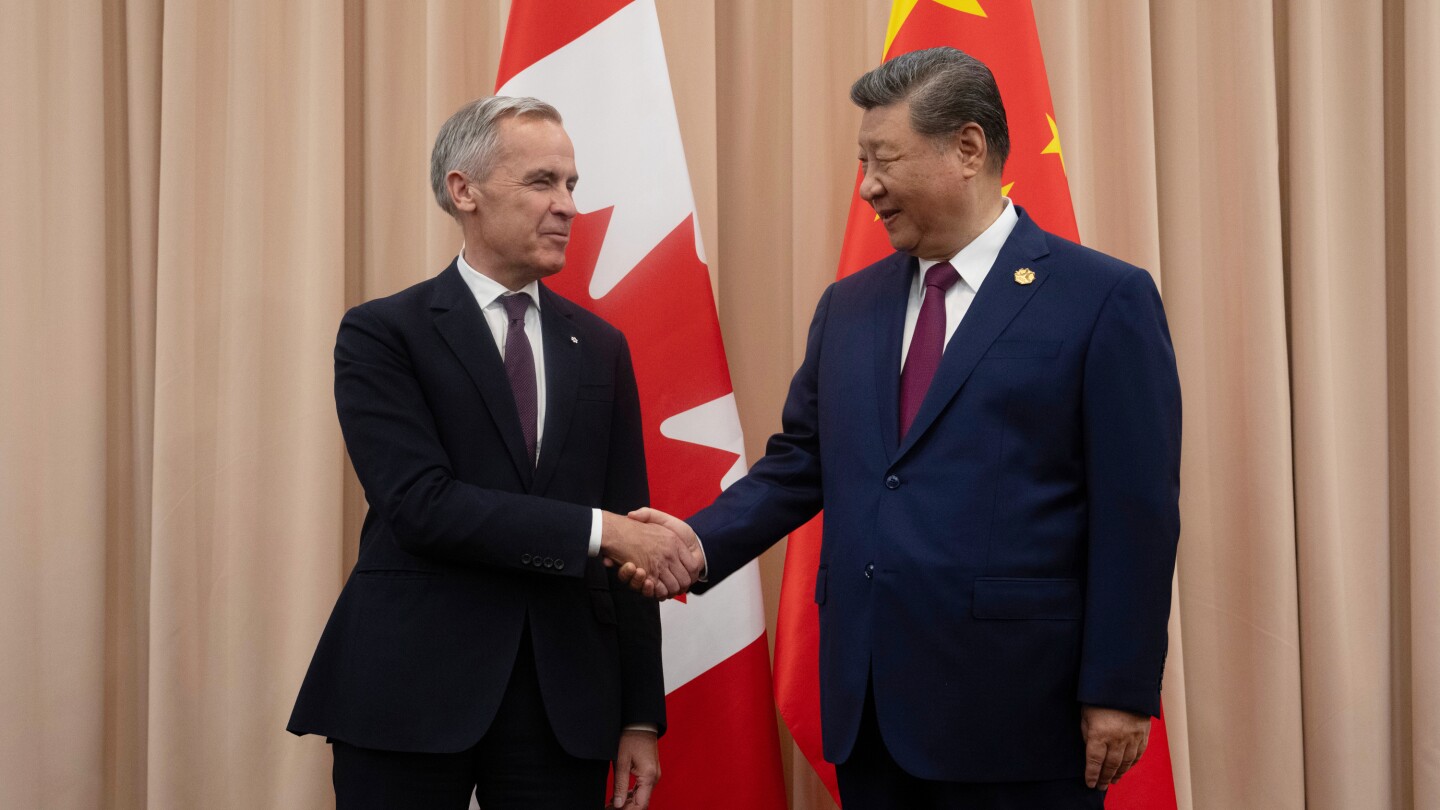
A leader of Canada is visiting China this week for the first time in nearly a decade, marking a significant effort to rebuild fractured relations with the world’s second-largest economy. Prime Minister Mark Carney’s visit represents a strategic pivot as Canada seeks to reduce its economic dependence on the United States.
Arriving Wednesday, Carney aims to double Canada’s non-American exports in the next decade. This ambitious target comes in response to U.S. President Donald Trump’s tariffs and controversial remarks suggesting Canada could become “the 51st state.”
“At a time of global trade disruption, Canada is focused on building a more competitive, sustainable, and independent economy,” Carney said in a statement. “We’re forging new partnerships around the world to transform our economy from one that has been reliant on a single trade partner.”
Carney’s schedule includes a meeting with Chinese President Xi Jinping on Friday, along with discussions with other senior officials. Canadian officials described the visit as an attempt to “reenergize a dormant strategic partnership.” While progress on trade irritants with Beijing is expected, they cautioned that definitive elimination of certain tariffs remains unlikely.
The visit comes at a time when global trade relationships are undergoing significant realignment. Trump’s protectionist policies have inadvertently pushed both Canada and China to explore opportunities for strengthened cooperation, according to Zhu Feng, dean of the School of International Studies at China’s Nanjing University.
“Carney’s visit does reflect the new space for further development in China-Canadian relations under the current U.S. trade protectionism,” Zhu noted, while cautioning against overestimating the significance given Canada’s enduring alliance with the United States.
Carney, who has been in office less than a year after succeeding Justin Trudeau, joins a growing list of Western leaders attempting to repair relations with China. Australian Premier Anthony Albanese has successfully reset ties since his Labor Party came to power in 2022, gradually unwinding Chinese trade restrictions on Australian exports including wine, beef, coal, and most recently, lobsters. Similarly, UK Prime Minister Keir Starmer has sought to repair ties since his Labour Party took office in 2024, though maintaining firm positions on human rights issues including the case of former Hong Kong media magnate Jimmy Lai.
Relations between Canada and China deteriorated significantly in 2018 following Canada’s detention of Huawei Technologies executive Meng Wenzhou at the request of the United States. China retaliated by arresting two Canadians, Michael Kovrig and Michael Spavor, on spying charges. The three were eventually released in 2021 under a negotiated deal.
More recently, tensions escalated when Canada followed the U.S. in imposing a 100% tariff on Chinese electric vehicles and a 25% tariff on steel and aluminum. China responded with tariffs on Canadian exports including canola, seafood, and pork. Chinese officials have indicated a willingness to remove some of these tariffs if Canada drops the EV charges.
China’s state-run Global Times welcomed Carney’s visit as “a new starting point” and urged Canada to lift “unreasonable tariff restrictions.” Chinese Foreign Ministry spokesperson Mao Ning expressed hope that the visit would “consolidate the momentum of improvement in China-Canada relations.”
Carney’s diplomatic initiative extends beyond China. He has also been working to mend ties with India, where relations deteriorated in 2024 after the Trudeau government accused India of involvement in the 2023 killing of a Sikh activist in Canada. A cautious thaw began last June, with both sides restoring some consular services and resuming diplomatic contacts. Carney is expected to visit India later this year.
After concluding his China trip on Saturday, Carney will visit Qatar before attending the annual meeting of the World Economic Forum in Davos, Switzerland, next week, continuing his efforts to diversify Canada’s international partnerships.
Fact Checker
Verify the accuracy of this article using The Disinformation Commission analysis and real-time sources.

14 Comments
I’m curious to see if Carney can make progress on reducing tariffs and other trade barriers with China. That would be a significant win for Canadian businesses and consumers.
Agreed. Reducing trade frictions would be a positive outcome, though the political sensitivities mean it may be challenging to achieve substantial breakthroughs on that front in the short term.
I’m a bit skeptical that this visit will lead to any major breakthroughs. Canada-China relations have been strained for years, and there are still significant political and economic hurdles to overcome.
That’s a fair point. The history of tensions between the countries means this visit is more about beginning to rebuild trust than securing concrete deals. Small steps in the right direction may be the best outcome.
Reducing dependence on the US market is a sensible goal, but China comes with its own set of challenges. Canada will need to balance the opportunities and risks carefully.
Absolutely. China’s authoritarian political system and human rights record make it a complex trading partner. Canada will have to weigh economic interests against its values and principles.
Interesting move by Canada to reduce dependence on the US market. Diversifying trade relationships is prudent in these uncertain times. I’m curious to see what concrete steps come out of Carney’s visit to China.
Agreed. Reducing reliance on any single major trading partner is a smart strategy. It will be important for Canada to find the right balance between the US and China.
This visit could open new doors for Canadian businesses, especially in the mining and commodities sectors. China’s huge appetite for raw materials could provide opportunities if the relationship improves.
You’re right, the mining and resources sectors are likely areas of focus. Canada has abundant natural resources that could complement China’s industrial needs if trade barriers can be reduced.
This visit is a recognition that Canada needs to diversify its economic partnerships. Relying too heavily on the US market has risks, so exploring opportunities with China makes sense.
Well said. Broadening Canada’s trade relationships is a prudent strategy, even if the China path is more complex. Striking the right balance will be crucial for Canada’s long-term economic prosperity.
This visit could have implications for Canadian companies in the mining, energy, and materials sectors. If trade ties with China improve, it could open new avenues for investment and exports.
That’s a good point. Sectors like mining, energy, and critical minerals could benefit if Canada and China can find common ground on trade. But the political dynamics will be crucial.