


Listen to the article
Olympic Speedskating Gets First-Ever Temporary Ice Rink for 2026 Milan Cortina Games
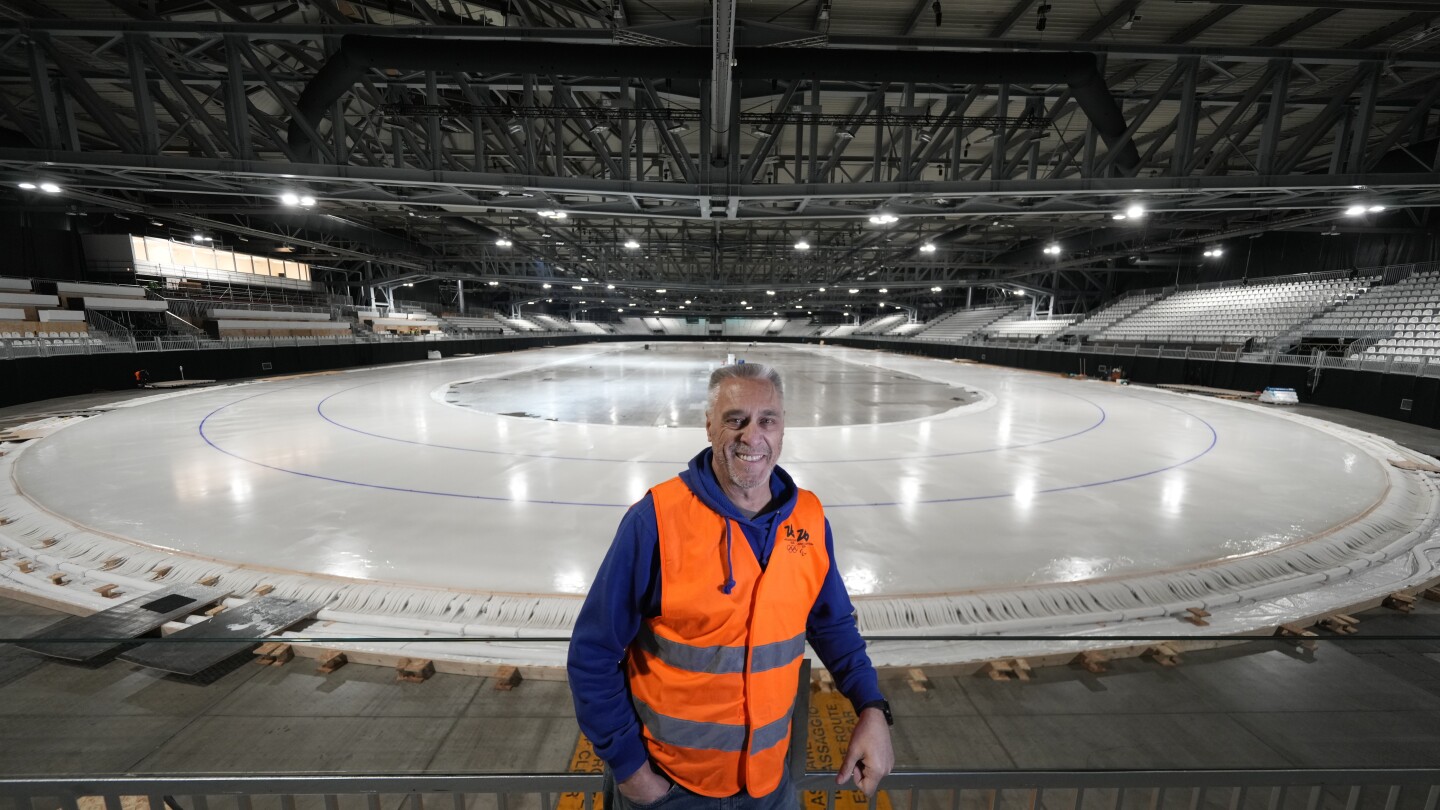
RHO, Italy — For the first time in Olympic history, speedskaters will compete for gold medals on a temporary indoor rink at the 2026 Milan Cortina Winter Games, presenting unique challenges for the technicians responsible for creating the perfect surface.
No ice is colder and harder than speedskating ice. The precision required has historically meant Olympic speedskaters competed only on permanent facilities, but the Milan organizers are breaking new ground at the Speed Skating Stadium, constructed inside repurposed trade fair halls in Rho, just north of Milan.
“It’s one of the biggest challenges I’ve had in icemaking,” said Mark Messer, the veteran ice master overseeing the project. Messer brings considerable expertise, having created the ice for six previous Olympic speedskating competitions and serving as ice technician at Calgary’s Olympic Oval—one of the world’s fastest tracks with more than 300 records.
Messer has been meticulously building the ice surface since late October, applying one thin layer at a time in a process that demands extraordinary precision and patience.
The science of speedskating ice differs significantly from other winter sports surfaces. Hockey ice is medium-hard for fast puck movement and sharp turns. Figure skating ice is softer, allowing push-off for jumps while preventing shattering on landings. Curling ice is the softest and warmest for controlled sliding.
But speedskating ice must be exceptionally hard, cold, clean, and extraordinarily smooth to minimize friction and maximize glide. Even the smallest imperfection can significantly impact performance.
“The blades are so sharp that if there is some dirt, the blade will lose the edge,” Messer explained, “and the skater will lose speed.”
Enrico Fabris, who won two Olympic golds for Italy in Turin in 2006 and now serves as deputy sports manager at the Rho venue, emphasizes that perfect ice means consistent conditions for all competitors—though fast ice is always preferable. “It’s more of a pleasure to skate on this ice,” he noted.
The precision icemaking process began with extensive preparation. Workers spent weeks installing insulation to level the floor, followed by laying a network of pipes and rubber tubes carrying glycol—an antifreeze solution chilled to between minus 7 and minus 8 degrees Celsius (17.6 to 19.4 degrees Fahrenheit).
Water passes through a specialized purification system, though Messer notes it can’t be too pure. “Just the right amount of impurities holds the ice together,” he explained, preventing brittleness that could lead to cracks or breaks.
The first water layers are applied slowly with a spray nozzle. Once the ice reaches a few centimeters thick, it’s painted white—a full day’s work—before adding the lane markings. “The first layer takes about 45 minutes. And then as soon as it freezes, we go back and do it again, and again and again. So we do it hundreds of times,” Messer said.
As the ice thickens and stabilizes, workers apply subsequent layers using hoses, with Messer attaching his to hockey sticks for easier spreading. Throughout this process, maintaining absolute cleanliness is paramount—dust, dirt, or frost creates friction that slows skaters. The Zamboni ice resurfacing machine plays a critical role, cutting off thin layers and spraying water to create fresh surfaces.
A key challenge for this temporary venue is determining how quickly water from the resurfacing machine freezes. Equally critical is achieving the correct ice thickness to support the six-ton Zamboni without shifting the underlying insulation, tubing, or ice itself. “When you drive that out, if there’s anything moving it will move. We don’t want that,” Messer emphasized.
The rink underwent its first major test in late November during a Junior World Cup event. Unlike permanent facilities where test events typically occur a year before the Olympics, this temporary venue has a compressed timeline for adjustments. “We have a very small window to learn,” Messer acknowledged.
Dutch speedskater Kayo Vos, who won the men’s neo-senior 1,000 meters during the test event, reported the ice was slightly soft—feedback Messer welcomes as part of the fine-tuning process.
“We went very modest to start, now we can start to change the temperatures and try to make it faster and still maintain it as safe ice,” he said.
The technical team continues methodically adjusting air temperature, humidity and ice temperature, accounting for the 6,000 spectators expected at each Olympic event. The next critical evaluation comes January 31, when Olympic athletes take their first training sessions on the ice.
“Eighty percent of the work is done but the hardest part is the last 20 percent,” Messer said, “where we have to try to find the values and the way of running the equipment so all the skaters get the same conditions and all the skaters get the best conditions.”
Fact Checker
Verify the accuracy of this article using The Disinformation Commission analysis and real-time sources.

14 Comments
It’s fascinating to learn about the science and precision that goes into creating the perfect speedskating ice. Kudos to the ice master for taking on this unique challenge for the 2026 Winter Games.
Fascinating that they’re using a temporary indoor rink for the first time at the Olympics. I wonder how the ice quality and conditions will compare to the permanent facilities. Should be an interesting challenge for the ice technicians.
Breaking new ground with a temporary indoor rink is an exciting innovation for the Olympic speedskating events. I’m curious to see if any records will be set on this unique ice surface.
It’s great to see the Olympics embracing new technologies and innovations like this temporary indoor speedskating rink. I wonder what other surprises the 2026 Games might have in store.
A temporary indoor speedskating rink at the Olympics is a fascinating concept. I’m really curious to see how the ice quality and conditions compare to traditional permanent facilities. Should make for an exciting competition!
Speedskating is such a demanding discipline, so I’m really impressed by the ice master’s expertise in building up the ice layer by layer to such exacting standards. This should make for some thrilling competition.
It’s amazing that the organizers were able to build a high-performance speedskating rink inside repurposed trade fair halls. I wonder what kind of cooling and ice maintenance systems they had to install to make it work.
I’m curious to see how the temporary rink setup affects the skating experience compared to a permanent facility. Will the athletes notice any differences in terms of speed, stability, or other factors?
The level of precision required to create the perfect speedskating ice surface is truly impressive. Kudos to the veteran ice master Mark Messer for taking on this unique challenge.
The use of a temporary indoor speedskating rink is a bold move by the 2026 Olympic organizers. I’m curious to see if the athletes will be able to achieve the same speeds and performance as on permanent facilities.
Kudos to the ice master for taking on the challenge of creating a high-performance speedskating surface in a temporary indoor facility. That must require an incredible level of skill and expertise.
A temporary indoor speedskating rink at the Olympics is an exciting innovation. I wonder what kind of logistical and technical hurdles the organizers had to overcome to make it a reality.
Pioneering a first-of-its-kind temporary indoor speedskating rink for the Olympics is a bold move. I’m eager to see how it all comes together and how the athletes perform on this new type of ice surface.
Hats off to the ice technicians for their meticulous work in building up the ice layer by layer. Speedskating requires such an incredibly smooth and hard surface, it must be a real art form to create it from scratch.