


Listen to the article
Bulgaria Set to Join Eurozone on New Year’s Day, Despite Public Skepticism
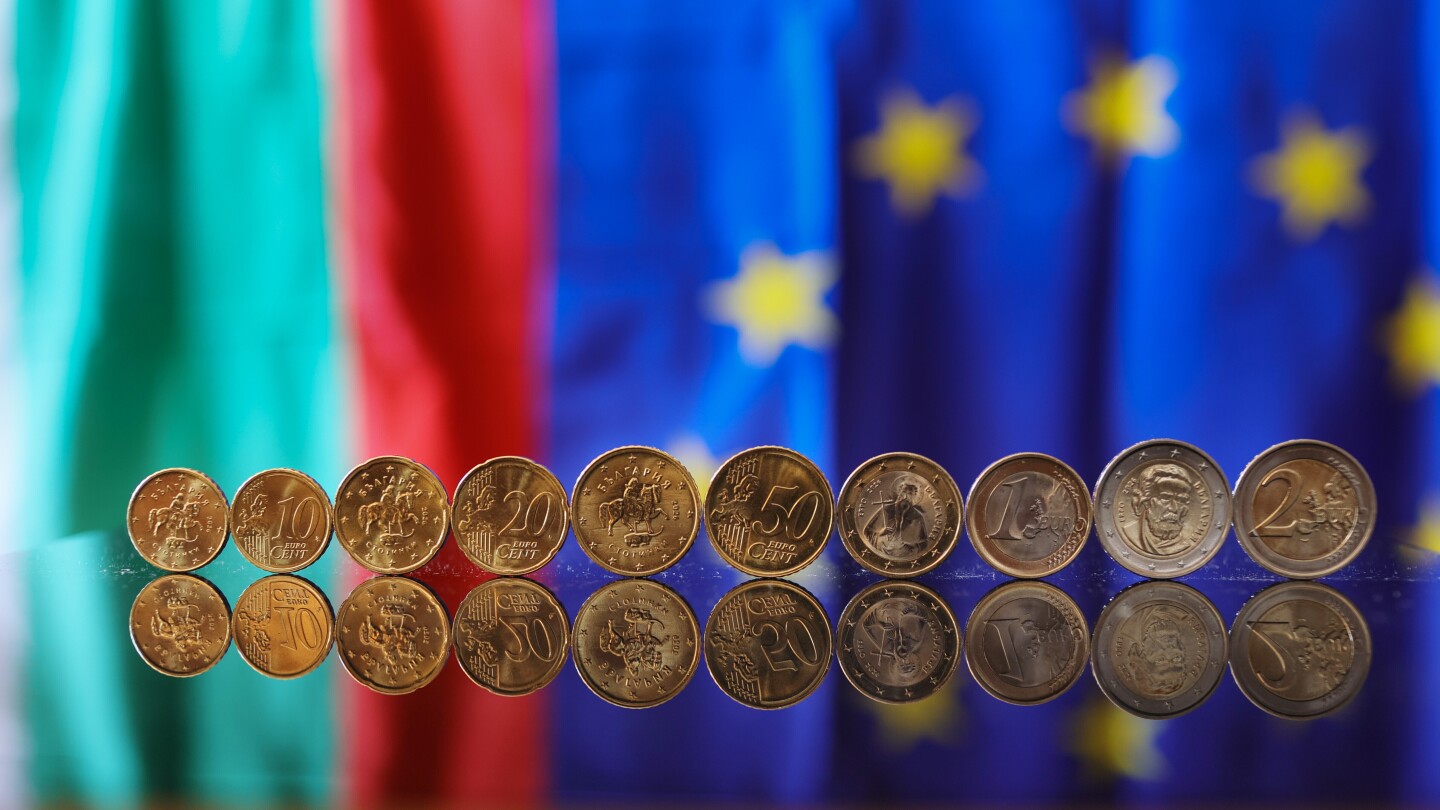
Bulgaria will achieve its long-sought goal of joining the eurozone on January 1, marking a significant milestone in the nation’s economic integration with Western Europe. After years of government lobbying and preparation, the Balkan country of 6.4 million people will become the 21st member of the European Union’s shared currency union.
The transition has been meticulously planned. In recent months, price tags and bank accounts have displayed both currencies at the fixed exchange rate of 51 euro cents to one Bulgarian lev. On New Year’s Day, all bank accounts will automatically convert to euros, though Bulgarians will still be able to pay in levs for approximately a month before receiving change exclusively in euros.
Old currency is expected to circulate for only a few weeks. Citizens can exchange lev notes and coins without fees at banks, post offices, and the Bulgarian Central Bank until June 30, with the central bank continuing to accept exchanges indefinitely thereafter.
For Bulgaria, eurozone membership represents more than a currency change—it signifies deeper economic integration with Europe’s core. The country will gain a seat on the European Central Bank’s governing council, giving it influence over monetary policy decisions that affect the entire currency bloc.
“This transition removes significant barriers to cross-border commerce,” explained an economist at the Bulgarian National Bank, which estimates businesses will save approximately 1 billion levs annually by eliminating currency exchange costs with eurozone trading partners.
The practical benefits for ordinary citizens are substantial. Bulgarians vacationing in neighboring Greece, for instance, will no longer need to exchange currency or return home with unusable foreign cash. Online shopping across European borders will become more straightforward, with price comparisons immediately apparent without conversion calculations.
Bulgaria’s path to the euro began with its 2007 EU accession, which included a commitment to eventually adopt the single currency. While some EU members like Denmark secured opt-outs, and others like Poland and Hungary have postponed the transition, Bulgaria has steadily worked toward meeting the necessary criteria of stable exchange rates and controlled inflation, debt, and deficits.
The eurozone itself has evolved significantly since the debt crisis of 2010-2015, when countries including Greece and Portugal required financial bailouts. The EU has since implemented safeguards, including centralized banking regulation under the ECB and establishing rescue mechanisms to prevent similar crises.
Despite these preparations, public opinion in Bulgaria remains divided. Recent Eurobarometer polls show that approximately half of Bulgarians oppose adopting the euro, while around 45% support the change. This skepticism largely stems from concerns about potential price increases during the changeover and broader economic anxieties.
“The hesitation isn’t necessarily about the euro itself,” said Dimitar Keranov, program coordinator at the German Marshall Fund in Berlin. “It’s more about economic anxiety and low institutional trust overall, not ideological concerns against European integration.”
Bulgaria faces significant challenges, ranking as the EU’s second most corrupt country according to Transparency International, with average monthly wages of just 1,300 euros—among the lowest in the bloc. Russian disinformation campaigns have reportedly exacerbated public concerns.
European Central Bank President Christine Lagarde has sought to address inflation fears, noting that previous euro adoptions typically resulted in minimal and temporary price increases of 0.2% to 0.4%. “Before adoption, uncertainty is natural,” Lagarde stated. “But once households and firms begin using the new currency in their daily lives—and see that a credible central bank is safeguarding price stability—confidence grows.”
Historical patterns support this assessment. ECB economists Ferdinand Dreher and Nils Hernborg have documented that public approval of the euro typically increases by an average of 11 percentage points after adoption.
As Bulgaria prepares for this historic transition, the government hopes these economic benefits will soon outweigh initial apprehensions, positioning the country for increased investment, trade, and integration with Europe’s most developed economies.
Fact Checker
Verify the accuracy of this article using The Disinformation Commission analysis and real-time sources.

10 Comments
Joining the eurozone is a significant milestone for Bulgaria. Deeper economic integration with Western Europe could open new doors, but there may also be challenges to navigate.
Valid point. Bulgaria will need to ensure its economy is well-prepared to compete within the eurozone framework.
The article mentions Bulgaria’s public skepticism about the euro transition. I’m curious to see if public sentiment shifts over time as the benefits become more apparent.
Good observation. Public buy-in will be crucial for the euro’s long-term success in Bulgaria. Effective communication from the government will be key.
As a resource-rich country, I’m wondering how Bulgaria’s mining and energy sectors may be impacted by the euro adoption. Could this lead to more foreign investment in those industries?
Curious to see how this euro adoption impacts Bulgaria’s relationship with other Eastern European economies that have not yet joined the eurozone. Could it drive further regional integration?
With Bulgaria’s location and resources, joining the eurozone could open up new trade and investment opportunities. However, adapting to the new currency system will take time and effort.
Interesting to see Bulgaria joining the eurozone. Curious how this will impact their economy and businesses. Hopefully it leads to more stability and opportunities for growth.
The currency conversion process sounds well-planned, with a smooth transition period. It will be important for consumers and businesses to adapt to the new euro system efficiently.
Agreed, the gradual rollout of the euro should help minimize disruptions. Curious to see if this helps boost trade and investment in Bulgaria.