


Listen to the article
In a demonstration at CES in Las Vegas, attendees glimpsed a future where vehicles recognize occupants instantly – like a car that detects a child entering, acknowledges her birthday, and plays her favorite song without prompting.
“Think of the car as having a soul and being an extension of your family,” explained Sri Subramanian, Nvidia’s global head of generative AI for automotive, during his Tuesday presentation.
This scenario illustrates the rapidly advancing sophistication of AI-powered vehicle systems and the expanding scope of personal data that tomorrow’s cars will collect and utilize to enhance the driving experience.
Throughout the convention floor, automobiles were portrayed less as transportation machines and more as intelligent companions. Various manufacturers showcased vehicles capable of adapting to drivers and passengers in real time – from monitoring heart rates and emotional states to providing alerts if a child is accidentally left behind.
Bosch unveiled its new AI vehicle extension designed to transform the cabin into what it calls a “proactive companion.” Meanwhile, Nvidia, a leading force in the AI revolution, announced Alpamayo, a new vehicle AI initiative created to help autonomous vehicles process complex driving decisions. Nvidia’s CEO Jensen Huang described the advancement as a “ChatGPT moment for physical AI.”
The transformation of cars into data-rich environments is raising significant privacy concerns, according to industry watchers.
“The magic of AI should not just mean all privacy and security protections are off,” warned Justin Brookman, director of marketplace policy at Consumer Reports.
Unlike smartphones and online platforms, which have long been known for data collection, vehicles have only recently emerged as major repositories of personal information, Brookman noted. As a result, the automotive industry is still establishing appropriate boundaries for what companies can do with driver data.
This uncertainty is heightened by the deeply personal relationship many people have with their vehicles. “Many people see their vehicles as an extension of themselves — or even their homes,” Brookman explained, which makes the presence of monitoring technologies like cameras and microphones feel particularly intrusive.
“Sometimes privacy issues are difficult for folks to internalize,” he said. “People generally feel they wish they had more privacy but also don’t necessarily know what they can do to address it.”
Brookman acknowledged that many of these technologies offer genuine safety benefits, creating a complex balance between convenience and privacy concerns.
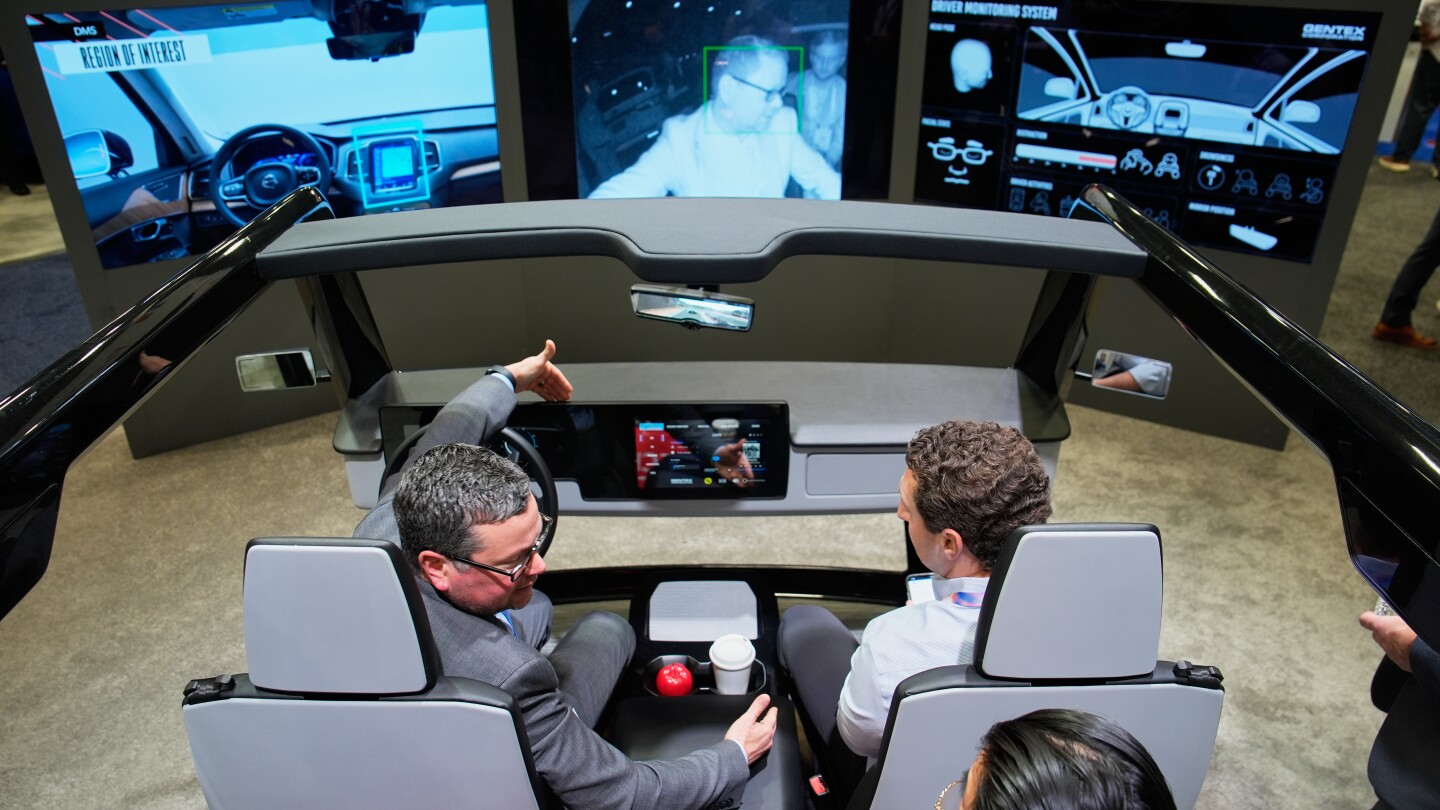
At automotive supplier Gentex’s booth, attendees experienced these innovations firsthand while sitting in a mock six-seater van. Large displays demonstrated how the company’s AI-equipped sensors and cameras could monitor driver and passenger behavior in remarkable detail.
“Are they sleepy? Are they drowsy? Are they not seated properly? Are they eating, talking on phones? Are they angry? You name it, we can figure out how to detect that in the cabin,” said Brian Brackenbury, Gentex’s director of product line management.
Brackenbury emphasized that car manufacturers ultimately decide how vehicles respond to collected data, which he stated is stored within the car and deleted after processing. He stressed Gentex’s commitment to responsible innovation.
“One of the mantras we have at Gentex is we’re not going to do it just because we can, just because the technology allows it,” Brackenbury said, adding that “data privacy is really important.”
This evolution represents a significant shift in how consumers interact with their vehicles. As cars become increasingly intelligent and personalized, they’re transforming from mere transportation devices into digital environments that rival smartphones in their ability to collect and analyze personal data.
For automakers and tech companies, the challenge lies in balancing innovative features with appropriate privacy safeguards. Meanwhile, consumers face decisions about how much personal information they’re willing to share in exchange for convenience and safety enhancements.
As the automotive industry accelerates toward this AI-powered future, the conversation around data privacy in vehicles is likely to intensify, with stakeholders working to establish standards that protect consumers while enabling technological advancement.
Fact Checker
Verify the accuracy of this article using The Disinformation Commission analysis and real-time sources.

12 Comments
Transforming cars into intelligent, personalized companions is an intriguing concept. Curious to see how automakers navigate the balance between innovation and responsible data practices as these technologies mature.
Agreed, the privacy implications will be critical as vehicles gather more intimate details about passengers. Transparency and user control should be top priorities.
The advancements in AI-powered vehicle systems shown at CES are quite impressive. Vehicles adapting in real-time to occupants’ needs could significantly enhance the driving experience. Important to get the privacy and security aspects right, though.
This trend towards vehicles becoming proactive and adaptive to drivers/passengers is really exciting. It will be interesting to see how automakers and tech companies balance innovation with user privacy and ethical AI development.
The idea of cars having a ‘soul’ and being an extension of the family is a compelling concept, but raises important questions around data ownership and responsible implementation of these new capabilities.
Fascinating to see how the automotive and tech industries are envisioning the future of the driving experience. Personalized, AI-powered vehicles could revolutionize how we interact with our cars. Crucial to get the ethical and privacy considerations right, though.
Agreed, the potential for misuse of sensitive user data is a major concern that must be proactively addressed. Transparency and user control will be essential as these technologies advance.
The vision of cars becoming an extension of our families, with the ability to recognize occupants and cater to their preferences, is quite compelling. However, the data privacy and security risks need to be meticulously addressed.
Fascinating to see how AI-powered vehicles are evolving into intelligent, personalized companions. The ability to detect occupants, acknowledge birthdays, and play favorite music is a glimpse into the future of the driving experience.
I’m curious to learn more about the privacy and security implications as cars collect increasing amounts of personal data on passengers.
Monitoring biometrics and emotional states in vehicles opens up a whole new frontier for personalized experiences. However, there need to be robust safeguards to protect sensitive user data and prevent misuse.
While the vision of cars as ‘proactive companions’ is innovative, I hope automakers prioritize transparency and user control when it comes to data collection and usage.