


Listen to the article
Asian Markets Retreat as Japan Reports Economic Contraction, Geopolitical Tensions Rise
Asian stock markets mostly declined Monday while U.S. futures edged higher following a lackluster performance on Wall Street last week. Japan’s Nikkei 225 dropped 0.3% to 50,226.67 after government data revealed the Japanese economy contracted at a 1.8% annual rate during the July-September quarter, signaling potential economic challenges ahead.
The dollar strengthened slightly against the Japanese yen, reaching 154.65 yen from 154.58 yen previously, as currency traders responded to the economic data.
Chinese markets also faced downward pressure, with Hong Kong’s Hang Seng index falling 0.8% to 26,359.22, while the Shanghai Composite index slipped 0.4% to 3,973.31. These declines come amid escalating diplomatic tensions between China and Japan.
The relationship between the two major Asian economies has deteriorated significantly after Japanese Prime Minister Sanae Takaichi suggested that a Chinese move against Taiwan could prompt a Japanese military response. China, which claims Taiwan as its own territory, has strongly objected to foreign involvement in what it considers an internal matter. The dispute has intensified to the point where Beijing has warned its citizens against traveling to or studying in Japan.
“China’s escalation against Japan over Prime Minister Takaichi’s Taiwan remarks has moved from a diplomatic irritant to a consequential macro input, with markets now forced to reprice Asia’s near-term risk curve,” noted Stephen Innes of SPI Asset Management, highlighting how geopolitical tensions are increasingly influencing market sentiment.
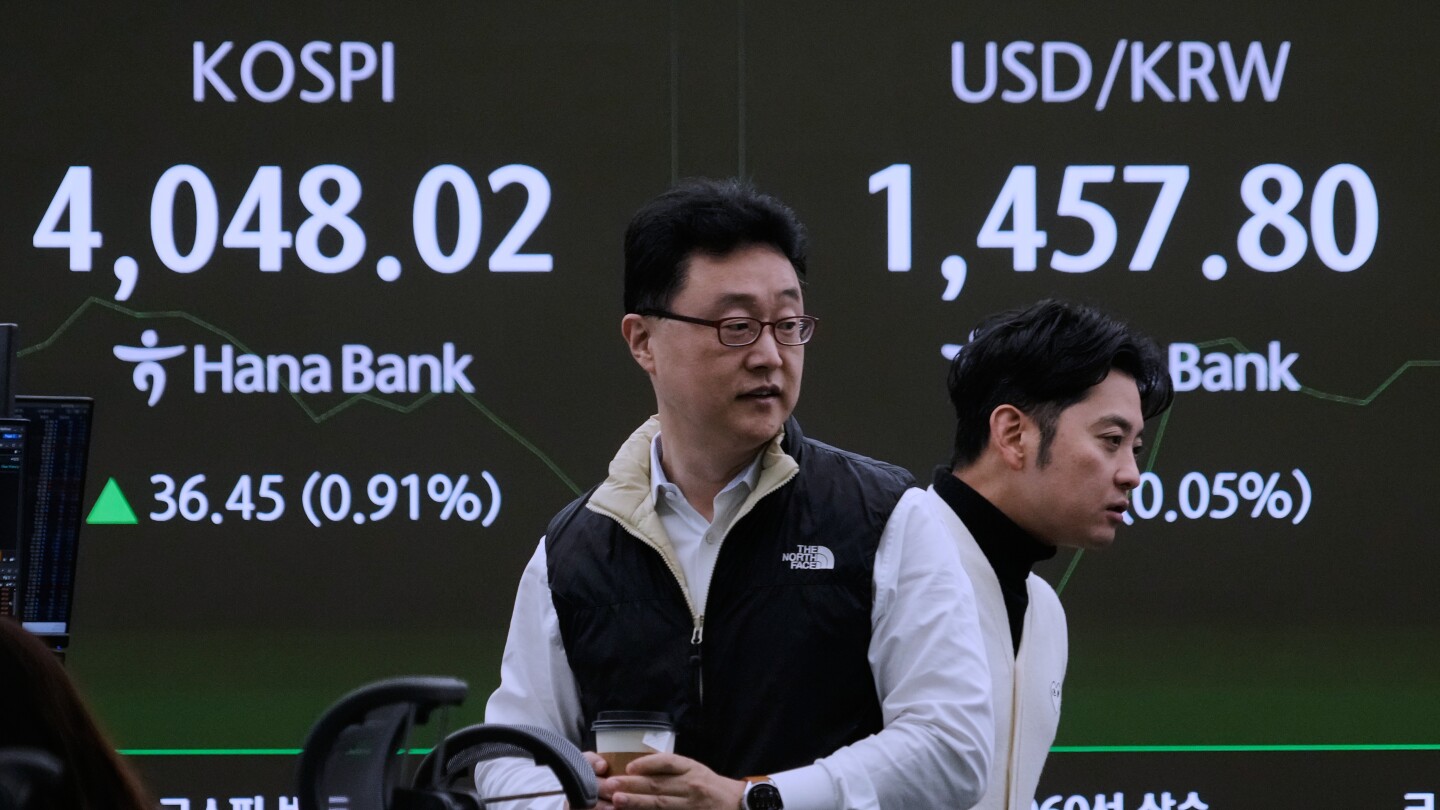
In contrast, South Korea’s Kospi gained 1.7% to 4,078.39, buoyed by strong performance in technology stocks. Computer chip manufacturers rallied after announcing plans to collaborate with industry leader Nvidia on artificial intelligence development. SK Hynix surged 6.8% while Samsung Electronics rose 3.3%, reflecting investor optimism about the potential of these partnerships.
Elsewhere in the region, Australia’s S&P/ASX 200 edged down marginally, slipping less than 0.1% to 8,628.60. Taiwan’s Taiex managed a 0.4% gain, while India’s Sensex added 0.3%.
Looking ahead to U.S. markets, futures for the S&P 500 rose 0.5% while Dow Jones Industrial Average futures edged up 0.1%, suggesting a potentially positive opening after Friday’s mixed close. The S&P 500 ended last week virtually unchanged, down less than 0.1% at 6,734.11. The Dow fell 0.7% to 47,147.48, while the tech-heavy Nasdaq composite inched up 0.1% to 22,900.59.
Friday’s trading followed one of Wall Street’s worst drops since the spring sell-off, with Nvidia—a bellwether for AI technology stocks—experiencing significant volatility. The chipmaker initially dropped 3.4% before rebounding to close up 1.8%, demonstrating the market’s ongoing sensitivity to movements in key technology stocks.
Market analysts have been warning that U.S. equities may be overvalued following their substantial rally since April. Despite recent volatility, the S&P 500 remains within 2.3% of its record high set late last month.
Investor attention is now focused on Nvidia’s upcoming earnings report on Wednesday, which will provide crucial insights into the financial health of the AI sector that has driven much of this year’s market gains.
In the bond market, Treasury yields have generally declined throughout the year as the Federal Reserve has cut its main interest rate twice to support a slowing job market. However, uncertainty is growing about whether a third cut will materialize at the Fed’s December meeting as previously expected.
Fed officials have cited the recent U.S. government shutdown, which delayed economic data releases, as complicating their decision-making process. With limited information available, some officials suggest a wait-and-see approach might be more prudent.
In cryptocurrency markets, Bitcoin traded at approximately $95,400 early Monday, up 1.1% but still well below its October peak near $125,000.
Oil prices retreated, with U.S. benchmark crude losing 63 cents to $59.46 per barrel and Brent crude, the international standard, falling 63 cents to $63.76 per barrel. The euro weakened slightly to $1.1602 from $1.1605.
Fact Checker
Verify the accuracy of this article using The Disinformation Commission analysis and real-time sources.

12 Comments
The Japanese economic contraction is a reminder that the global recovery remains uneven. Commodity producers and energy companies will be watching this closely, as Asia is a major demand center.
Absolutely. Any slowdown in Asia’s major economies could impact commodity prices and the performance of related equities. Diversification and risk management will be crucial for investors in this space.
The commodity markets and related equities will likely be watching these developments closely. Geopolitical risks and economic data can significantly impact global resource and energy prices.
Absolutely, the commodity space is highly sensitive to macroeconomic and political factors. Investors will be monitoring the situation in Asia for any potential disruptions to supply chains or trade flows.
Interesting to see how the market dynamics are playing out across Asia. The Japanese economic data and the geopolitical situation between China and Japan are both significant factors that could impact commodity prices and related equities.
The China-Japan tensions are certainly concerning, given the importance of their economic relationship. Investors in mining, metals, and energy will be closely monitoring developments to assess potential supply chain disruptions.
The Japanese economy’s contraction is a concerning sign, especially given the broader geopolitical tensions in the region. Commodity and energy companies will need to stay vigilant and adaptive to navigate this uncertain environment.
Curious to see how China and Japan navigate this delicate diplomatic situation. Their economic ties are deep, so any escalation could have far-reaching consequences for the region and global markets.
You raise a good point. Both countries have a vested interest in maintaining stability and avoiding outright confrontation. Careful diplomacy and compromise will be key to managing these tensions.
The divergence between US and Asian stock market performance highlights the complexity of the global economic landscape. Commodity investors will be closely watching these developments to gauge potential impacts on their portfolios.
Interesting to see the ripple effects of the US stock market performance on Asian exchanges. The Japanese economy’s contraction is certainly a concerning sign, especially with the geopolitical tensions between China and Japan rising.
Japan’s economy faces some headwinds, but I’m curious to see how they respond and adapt. The China-Japan tensions are quite worrying though – that could have broader regional implications.