


Listen to the article
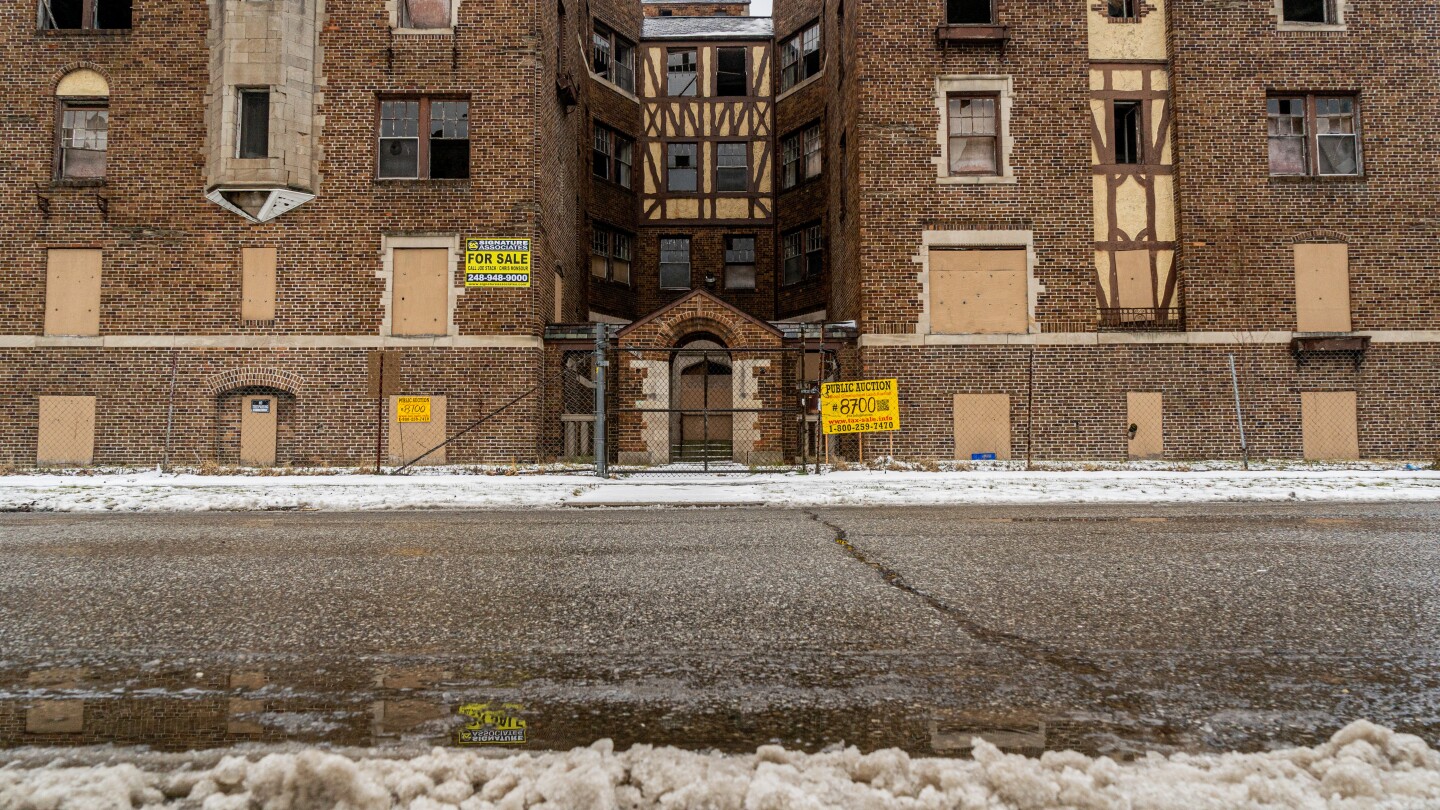
A real estate investment failure has left more than a third of Palmer Park’s historic apartment buildings abandoned, threatening the future of one of Detroit’s most architecturally significant neighborhoods. Since 2020, Phoenix-based Urban Communities acquired 21 apartment buildings in the neighborhood, all of which are now in receivership, foreclosed upon, or severely distressed.
The scale of deterioration became evident when Wayne County attempted to auction five buildings seized for unpaid taxes earlier this year. Not a single bid was placed, despite the county’s marketing efforts. According to inspection reports from one property at 361 Merton Road, the buildings have suffered extensive damage, including stolen electrical wiring and plumbing, fire damage, unstable stairs, and deteriorating walls.
“Getting this building back to an occupiable condition will be a significant undertaking,” noted one inspection report.
Frank Simon, the court-appointed receiver for 14 of the buildings, inherited properties in deplorable condition. “The portfolio definitely was not in good shape at all,” he said. “It was not managed well and had much deferred maintenance.”
Edward Lennon, attorney for Urban Communities and its CEO Maximiliano Palacio, blamed several factors for the company’s collapse in an emailed statement to Outlier Media. These included increased construction costs, nearby crime, and what he characterized as the local court’s “refusal to enforce evictions for non-payment.”
While other landlords have faced challenges in Detroit’s rental market, Urban Communities’ rapid collapse suggests fundamental mismanagement. The company maintained high vacancy rates, accumulated mounting repair issues, and left a trail of unpaid bills. In one instance, the company defaulted on a mortgage just months after securing it.
Former tenants described persistent maintenance problems. Dayton Martindale rented an Urban Communities apartment for seven months beginning in June 2022. His stove and oven were broken upon move-in, and despite repeated requests, repairs took over a month. When he later experienced a break-in, management promised “emergency maintenance” to fix his broken doorknob, but it remained unrepaired until he moved out a month later.
Emma Greschak, another former tenant from 2022, recalled broken windows throughout her building, unsecured doors, and a weeklong outage of both heat and hot water. “They didn’t care about the tenants at all and didn’t update the building,” she said.
Palmer Park stands as a unique architectural treasure in Detroit. Unlike most of the city’s residential neighborhoods dominated by single-family homes, the Palmer Park Historic District features 57 apartment buildings representing diverse architectural styles from Moorish to Art Deco, designed by renowned architects including Albert Kahn.
“The density, the diversity and the beauty” of Palmer Park’s buildings create “a really one-of-a-kind collection that you don’t see anywhere else in the city,” noted Detroit historian Amy Elliot Bragg. She expressed concern about how prolonged abandonment threatens this architectural heritage.
Court records and Wayne County Register of Deeds filings reveal Urban Communities’ financial collapse began shortly after its acquisition spree. The company took out a $25 million loan on 15 properties in June 2022 but missed its first payment just nine months later.
By 2023, Urban Communities had stopped paying contractors. Suzanne Pierce, co-owner of Cardinal Roofing, completed about 10 roofing jobs under a $214,000 contract but was left unpaid for roughly half that amount. “We’re a smaller company,” Pierce said. “My husband and I own it, and we have four salesmen and a crew for commercial work. So it was a huge hit for us.”
Legal documents filed in Michigan’s 3rd Circuit Court revealed that Urban Communities never maintained adequate insurance on 15 properties, which had less than 50% occupancy, over $2 million in unpaid bills, and nearly $700,000 in unpaid taxes. By 2025, the tax debt for the entire portfolio had grown to more than $4.1 million.
“Urban Communities and its investors were wiped out of their equity investment, rendering a loss in excess of $17 million,” said Lennon, the company’s attorney.
The future of these historic buildings remains uncertain. Urban Communities sold one tax-delinquent property in February, while another foreclosed property was sold at auction in September to a Florida-based bidder for $35,000. Adam Abusalah, spokesperson for the treasurer’s office, said the county would hold another auction for the five unsold properties at a later date.
Simon, the receiver, indicated that some buildings remain partially occupied, and the lender has invested “substantial” funds into renovations. He noted that several companies have expressed interest in purchasing the portfolio.
Former tenants Martindale and Greschak each won default judgments in small claims court for their unreturned security deposits when Urban Communities failed to appear for hearings. However, neither has received payment, joining a long list of creditors.
“I had to pay money, do some digging and go to court to be told I was owed my security deposit, then I never got it back,” Martindale said. “One can only assume this happened to every single person who lived there.”
Fact Checker
Verify the accuracy of this article using The Disinformation Commission analysis and real-time sources.

5 Comments
This is a classic case of asset stripping – buy up properties, let them fall into disrepair, then abandon them. It’s a disgraceful business model that harms the community. I hope the courts can compel the investors to make amends.
As an investor myself, I’m appalled by this. There’s no excuse for letting buildings fall into such a state of disrepair. The investors clearly failed in their duty of care. I hope the authorities can find a way to restore these properties and prevent similar exploitation in the future.
This is a concerning situation. Investors need to be responsible stewards of the properties they acquire, especially in historic neighborhoods. Letting buildings deteriorate to this extent is a dereliction of duty that harms the community.
The scale of deterioration is truly shocking. I hope the authorities are able to hold the investors accountable and find a way to restore these historic buildings before they are lost forever. Responsible development is critical for communities like this.
It’s disheartening to see a neighborhood’s architectural heritage neglected like this. These investors seem to have prioritized short-term profits over long-term preservation. The local authorities should look into strengthening regulations to prevent such exploitation in the future.