


Listen to the article
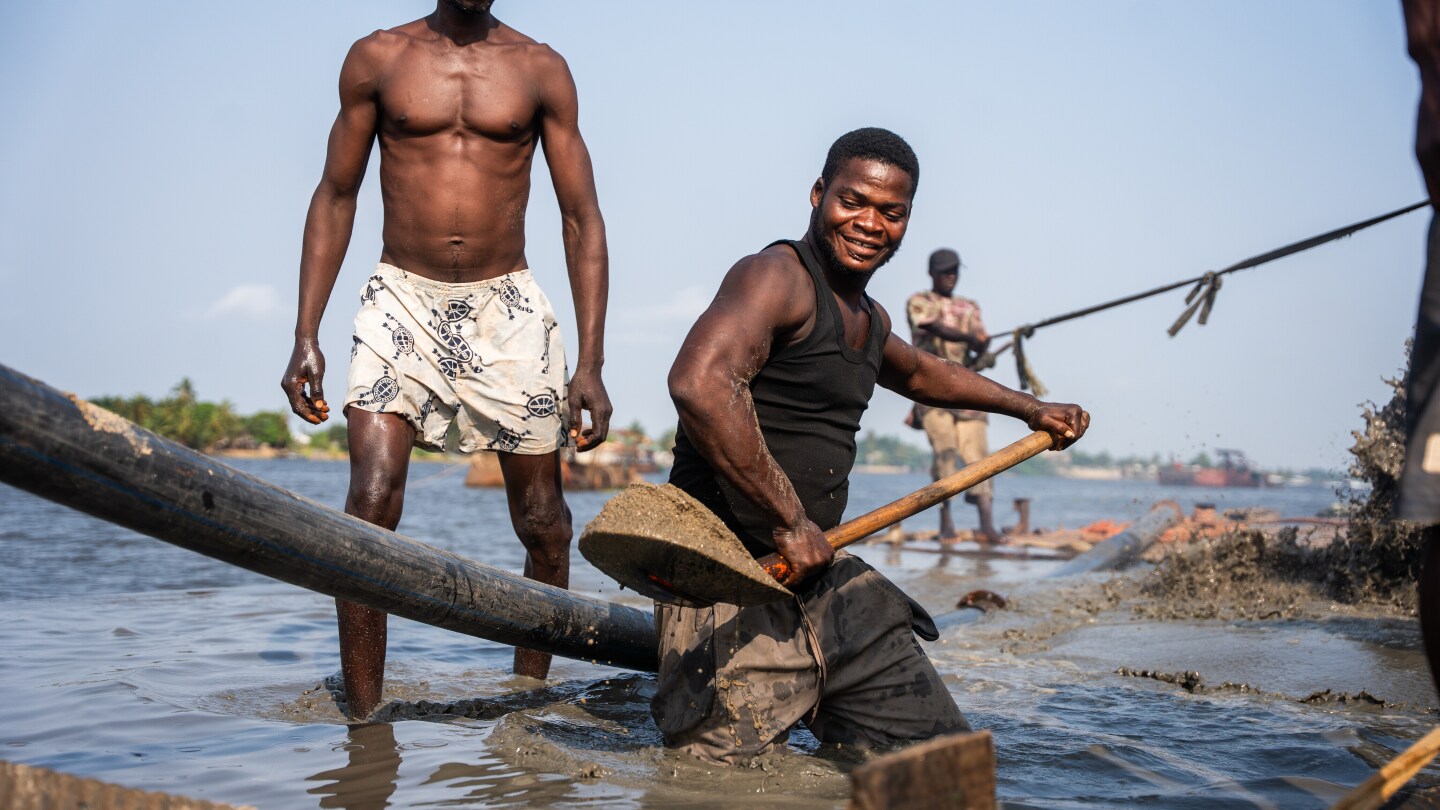
Beneath an eight-lane expressway in Lagos, men stand waist-deep in murky lagoon water, lowering buckets to retrieve sand from below. Each scoop contributes to reshaping the coastline of Africa’s largest city while simultaneously driving away fish and threatening livelihoods in some of the city’s poorest communities.
Among these local dredgers is Akeem Sossu, a 34-year-old former tailor who has been diving for sand for at least three years. He submerges himself for about 15 seconds at a time, hauling up bucketloads of sand destined for construction sites across the burgeoning metropolis.
“I come out early, sometimes 5 a.m. or 6 a.m., depending on the tide,” Sossu explains. He and his partner earn approximately 12,000 naira ($8) per boatload, selling to middlemen who supply larger buyers. Filling a boat requires about three hours of intensive labor.
The price of sand, a crucial component for making concrete, has risen steadily as Lagos development has accelerated. A standard 30-ton truckload of “sharp sand”—coarse and gritty material prized by builders—now sells for about 290,000 naira ($202), reflecting the insatiable demand driving this informal industry.
The environmental transformation of the Lagos Lagoon is unmistakable. What was once an open stretch of water is increasingly fragmented by sandy patches and narrowed channels, fundamentally altering currents that have supported thousands of fishermen for generations.
These changes are most visible near Makoko, one of Lagos’ oldest fishing communities. Large dredging barges now operate perilously close to homes built on stilts, while reclaimed land and luxury beachfront properties encroach from the periphery. Residents report that this intrusion has destroyed traditional fishing grounds and pushed many out of work.
Nearby, fishermen wait for the day’s dredging operations to pause, noting that when machines fall silent, even briefly, some fish temporarily return to these disrupted waters.
Lagos, Nigeria’s economic powerhouse with approximately 17 million residents, exists in a state of perpetual construction. Roads, bridges, and housing estates rise daily on reclaimed waterfronts as wealthy developers displace poorer communities. Over the past five years, dozens of registered dredging firms and countless informal operators have proliferated, extracting sand from rivers and coastal waters throughout Lagos State.
Industry analysts estimate the city consumes tens of millions of cubic meters of sand annually—roughly equivalent to 16,000 Olympic-sized swimming pools. Lagoon sand is especially valued by builders who claim it produces stronger concrete than inland-dredged alternatives.
“We are not powerful,” laments Baale Semede Emmanuel, a community leader from Makoko. “Dredgers have spoiled the entire waters.”
Local fishermen explain that dredging has eliminated shallow areas where fish once spawned before moving to deeper waters. In some cases, fish are directly sucked through dredging pipes. “Anywhere dredging is happening, there’s no fish,” Emmanuel states. “The noise drives them away. The places where they used to reproduce are gone.”
With catches diminishing dramatically, fishermen must venture farther offshore, increasing fuel costs and exposure to dangerous conditions. Some have abandoned fishing entirely.
“We have no other work apart from fishing,” Emmanuel emphasizes. “If we don’t find fish, we will starve.”
For some, this environmental disruption has forced an uneasy career change. Joshua Monday has largely abandoned his two fishing boats and now works as a boat mechanic, a skill he fortunately developed years ago.
“If not for this mechanic work, I don’t know how I would survive,” Monday says. He explains that rising operational costs and diminishing catches have made fishing financially untenable. Fuel can cost more than 150,000 naira ($104) for a single trip, with no guarantee of success.
Meanwhile, dredgers defend their work as providing rare income in a city with limited economic opportunities. “I’m a father of one,” explains Joshua Alex, a dredging operator. “This is how I take care of myself.”
Alex describes how informal dredgers navigate regulatory systems through payments to authorities. “Marine Police will come, we settle them. NIWA will come, we settle them,” he says, referring to the National Inland Waterways Authority. These arrangements effectively blur the line between legal and illegal operations.
Lagos State officials, including Governor Babajide Sanwo-Olu, have repeatedly pledged to crack down on unauthorized dredging, particularly operations blamed for exacerbating flooding, erosion, and coastal degradation. The government claims to have closed illegal sites and strengthened monitoring through various agencies.
Community leaders, however, report that enforcement remains inconsistent. Emmanuel accuses authorities of prioritizing revenue and private development over the survival of fishing communities, citing numerous land allocations for waterfront real estate projects.
Scientific research supports the fishermen’s observations. Studies conducted along major dredging zones have found water turbidity levels far exceeding national safety standards—conditions that disrupt fish feeding, reproduction, and migration patterns. Researchers have documented unstable seabeds beneath dredging sites and contaminated groundwater in some locations.
Environmental scientists warn that dredging reduces the lagoon’s capacity to absorb floodwaters, increasing long-term vulnerability for Lagos and its population. The removal of wetlands and shallow lagoon areas eliminates natural buffers against flooding—a growing concern as the city has experienced increasingly severe inundation in recent years.
As Lagos continues its relentless expansion, the environmental costs of its sand hunger remain largely unaddressed, leaving communities like Makoko caught between development pressures and diminishing traditional livelihoods.
Fact Checker
Verify the accuracy of this article using The Disinformation Commission analysis and real-time sources.

10 Comments
This is a sobering look at the high environmental cost of Lagos’ rapid urbanization. The informal sand dredging industry is clearly having a major impact on the local lagoon and fishing communities. Sustainable alternatives and stronger regulations will be essential to mitigate these damaging effects while still supporting the city’s growth.
The story of the informal sand dredgers in Lagos is a vivid illustration of the tensions between urban development and environmental protection. While the workers are earning much-needed income, the long-term damage to the lagoon ecosystem is deeply concerning. Holistic, sustainable approaches will be key going forward.
The article highlights the delicate balance between urban growth and environmental protection. While dredging provides an important resource, the long-term impacts on the lagoon and fishing communities are worrying. Careful management and investment in alternative materials will be crucial to mitigate the risks.
Agreed. Policymakers will need to find ways to regulate the sand mining industry and incentivize more sustainable construction practices. Restoring damaged ecosystems and supporting affected livelihoods should also be priorities.
It’s concerning to see how the demand for construction materials is driving these unsustainable dredging practices in Lagos. The environmental and social costs seem quite high. I hope the city can find ways to meet its development needs without such severe impacts on the local ecology and communities.
The article highlights the complex challenges of urban development in a megacity like Lagos. While the need for building materials is clear, the dredging activities are clearly having damaging effects on the coastal environment and livelihoods. Creative solutions will be required to balance growth and sustainability.
Absolutely. Policymakers should explore options like recycled aggregates, alternative construction materials, and stronger environmental regulations to reduce the reliance on dredged sand. Engaging local communities will also be crucial in finding equitable solutions.
This article underscores the complex trade-offs involved in rapidly growing cities like Lagos. The voracious demand for construction materials is fueling unsustainable dredging practices that disrupt local livelihoods and ecosystems. Policymakers will need to get creative to meet development needs while safeguarding the environment.
Agreed. Innovations in construction materials, recycling, and environmental regulations could help strike a better balance. But it will require political will and collaboration between government, industry, and affected communities to find lasting solutions.
Interesting to see how the rapid development of Lagos is impacting the local environment. Dredging for construction sand seems to be a lucrative but concerning practice that is disrupting coastal ecosystems and livelihoods. I wonder what sustainable alternatives could be explored to meet the city’s building needs.