


Listen to the article
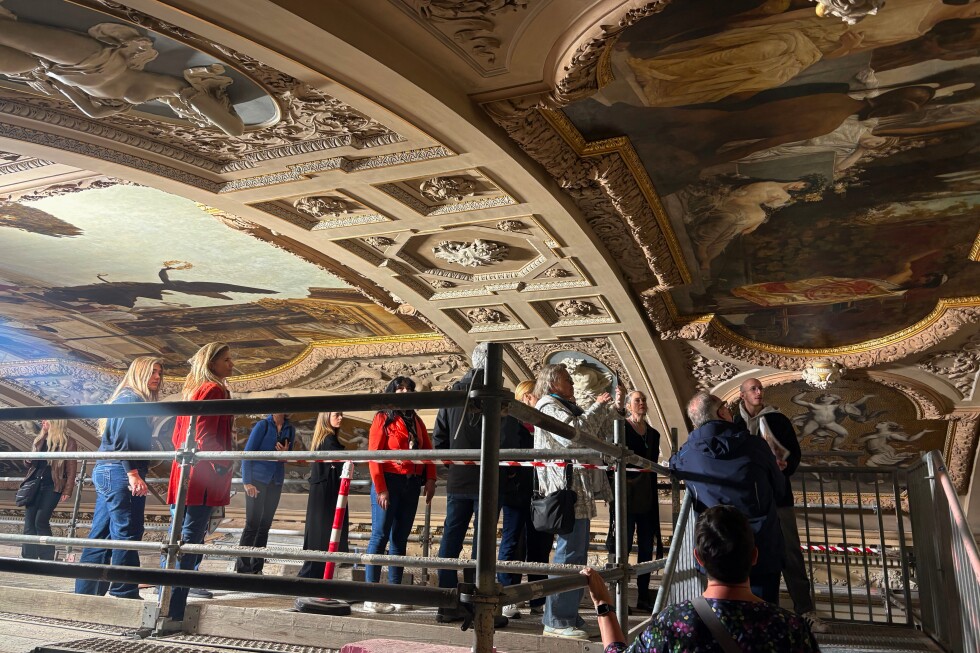
For the first time in over a century, art enthusiasts have the rare opportunity to view early works by Austrian master Gustav Klimt up close at Vienna’s prestigious Burgtheater. The guided tours take visitors high onto scaffolding where they can examine ceiling paintings that have remained distant and largely inaccessible to the general public until now.
The 10 oil paintings, situated 18 meters (60 feet) above the theater floor, are currently undergoing meticulous restoration due to water damage. The project has opened a unique window for art lovers to experience these lesser-known early works by one of Austria’s most celebrated artists.
“The special thing about Klimt for me is that we only know about his later works,” said visitor Hannes Höllinger, who recently participated in one of the tours. “It was very interesting to see that already at age 24 he made these very beautiful paintings which I myself had not seen before.”
Klimt, whose bold art nouveau style revolutionized early 20th-century artistic modernism, created these ceiling paintings between 1886 and 1888 alongside his brother Ernst and fellow artist Franz Matsch. This commission, secured when Klimt was just 24 years old, marked his first significant professional breakthrough.
Robert Beutler, commercial director of the Burgtheater, explained the painstaking restoration process to The Associated Press: “We were allowed to invest several hundred thousand euros to let Gustav Klimt shine in his original splendor again. Everything gets cleaned by hand with very fine cotton swabs and condensed water.”
The scale of the project is immense, with the largest painting covering approximately 35 square meters (375 square feet). “You can imagine how long that takes when you remove dust and grime piece by piece and layer by layer,” Beutler noted.
According to Thomas Mahr, the conservator responsible for restoring the stucco surrounding the artwork, the young artists secured this prestigious commission with a compelling pitch: “We are young, we are fast, and provide great work at low cost — and that’s how they got into business.”
The ceiling paintings depict various scenes from theater history. One of the most significant works shows Queen Elizabeth I watching a performance of “Romeo and Juliet” at London’s Globe Theatre in the 16th century. In a fascinating detail, Klimt included himself, his brother, and Matsch as observers behind the queen—marking what art historians believe is Klimt’s only known self-portrait.
These early works offer intriguing glimpses of Klimt’s developing style, which would later culminate in masterpieces like “The Kiss” (1907-1908)—now housed in Vienna’s Belvedere Museum and considered among the most valuable paintings in the world. Klimt’s mature works have fetched some of the highest prices at auction of any artist, cementing his status in the art market.
Susanne Höllinger, who took the tour with her husband Hannes, was struck by the details invisible from the theater floor: “To be so close to these freshly renovated paintings—just a unique experience.” She particularly noted small, finely painted figures and the cigarette held by Klimt’s brother Ernst, details that reveal the young artist’s already remarkable attention to detail.
The scaffolding tours provide a once-in-a-lifetime perspective on these works, allowing visitors to observe techniques and nuances that foreshadow Klimt’s later, more famous style. Art historians have long noted that these early commissions, though more conventional than his later groundbreaking work, already display the technical brilliance that would define his career.
The special guided tours will continue until August, after which the scaffolding will be removed, and the paintings will once again be viewable only from the theater’s floor—from a considerable distance. General admission tickets are available for 25 euros ($29) through the theater’s website, offering a limited-time window into this overlooked chapter of Klimt’s artistic journey.
Fact Checker
Verify the accuracy of this article using The Disinformation Commission analysis and real-time sources.

19 Comments
Interesting update on Vienna theater offers scaffolding tours of Klimt ceiling paintings. Curious how the grades will trend next quarter.
Good point. Watching costs and grades closely.
Uranium names keep pushing higher—supply still tight into 2026.
I like the balance sheet here—less leverage than peers.
Production mix shifting toward World might help margins if metals stay firm.
Good point. Watching costs and grades closely.
Exploration results look promising, but permitting will be the key risk.
Good point. Watching costs and grades closely.
Nice to see insider buying—usually a good signal in this space.
Good point. Watching costs and grades closely.
Nice to see insider buying—usually a good signal in this space.
Good point. Watching costs and grades closely.
Good point. Watching costs and grades closely.
Exploration results look promising, but permitting will be the key risk.
The cost guidance is better than expected. If they deliver, the stock could rerate.
Good point. Watching costs and grades closely.
The cost guidance is better than expected. If they deliver, the stock could rerate.
Good point. Watching costs and grades closely.
Good point. Watching costs and grades closely.