


Listen to the article
U.S. military has expanded its blockade of Iran to target vessels worldwide, according to Pentagon officials. The operation now extends beyond the Strait of Hormuz to intercept any Iranian-flagged vessels or ships carrying supplies that could aid Tehran’s government.
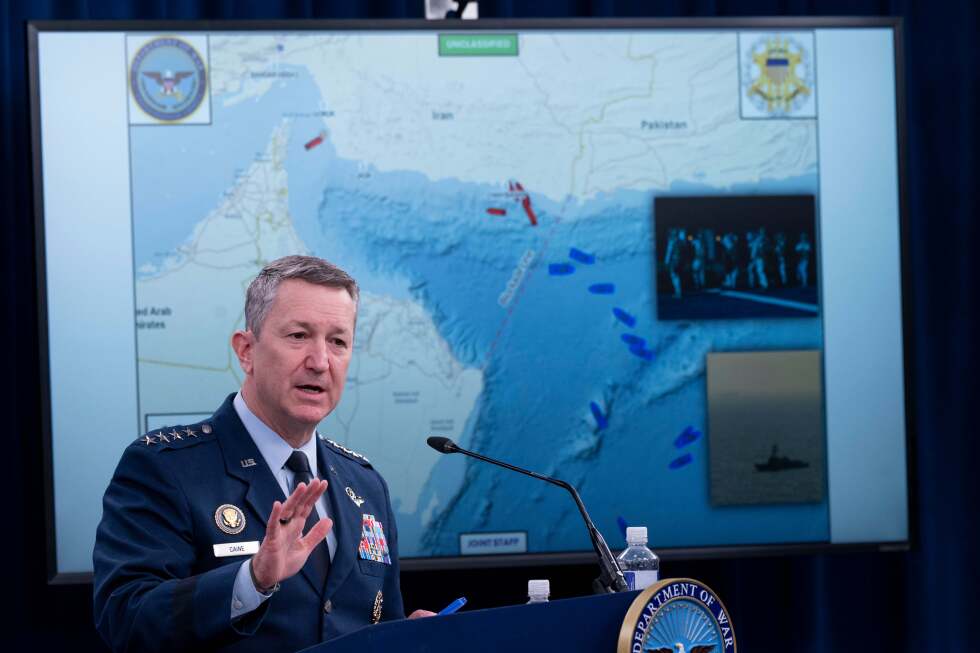
Gen. Dan Caine, chairman of the Joint Chiefs of Staff, emphasized that U.S. forces will actively pursue vessels that departed before the initial blockade, particularly highlighting operations in the Pacific region.
“U.S. forces in other areas of responsibility will actively pursue any Iranian-flagged vessel or any vessel attempting to provide material support to Iran,” Caine told reporters at the Pentagon briefing.
The military has published an extensive list of contraband goods subject to seizure “regardless of location.” According to the notice released Thursday, items “destined for an enemy and that may be susceptible to use in armed conflict” can be captured anywhere beyond neutral territory.
The contraband list includes obvious military supplies classified as “absolute contraband,” such as weapons and ammunition, but also encompasses “conditional contraband” like oil, steel, aluminum, and other dual-use materials that could serve both civilian and military purposes. Even common items such as electronics, power generation equipment, and machinery may be seized if circumstances suggest military end-use.
This expanded pressure campaign against Iranian shipping comes at a critical moment, with a ceasefire between Israel, the U.S., and Iran set to expire within days. Mediators are working urgently to extend the truce that has paused nearly seven weeks of conflict.
More than 10,000 American troops are currently enforcing the blockade on Iranian ports. Defense Secretary Pete Hegseth noted that this represents “less than 10% of America’s naval power.” The U.S. Navy has deployed 16 warships to the Middle East region, including 11 destroyers, three amphibious assault ships, an aircraft carrier, and a littoral combat ship.
U.S. Central Command reported that within the first three days of the blockade, 14 ships have already turned around rather than face potential boarding. Shipping data firms have observed that some Iran-linked or sanctioned vessels that had passed through the strait have either halted their movements, disabled their transponders, or retreated toward Iranian waters.
Vessels approaching the blockade receive direct warnings from U.S. forces. A radio broadcast released by Central Command delivers a clear message: “Vessels will be boarded for interdiction and seizure transiting to or from Iranian port.” Gen. Caine emphasized that any ship attempting to cross the blockade would face “pre-planned tactics designed to bring force to that ship — if need be, board the ship and take her over.”
Kevin Donegan, a retired vice admiral and former commander of the Navy’s Fifth Fleet based in Bahrain, described the complexity of the operation during a webinar hosted by the Middle East Institute.
“It’s a pretty complex operation to make work,” Donegan said, “not just from the intelligence standpoint, but positioning all the ships in the right way to make the intercepts if you have to.”
The Navy is employing sophisticated tracking methods including satellites, drones, and other surveillance technologies to monitor Iran-linked vessels, while also considering each ship’s past activity and history.
Donegan emphasized that the blockade represents just one element of pressure on Iran and cannot resolve the conflict independently. “For it to be most effective, this military tool is added to the other operational tasks that were being done and paired with — hopefully, diplomacy,” he said. “And if those two are scripted together in the right way, we can potentially get the outcomes we want.”
During the Pentagon briefing, Adm. Brad Cooper, head of U.S. Central Command, made a rare appearance to highlight the multinational cooperation involved in regional security operations. Cooper noted that before the ceasefire, American service members had “fought together side by side” with allied troops from Persian Gulf nations.
“In creating the largest air defense umbrella in the world across the Middle East, we embedded specially trained U.S. military air defenders alongside our partner nation soldiers,” Cooper said, adding that Bahrain’s leadership had developed close relationships with American personnel.
The intensification of the blockade represents a significant escalation in economic pressure against Iran, coming at a pivotal moment as regional diplomatic efforts continue to prevent a return to open conflict.
Fact Checker
Verify the accuracy of this article using The Disinformation Commission analysis and real-time sources.

11 Comments
This news raises serious concerns about the scope and legality of the US military’s actions. Intercepting ships worldwide, regardless of location, seems like a very broad and aggressive assertion of power. I hope there are robust legal and diplomatic processes being followed.
While I understand the US government’s desire to increase pressure on Iran, a global maritime blockade seems like an extreme measure that could backfire. I worry about the potential for miscalculation, unintended consequences, and further escalation of tensions. Diplomacy should remain the priority.
I share your concerns. Diplomatic solutions that address the root causes of the conflict should be the focus, not unilateral military actions that risk sparking a wider crisis.
This seems like a concerning escalation of the US military’s blockade against Iran. Intercepting ships worldwide could lead to increased tensions and potential conflicts. I hope diplomatic solutions can be found to address any legitimate concerns without resorting to such aggressive measures.
You raise a good point. Unilateral actions like this often risk provoking further escalation. Negotiation and diplomacy should be the priority to find a peaceful resolution.
The US seems determined to cut off Iran’s access to the global economy, even beyond its borders. While sanctions may be a tool, such a broad maritime blockade raises questions about proportionality and the potential for unintended consequences.
Agreed, this appears to be an extremely aggressive and expansive use of US military power. The risks of miscalculation or retaliation are high. Diplomatic efforts to address underlying issues may be a wiser path forward.
Interesting that the US is now targeting ‘conditional contraband’ like oil, steel, and aluminum in addition to direct military supplies. This suggests they are trying to cripple Iran’s economy as much as possible. However, the legality and ethics of such a wide-ranging blockade are certainly debatable.
Expanding the blockade to the Pacific region is a significant escalation. I wonder how US allies in Asia will respond, and whether this could lead to broader geopolitical tensions. Careful diplomacy will be crucial to avoid miscalculation and unintended conflict.
You make a good point. The global reach of this blockade could have major repercussions, especially in Asia. Coordinating with allies and ensuring clear communication channels will be vital to manage the risks.
This news highlights the complex geopolitical dynamics at play. The US is clearly taking a hardline stance against Iran, but the legality and long-term implications of such an expansive blockade are questionable. I hope cooler heads can prevail and find a peaceful resolution.