


Listen to the article
Ukrainian Drone Strikes Hit Russian Oil Facilities, Bringing War to Distant Regions
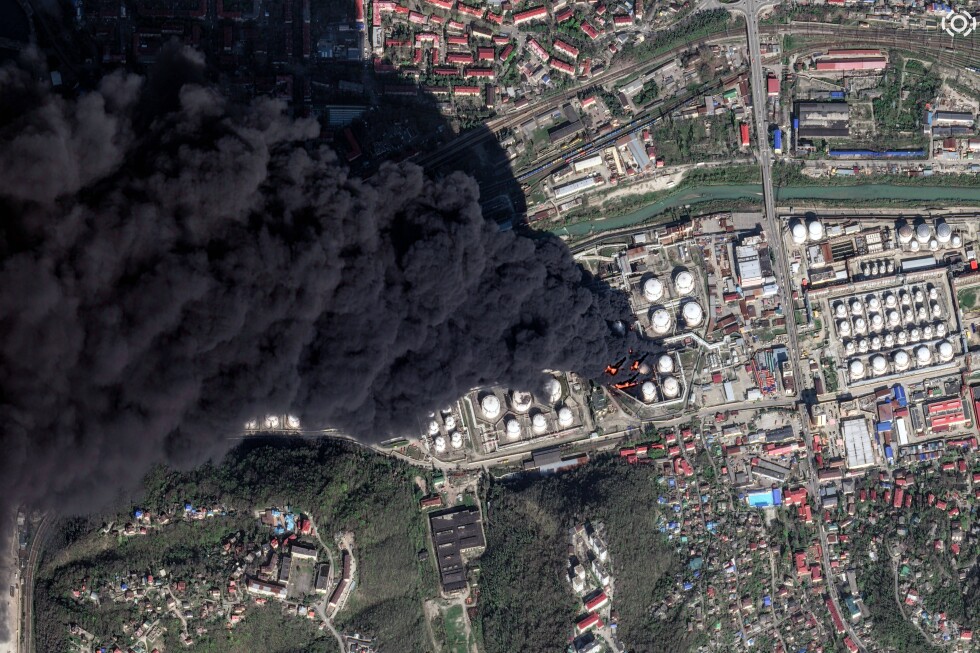
Ukrainian drones have penetrated deep into Russian territory to strike critical oil facilities, generating massive plumes of smoke visible from space and causing toxic rainfall in popular Black Sea tourist destinations.
The strategic attacks aim to cripple Moscow’s oil exports, a vital funding source for Russia’s ongoing invasion of Ukraine. While the economic impact remains uncertain, the environmental consequences and psychological effect on Russian civilians far from the front lines have been significant.
In the Black Sea town of Tuapse, approximately 450 kilometers (280 miles) from the fighting, Ukrainian forces have struck the oil refinery and export terminal four times in just over two weeks. These attacks triggered fires that necessitated local evacuations and sent enormous smoke plumes skyward.
The situation in Tuapse grew dire following the third attack on April 18. In a video posted by local Governor Veniamin Kondratyev, an emergency official reported that boiling oil products had spilled onto streets, damaging vehicles and creating hazardous conditions.
Ukraine’s reach has extended even further. On Thursday, Ukrainian forces claimed successful strikes against an oil pumping station in Russia’s Perm region, more than 1,500 kilometers (900 miles) from Ukrainian territory, on consecutive days. While Russian media acknowledged the attacks, Perm Governor Dmitry Makhonin downplayed them, only confirming that drones had hit “industrial facilities.”
Ust-Luga on the Baltic Sea, one of Russia’s largest oil and gas export terminals located more than 800 kilometers (500 miles) from Ukraine, was targeted three times within a single week in late March. The threat to the St. Petersburg region was so significant that regional Governor Alexander Drozdenko later described it as a “front-line region” due to aerial threats—a stark admission for an area previously considered safely removed from conflict.
Ukrainian President Volodymyr Zelenskyy has framed these strikes as complementary to international sanctions against Russia. Their importance has grown as Moscow collects windfall profits from the global energy crisis linked to Iran’s closure of the Strait of Hormuz.
According to Zelenskyy, Russia has lost at least $7 billion since January 2024 as a direct result of attacks on its oil sector. Ukrainian intelligence reportedly indicates decreased exports from key oil ports like Ust-Luga and Primorsk. The drone strikes have also disrupted Russia’s oil refining capabilities, a problem compounded by sanctions that hinder the acquisition of replacement parts.
However, the full economic picture is complex. Russian crude and oil product exports actually increased by 320,000 barrels per day to reach 7.1 million in March, according to the International Energy Agency. Rising global prices nearly doubled Russia’s oil export revenues from $9.7 billion to $19 billion. It remains unclear whether April’s intensified strikes will reverse this trend.
“U.S. action against Iran has saved both the Russian oil sector and the federal budget from a crisis that was clearly developing in late February,” noted Chris Weafer, CEO of Macro-Advisory Ltd. Consultancy.
Weafer also suggested that the spectacular nature of the explosions might overstate the actual damage. “If you hit an oil tank, particularly one that’s not full, the vapors ignite and you get flames. So it looks very spectacular,” he explained. However, such strikes typically only delay deliveries by a couple of days rather than causing long-term disruption.
“It’s much less damaging than hitting pump stations, compressors, or loading infrastructure. Those appear to be well protected. The tanks are not,” Weafer added.
Ukraine’s ability to conduct these long-range strikes highlights its growing military capabilities and strains Russia’s air defenses. Ukraine’s Defense Ministry claims its forces have more than doubled their deep-strike range since Russia’s full-scale invasion in February 2022. The increased reach allows drones to attack from multiple directions, complicating countermeasures.
“Drone attacks have been a very successful case of leveraging simple technologies and domestically assembled technology to attack Russia in places that, at the start of the war, they would have never expected to be attacked,” said Marcel Plichta, a Ph.D. candidate at the University of St Andrews. “This capability just didn’t exist four years ago.”
The environmental impact of these strikes has been substantial. Following the Tuapse attacks, Russian President Vladimir Putin warned of “serious environmental consequences” while attempting to reassure the public that the situation was under control. Officials reported elevated levels of benzene, a carcinogen found in oil products, and advised residents to limit outdoor exposure.
Local residents have reported “black rain”—oily droplets falling on skin and clothes. Images circulating in local media show stray animals with gray-stained coats, while oil spills along the coastline have affected birds and fish. Recent footage of beached dolphins has particularly disturbed Russians accustomed to vacationing on the previously pristine Black Sea coast.
Vladimir Slivyak, co-chairman of the Russian environmental group Ecodefense, warned of potential long-term consequences for human health and regional ecosystems. “There is a lot of oil in the sea,” he said. “In the next few years, every storm will be bringing more oil pollution onto the coast.”
While Russia’s crackdown on dissent has so far prevented public backlash to these environmental consequences, Slivyak believes attitudes could shift as damage accumulates. “I think a lot of people understand that there is a very big difference between what Putin says and what regional authorities are saying, and what’s really going on,” he observed.
Fact Checker
Verify the accuracy of this article using The Disinformation Commission analysis and real-time sources.

8 Comments
Wow, Ukraine is really taking the fight to Russia’s economic lifelines by striking oil facilities deep inside Russian territory. While the move may hurt Russia’s war funding, the environmental damage is concerning. This conflict seems to be escalating in dangerous ways.
I agree, the environmental impact of these attacks is very concerning. Both sides seem willing to inflict significant collateral damage in pursuit of their strategic objectives. This conflict is becoming increasingly volatile and unpredictable.
Ukraine is taking an aggressive approach by targeting Russian oil facilities deep within its borders. While the strikes may hurt Russia’s war funding, the environmental consequences could be severe. This conflict is evolving in concerning ways, with both sides willing to escalate.
The Ukrainian drone strikes on Russian oil facilities are a bold and risky move. While they may impact Russia’s war funding, the environmental consequences like toxic spills and smoke plumes are worrying. This conflict is becoming increasingly complex with far-reaching implications.
The strikes on Russian oil infrastructure are clearly intended to cripple Moscow’s ability to fund its invasion of Ukraine. While the environmental damage is worrying, it appears Ukraine is willing to take the fight directly to Russia’s economic lifelines. This could potentially escalate tensions further.
You raise a good point. Ukraine seems determined to hit Russia where it hurts, even if it means risking environmental harm. It will be crucial to monitor the long-term impacts of these attacks on both sides.
Interesting to see Ukraine striking deep into Russian territory to target oil facilities. This seems to be a strategic move to undermine Russia’s war effort by cutting off vital funding sources. Though the environmental impact is concerning, it may put more pressure on Russia to end the conflict.
The strategic attacks on Russian oil infrastructure are a bold move by Ukraine to undermine Moscow’s ability to sustain its invasion. However, the environmental risks, like toxic spills and smoke plumes, are worrying. This situation is becoming increasingly complex with far-reaching implications.