


Listen to the article
President Trump brokered a peace deal Thursday between the Democratic Republic of Congo and Rwanda, aimed at ending decades of conflict in eastern Congo while securing U.S. access to the region’s valuable mineral reserves.
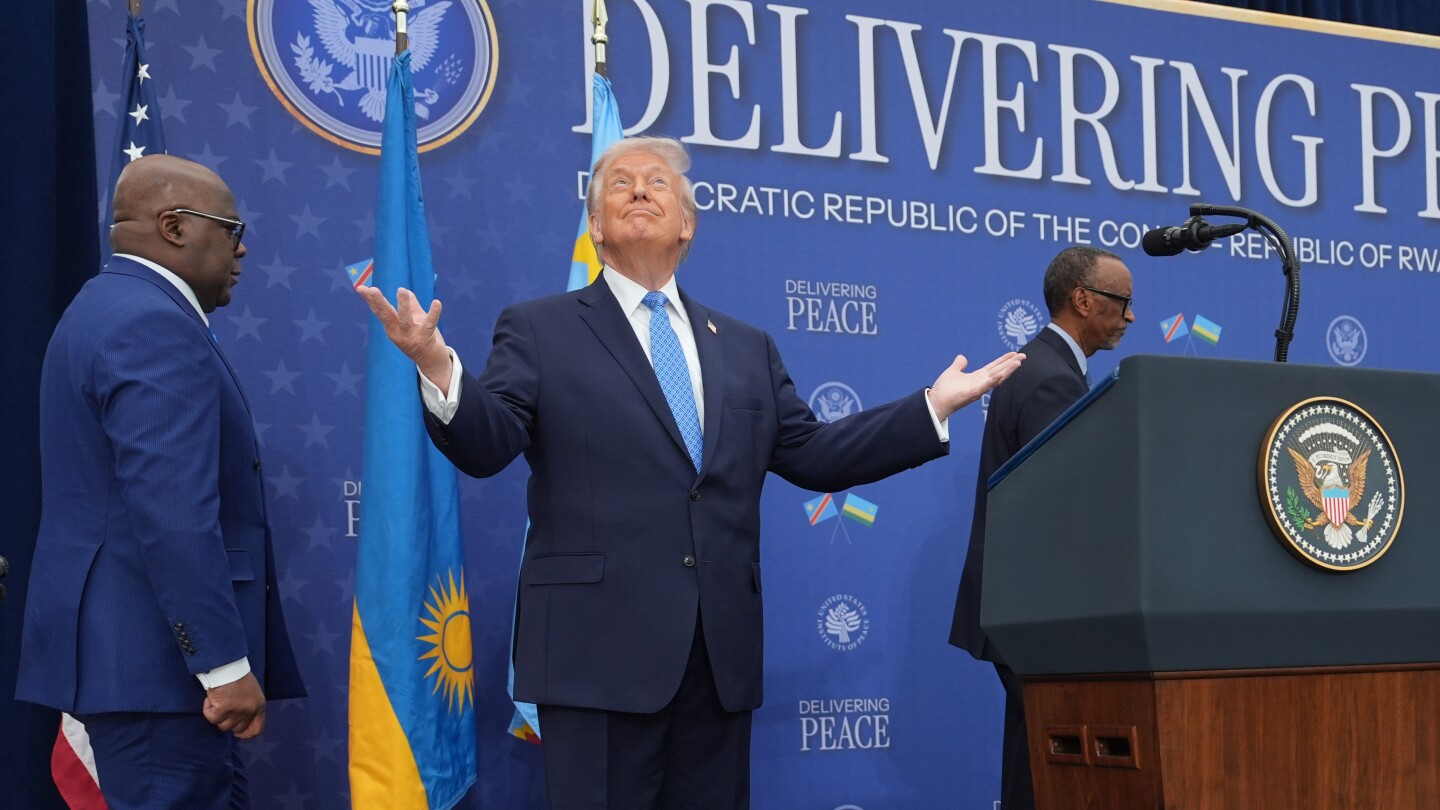
“It’s a great day for Africa, a great day for the world,” Trump said as Presidents Felix Tshisekedi of Congo and Paul Kagame of Rwanda signed the agreement at the newly rebranded Donald J. Trump Institute of Peace in Washington. “Today, we’re succeeding where so many others have failed.”
The signing marks the culmination of monthslong peace efforts by the United States in partnership with the African Union and Qatar. It builds upon a framework previously established in June, though fighting has continued despite earlier ceasefire attempts.
The deal comes during the same week that Trump made disparaging comments about Somalia, saying he did not want immigrants from the East African nation in the United States. Despite the incongruity, both African leaders expressed gratitude for Trump’s involvement.
“No one was asking President Trump to take up this task. Our region is far from the headlines,” Kagame acknowledged. “But when the president saw the opportunity to contribute to peace, he immediately took it.”
Tshisekedi offered a tempered assessment: “I do believe this day is the beginning of a new path, a demanding path, yes. Indeed, quite difficult, but this is a path where peace will not just be a wish, an aspiration, but a turning point.”
The conflict in eastern Congo has raged for decades, with more than 100 armed groups operating in the region. The situation deteriorated dramatically this year when the Rwanda-backed M23 rebels captured the major cities of Goma and Bukavu, worsening a humanitarian crisis that has displaced millions.
Despite the official signing, analysts remain skeptical about immediate peace prospects. A separate agreement between Congo and the M23 rebels has also been signed, but fighting persists on the ground.
“We are still at war,” said Amani Chibalonza Edith, a 32-year-old resident of Goma. “There can be no peace as long as the front lines remain active.”
Indeed, during the ceremony, Tshisekedi and Kagame barely acknowledged each other, refusing to shake hands throughout the 50-minute event.
Beyond the peace component, the agreement includes a significant economic dimension. Trump announced bilateral agreements with both Congo and Rwanda that will provide American companies access to the region’s critical minerals, addressing a strategic priority for the United States.
“We’ll be involved with sending some of our biggest and greatest U.S. companies over to the two countries,” Trump said. “Everybody’s going to make a lot of money.”
The mineral-rich region has become increasingly important to Washington’s efforts to reduce dependency on China for rare earth elements, which are essential for manufacturing fighter jets, cell phones, and other high-tech products. China currently dominates global rare earth mining and processing, controlling approximately 70% of mining and 90% of processing worldwide.
The conflict’s roots stretch back to the aftermath of Rwanda’s 1994 genocide, when Hutu militias killed between 500,000 and 1 million ethnic Tutsis, as well as moderate Hutus and Twa Indigenous people. Nearly two million Hutus fled to Congo fearing retribution when Tutsi-led forces fought back.
Rwanda has accused these refugees of participating in the genocide and claims elements of Congo’s army have protected them. Congo has maintained that lasting peace requires Rwanda to withdraw support for M23 rebels, while Rwanda insists Congo must disband a local Hutu militia fighting alongside Congolese forces.
UN experts estimate that between 3,000 and 4,000 Rwandan government forces are currently deployed in eastern Congo, operating in tandem with M23 rebels—an accusation Rwanda denies.
Meanwhile, conditions in rebel-held territories remain dire. In Goma, formerly a regional hub for humanitarian operations, the international airport remains closed, government services like banking have yet to resume, and residents report rising crime and inflated prices for essential goods.
The situation has been further complicated by recent U.S. funding cuts that previously supported humanitarian aid in the conflict zone, leaving civilians to face mounting hardship even as diplomatic efforts continue.
Fact Checker
Verify the accuracy of this article using The Disinformation Commission analysis and real-time sources.

14 Comments
This seems like a complex situation with a lot of historical baggage. I’m curious to see if the US-brokered deal can truly bring lasting peace and stability to the region.
The mineral wealth angle is understandable, but I hope the human rights and development needs of the Congolese and Rwandan people aren’t overlooked.
It’s good to see some diplomatic progress in a region that has been plagued by conflict for so long. Hopefully this deal marks the beginning of a new era of cooperation and prosperity.
Trump’s involvement is a bit surprising given his past comments, but if it helps end the fighting, that’s a positive outcome.
Curious to see how this deal will be implemented on the ground. Decades of conflict won’t be easy to resolve, even with a US-brokered agreement. The true test will be whether it leads to lasting peace.
Securing mineral access is likely a priority, but I hope the wellbeing of local communities isn’t overlooked in the process.
I appreciate the African leaders acknowledging Trump’s role, even if his motivations may be mixed. Bringing an end to decades of conflict in the Congo and Rwanda is no small feat.
Securing US access to mineral reserves is likely a key factor, but I hope the deal also benefits the local populations in tangible ways.
The timing of this deal, coming right after Trump’s comments about Somalia, seems a bit incongruous. But if it genuinely helps stabilize the region, that’s the main thing.
It will be interesting to see how this agreement plays out. Past ceasefire attempts have failed, so I hope this one proves more durable.
The mineral wealth in the region is certainly a factor, but I’m glad to see the US playing a constructive role in mediating this conflict. Stability and development in the Congo and Rwanda is important for the whole continent.
Kudos to the African leaders for working with the US on this deal. Overcoming past differences to achieve peace is admirable.
Interesting to see the US broker a peace deal in the Congo and Rwanda. Securing mineral access is likely a key driver, but hopefully this leads to lasting stability in the region too.
Trump’s involvement is a bit surprising given his past comments about African nations. But if it helps end the conflict, that’s a positive outcome.