


Listen to the article
President Donald Trump is intensifying pressure on Ukrainian President Volodymyr Zelenskyy to accept a new 28-point peace plan that would require Ukraine to cede significant territory to Russia, drastically reduce its military, and abandon aspirations of NATO membership.
Trump’s proposal, presented to Zelenskyy in Kyiv last Thursday by U.S. Army Secretary Dan Driscoll, demands Ukraine’s response by next Thursday. The plan has reignited tensions in the already strained relationship between the two leaders.
“He’s going to have to approve it,” Trump declared on Friday, though he softened his tone a day later, saying, “I would like to get to peace. We’re trying to get it ended. One way or the other, we have to get it ended.”
At the core of Trump’s proposal is the demand that Ukraine surrender the entire eastern Donbas region, despite Ukrainian forces still controlling substantial portions of the territory. The Institute for the Study of War estimates it would take Russian forces several years to capture the region at their current pace of advance.
Nevertheless, Trump insists Ukraine’s defeat is inevitable. “They will lose in a short period of time. You know so,” Trump told Fox News Radio. “They’re losing land. They’re losing land.”
The proposal arrives as Zelenskyy faces multiple crises. A corruption scandal involving $100 million in kickbacks at the state-owned nuclear energy company has forced cabinet resignations and implicated Zelenskyy associates. On the battlefield, Ukraine struggles against Russia’s larger military while enduring relentless aerial bombardments targeting the country’s energy infrastructure ahead of winter.
“Now Ukraine may find itself facing a very difficult choice: either loss of dignity, or the risk of losing a key partner,” Zelenskyy acknowledged in a video address Friday.
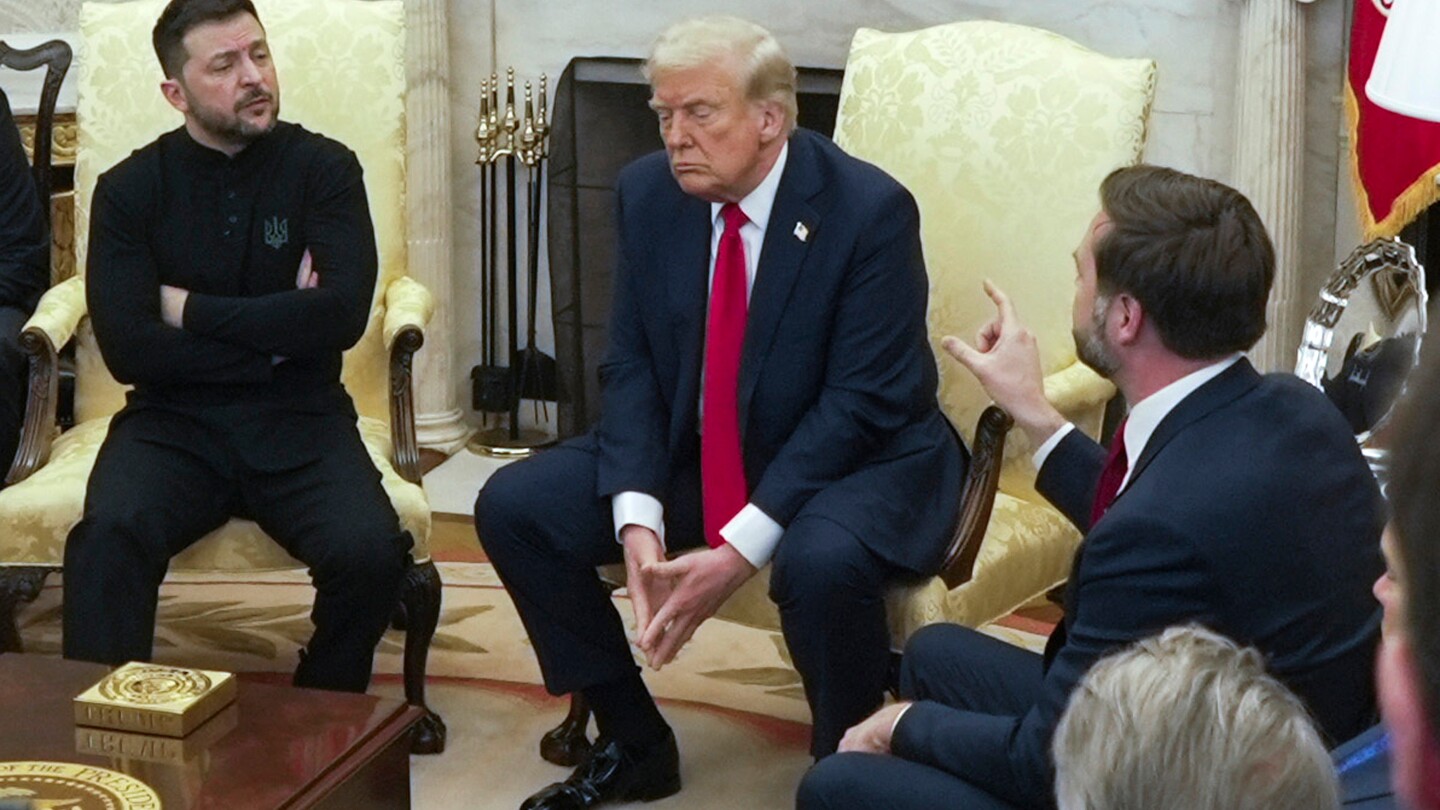
The troubled history between the two leaders dates back to 2019, when their first conversation – in which Trump pressured Zelenskyy to investigate Joe Biden ahead of the 2020 election – led to Trump’s first impeachment. Earlier this year, Trump and Vice President JD Vance berated Zelenskyy during an Oval Office meeting for what they characterized as insufficient gratitude for the more than $180 billion in U.S. aid to Ukraine, temporarily suspending assistance.
When asked about Zelenskyy’s hesitant response to the new proposal, Trump referenced that contentious February meeting: “You remember, right in the Oval Office, not so long ago, I said, ‘You don’t have the cards.'” While Trump left room for negotiation on Saturday, saying the proposal wasn’t his “final offer,” he added dismissively that if Zelenskyy rejects it, “Then he can continue to fight his little heart out.”
White House Press Secretary Karoline Leavitt described the plan as reflecting “the realities of the situation” and offering the “best win-win scenario, where both parties gain more than they must give.”
Konstantin Sonin, a political economist and Russia expert at the University of Chicago, noted that “what Donald Trump is certainly extremely good at is spotting weak spots of people.” He added, “Zelenskyy’s back is against the wall” and “his government could collapse if he agrees” to the U.S. proposal.
Beyond territorial concessions, the plan includes provisions that military historian David Silbey of Cornell University says “cut deeply into Ukrainian pride.” One requires both countries to “reject and prohibit” “all Nazi ideology and activities” – language that appears to validate Putin’s false narrative of invading Ukraine to “denazify” the country.
“Very clearly an attempt to build up Putin’s claim to Russian cultural identity within Ukraine,” Silbey observed. “From territory loss to the substantial reduction of the Ukrainian military to cultural concessions that have been demanded, I just don’t think Zelenskyy could do this deal and look his public in the eye again.”
Adding further pressure, the plan calls for Ukrainian elections within 100 days of agreement. Meanwhile, Ukraine’s 2025 budget remains uncertain as a European plan to finance it through loans linked to frozen Russian assets is now in question.
Zelenskyy has indicated he expects to speak with Trump in the coming days, setting the stage for what promises to be another difficult conversation between the two leaders as Ukraine faces what Zelenskyy called “perhaps the most difficult choice in its history.”
Fact Checker
Verify the accuracy of this article using The Disinformation Commission analysis and real-time sources.

11 Comments
Forcing Ukraine to give up territory and reduce its military capabilities is a non-starter. This plan appears to be more about Trump’s own political agenda than achieving a lasting peace. Zelenskyy will need to stand firm to protect Ukraine’s interests.
I’m skeptical of Trump’s motivations here. His past cozy relationship with Putin raises concerns about whether this proposal is truly in Ukraine’s best interests.
Ceding territory to Russia would be a major setback for Ukraine’s territorial integrity. However, I understand the desire to end the conflict. A more balanced approach that addresses both sides’ concerns may be needed.
It will be interesting to see how President Zelenskyy responds to this proposal. He faces a difficult choice in weighing Ukraine’s security interests against the desire for peace.
This peace plan seems to heavily favor Russia, potentially forcing Ukraine to surrender significant territory. While ending the war is important, it must be done on fair terms that protect Ukraine’s sovereignty and security interests.
I’m concerned that this plan places too much pressure on Ukraine to make unilateral concessions. A lasting peace requires compromise from all sides.
Surrendering the Donbas region would be a major concession for Ukraine. Given the slow pace of Russia’s advances, it’s unclear why Ukraine should be forced to make such a significant compromise at this stage. A more equitable settlement should be pursued.
While I appreciate the effort to find a diplomatic solution, this plan seems heavily skewed in Russia’s favor. Ukraine should not be forced to surrender hard-won territory, especially when Russian forces have not achieved a decisive victory.
Ultimately, any peace agreement must be acceptable to both Ukraine and Russia. Compromise from all parties will be necessary to end this conflict on fair terms.
While the desire to end the war is understandable, this plan puts an unacceptable burden on Ukraine. Zelenskyy must carefully weigh the costs and benefits before responding. A more balanced approach that respects Ukraine’s sovereignty would be preferable.
This proposal seems to prioritize Trump’s political interests over the legitimate security concerns of Ukraine. Zelenskyy must resist pressure to accept terms that undermine his country’s sovereignty and territorial integrity, even if it means continued conflict.