


Listen to the article
President Trump Extends Deadline for Iran to Reopen Strait of Hormuz Amid Market Turmoil
In a move reflecting growing economic concerns, President Donald Trump announced Thursday he would postpone potential military action against Iran, giving the Islamic Republic until April 6 to reopen the strategically vital Strait of Hormuz.
The decision came after U.S. markets recorded their biggest losses since the conflict began. The S&P 500 dropped 1.7%, while the Dow Jones Industrial Average fell 469 points, or 1%, and the Nasdaq composite sank 2.4%, falling more than 10% below its recent all-time high.
“They asked for seven (days),” Trump said during an appearance on Fox News Channel’s “The Five.” “And I said, ‘I’m going to give you 10.'”
This represents the third extension of Trump’s ultimatum. He initially threatened to bomb Iranian energy facilities last Saturday, giving Tehran a 48-hour deadline to reopen the strait. He then extended that deadline by five days on Monday following market turbulence in Asia, before announcing the latest postponement Thursday.
The pattern of policy adjustments following market volatility is familiar. Last April, Trump announced a 90-day pause on severe tariffs for most countries except China after implementing measures that triggered the worst two-day sell-off for the S&P 500 in five years.
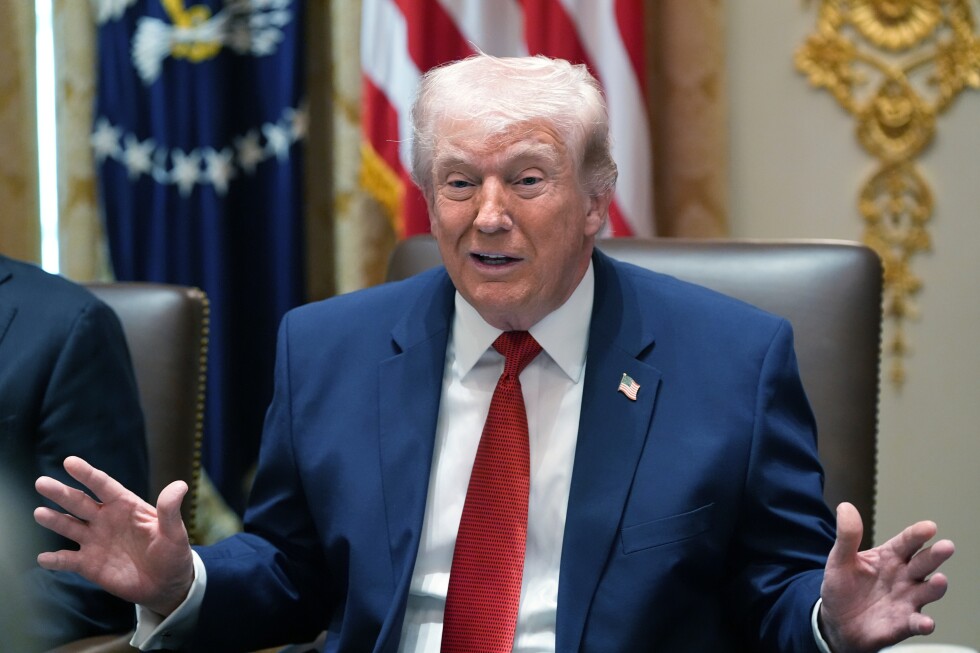
Despite the repeated extensions, the president insisted progress is being made in negotiations. “We have very substantial talks going on with respect to Iran — with the right people,” Trump told reporters during a Cabinet meeting. He claimed Iran was “begging” for a deal while simultaneously urging Tehran’s negotiators to “get serious soon, before it’s too late.”
The White House maintains that negotiations are proceeding through Pakistani intermediaries on a 15-point proposal to end the war. However, Iran continues to publicly deny direct talks with the administration.
Steve Witkoff, Trump’s envoy and a New York real estate developer-turned-diplomat, told the Cabinet that the administration had received “strong signs” that peace was possible and that “Iran is looking for an off-ramp” following Trump’s threat against its power plants.
Iran has effectively challenged Trump to follow through on his threat, warning it would retaliate against critical regional infrastructure, including desalination facilities for drinking water, if the U.S. or Israel targeted its power plants. Tehran has also strengthened its grip on the strait, attempting to establish what some analysts describe as a “toll booth” for passing tankers.
The Strait of Hormuz is a crucial chokepoint through which approximately 20% of the world’s oil passes daily. Its effective closure has sent global energy prices soaring, with U.S. gas prices rising more than a dollar per gallon in the past month alone.
Treasury Secretary Scott Bessent attempted to downplay the strait’s significance, saying Iran is “trying to take control of the global economy through a chokepoint that we believe does not exist.” This characterization is misleading, as the strait is indeed critical, particularly for Asian energy supplies.
While the White House projects optimism about diplomatic progress, military preparations continue. The Pentagon is preparing to deploy at least 1,000 soldiers from the Army’s elite 82nd Airborne Division to support operations against Iran, in addition to 5,000 Marines being shifted to the Middle East. These forces will join the 50,000 U.S. troops already stationed in the region.
The military buildup has fueled speculation that Trump may be positioning forces for limited ground operations to secure the strait or capture Kharg Island, a vital component of Iran’s oil infrastructure.
“Yes, we could do it, but the question isn’t can we do it?” said Mick Mulroy, a former deputy assistant secretary of defense now with the Middle East Institute. “It’s — should we do it? And the best route out is going to be diplomacy. I know it’s easier said than done, but diplomacy and negotiations only work if both sides are willing to compromise.”
In what Trump described as a positive sign, Iran has reportedly allowed several Pakistan-flagged tankers through the strait. “Well, I guess we’re dealing with the right people,” the president remarked.
As global markets remain on edge, the administration faces mounting pressure to find a diplomatic solution that reopens this critical waterway without triggering a wider regional conflict.
Fact Checker
Verify the accuracy of this article using The Disinformation Commission analysis and real-time sources.

9 Comments
While I’m encouraged by the additional time for talks, I remain cautiously optimistic about the prospects for a diplomatic breakthrough. The geopolitical tensions are deeply entrenched.
I’m glad to see the president take a more measured approach and give diplomacy more time to work. De-escalating tensions should be the primary objective at this stage.
Absolutely, diplomacy and restraint are essential to finding a constructive solution. Resorting to military action too hastily could have disastrous consequences.
This seems like a delicate geopolitical situation with significant economic implications. I’m curious to see how the negotiations progress and whether a peaceful resolution can be reached.
Agreed, it’s a complex issue with high stakes. Careful diplomacy and open communication will be crucial in navigating this crisis.
Extending the deadline for talks is a prudent move, given the potential fallout from military action. Maintaining stability in the global energy markets should be a top priority.
That’s a fair assessment. Avoiding further market turmoil and economic disruption is clearly a key consideration for the administration.
The strategic importance of the Strait of Hormuz cannot be overstated. Keeping it open and secure is crucial for global energy markets and economic stability.
That’s a good point. Any disruption to shipping and trade in that region would have far-reaching impacts, so a peaceful resolution is critical.