


Listen to the article
Climate Summit Visitors Discover Authentic Acai, a Far Cry from Global Trend
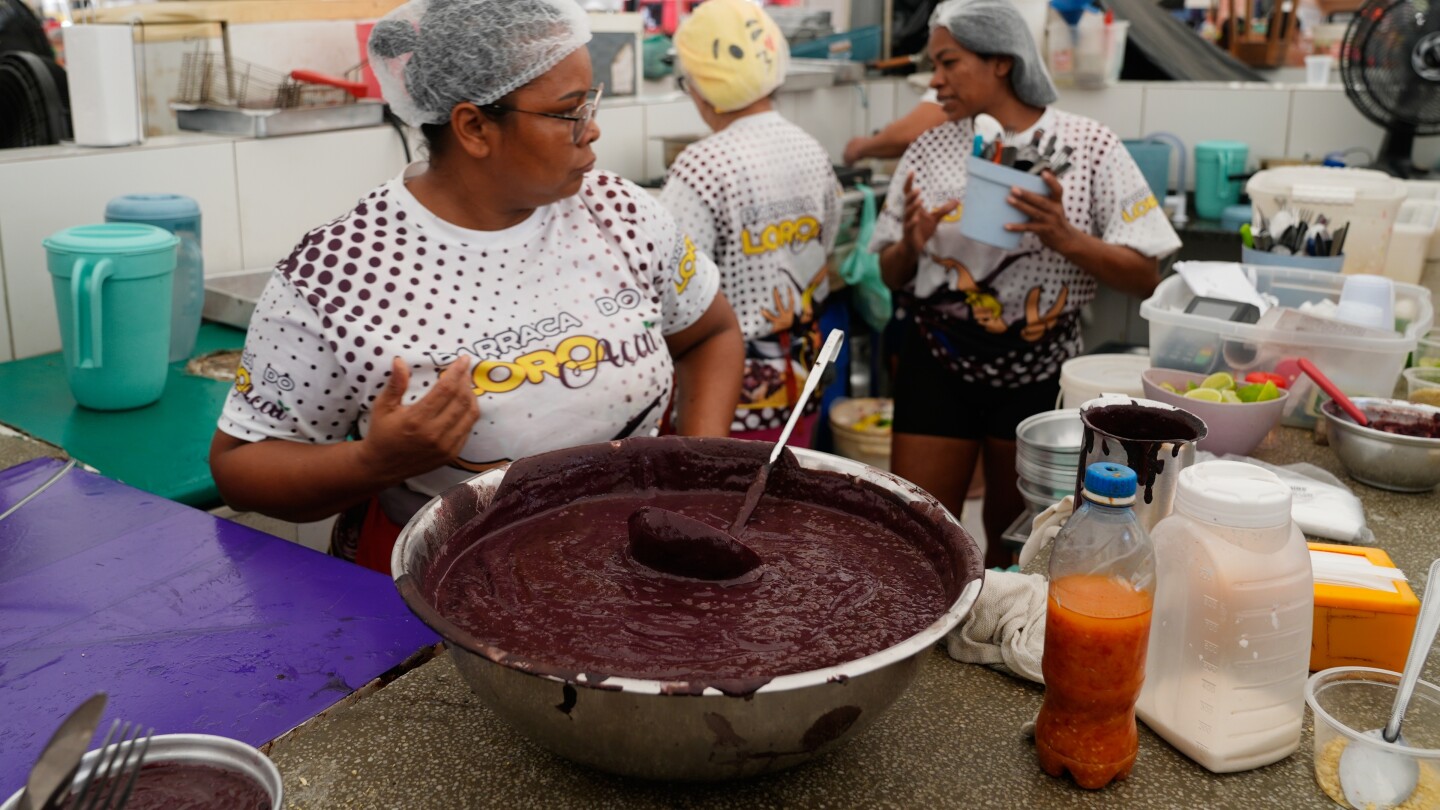
Visitors to the 30th United Nations Climate Summit in Belem, Brazil, are experiencing a cultural revelation in the form of a small purple berry. The acai bowls served by local vendors throughout the host city offer a stark contrast to the sweetened versions that have become a global health food sensation.
“I can’t say this is bad and I totally respect the cultural importance of it, but I still prefer the ice creamy version,” admitted Catherine Bernard, a 70-year-old French visitor, as she sampled a traditional acai bowl in downtown Belem. “Maybe if we add a little honey, some banana,” she suggested.
The traditional preparation, which serves as a window into the Amazon’s Indigenous food culture, comes without the sugar, granola, fresh fruits, or nuts that have become standard additions worldwide. Instead, it’s typically served at room temperature as a thick liquid made from whole berries and water, often sprinkled with tapioca flour.
A Staple, Not a Supplement
For Amazonian communities where the nutrient-rich berry has been cultivated for centuries, acai isn’t treated as a dessert or side dish—it’s often the main course.
“The acai coming from Indigenous people is the food when there’s no food. It was never a drink or an extra. It can be the main course for us,” explained Tainá Marajoara, a local activist and restaurant owner, who spoke to The Associated Press while wearing an Indigenous headdress.
As Marajoara served the dark purple liquid in a traditional Amazon vessel called a “cuia”—historically made from gourds—she emphasized the ecological importance of the fruit. “Acai is also the blood running in the forest,” she said, noting that the trees require a protected rainforest environment to thrive.
Her restaurant at the COP30 pavilion charges about $5 for a traditional bowl, comparable to prices for the sweetened versions found elsewhere in Brazil.
From Amazon Tradition to Global Sensation
The sweetened, frozen acai cream that has become a global phenomenon only emerged in the mid-1990s when surfers and jiujitsu fighters in Rio de Janeiro began popularizing it. That version—often topped with granola, fruits, and honey—eventually caught on with millions of tourists who carried their taste for it back to their home countries.
Today, even in many parts of Brazil, unsweetened acai can be difficult to find. Parents seeking the superfood’s benefits without added sugar must search for specialty stores selling unsweetened acai cream, as most popular brands only produce sweetened versions.
Economic and Environmental Significance
Nearly all acai consumed in the United States comes from Brazil, with Para state—where Belem is located—accounting for 90% of the country’s total production. Many Amazon communities depend economically on the harvest, which primarily feeds the industrial production of sweetened acai products.
However, U.S. consumers may soon face higher prices for acai smoothies due to a 50% tariff imposed by President Donald Trump on many Brazilian exports.
The harvesting process itself is physically demanding, requiring workers known as “peconheiros” to climb tall palm trees with minimal safety equipment to collect the berries. A full crate sells for around $50 at local markets in Brazil—a price that could drop significantly if U.S. imports decline. The United States remains the largest importer of Brazilian acai, which produces approximately 70,000 tons annually.
Climate Change Threatens Traditional Flavor
Environmental concerns are also impacting acai production. In some coastal Amazon areas with limited environmental protection, erosion is already altering the taste of the berries, making them saltier and less vibrant in color.
“The acai berry that belongs in our food culture comes from flood plain areas, from a healthy ecosystem,” Marajoara emphasized. “For acai to be healthy, the rainforest needs to be healthy too.”
For locals hosting the climate summit, introducing visitors to traditional acai isn’t just about preserving cultural heritage—it’s about raising awareness of how climate change and deforestation threaten both the rainforest ecosystem and the communities that depend on it.
By showcasing the berry in its original form, they hope to strengthen the connection between environmental protection, cultural preservation, and sustainable food production—core themes that align perfectly with the climate summit’s broader goals.
Fact Checker
Verify the accuracy of this article using The Disinformation Commission analysis and real-time sources.

21 Comments
Interesting update on Traditional acai berry dishes surprise visitors to Brazil climate summit, no sugar added. Curious how the grades will trend next quarter.
Good point. Watching costs and grades closely.
Good point. Watching costs and grades closely.
Interesting update on Traditional acai berry dishes surprise visitors to Brazil climate summit, no sugar added. Curious how the grades will trend next quarter.
I like the balance sheet here—less leverage than peers.
Good point. Watching costs and grades closely.
Exploration results look promising, but permitting will be the key risk.
Good point. Watching costs and grades closely.
Exploration results look promising, but permitting will be the key risk.
Nice to see insider buying—usually a good signal in this space.
Interesting update on Traditional acai berry dishes surprise visitors to Brazil climate summit, no sugar added. Curious how the grades will trend next quarter.
Good point. Watching costs and grades closely.
Silver leverage is strong here; beta cuts both ways though.
Good point. Watching costs and grades closely.
I like the balance sheet here—less leverage than peers.
Good point. Watching costs and grades closely.
The cost guidance is better than expected. If they deliver, the stock could rerate.
Good point. Watching costs and grades closely.
Good point. Watching costs and grades closely.
Production mix shifting toward World might help margins if metals stay firm.
Good point. Watching costs and grades closely.