


Listen to the article
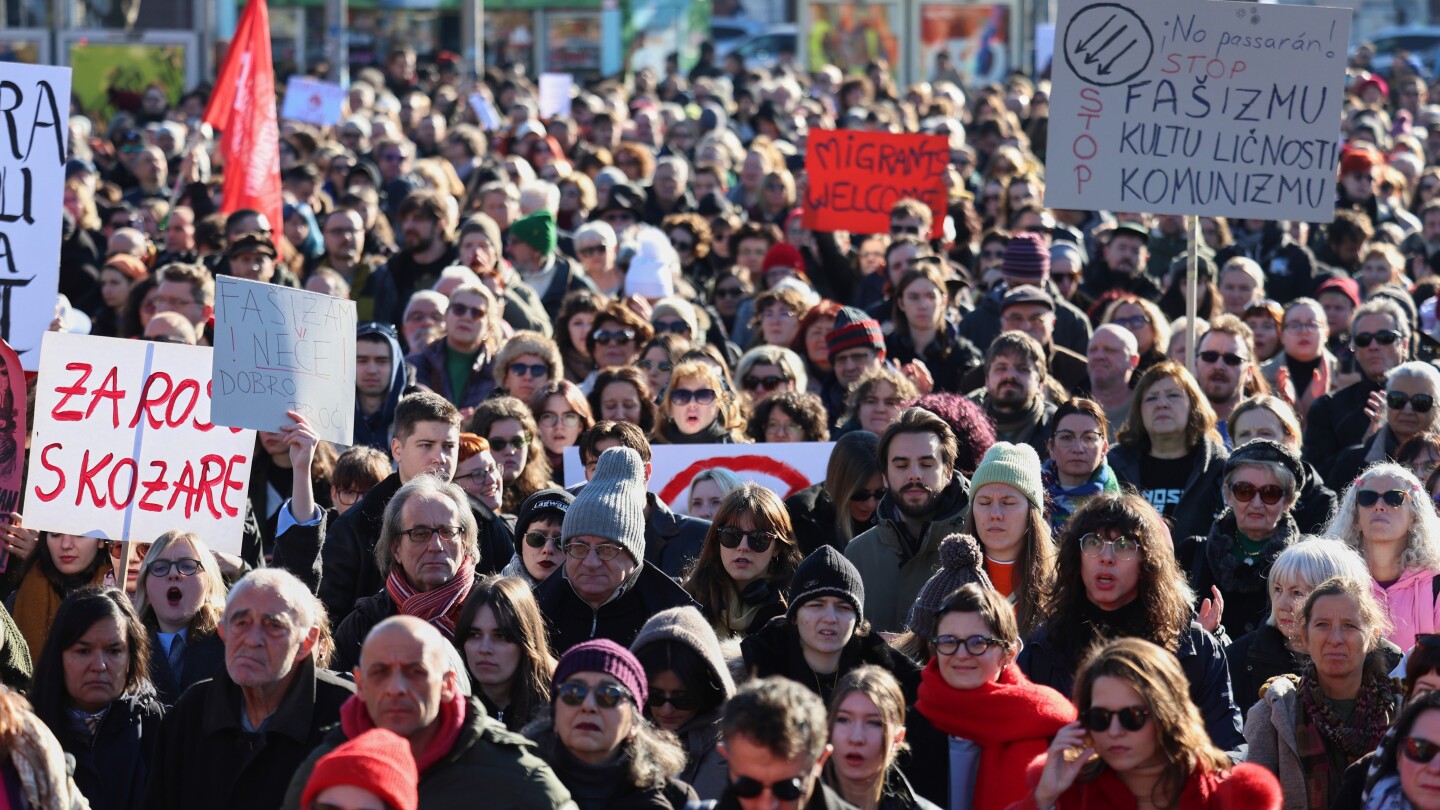
Thousands gathered across Croatia on Sunday to protest against a rising tide of far-right extremism that has sparked concerns over ethnic tensions and political polarization in the European Union nation.
The demonstrations, held under the banner “United against fascism,” took place in four major Croatian cities, including the capital Zagreb. Protesters chanted “we are all antifascists!” as they marched through city streets, vowing to counter what organizers described as attempts by right-wing groups to spread fear and silence opposition voices.
“All that has been happening around us is very dangerous,” journalist Maja Sever told participants at the Zagreb rally. “You have shown you will not be quiet but that we will fight for a democratic society.”
The protests come in response to a series of troubling incidents targeting ethnic minorities, particularly Croatia’s Serb population, as well as liberal groups and foreign workers. In November, extremists disrupted Serb cultural events in Zagreb and Split, raising fears of potential ethnic violence reminiscent of the 1991-95 Serb-Croat war that claimed more than 10,000 lives.
Demonstrators specifically called for authorities to take stronger action against far-right groups’ frequent use of symbols associated with Croatia’s World War II pro-Nazi Ustasha regime. The Ustasha puppet state ran concentration camps where tens of thousands of Serbs, Jews, Roma, and anti-fascist Croats were executed.
A protest declaration read at the gatherings stated: “We will not agree to treating national minorities as a provocation and to an idea of patriotism that draws its symbols from the darkest episode of our history.”
Counter-protesters appeared at some rallies, with groups of young men dressed in black gathering in the coastal cities of Rijeka and Zadar. According to reports from HRT public broadcaster, these groups shouted insults and threw firecrackers and red paint at the demonstrators.
“We have groups throwing smoke bombs and firecrackers and threatening violence, raising their right hand in the air and shouting ‘For the homeland — Ready,'” said Iva Davorija, an organizer of the Zadar march, referring to the Ustasha-era salute that has become a rallying cry for far-right groups.
Political analysts point to several factors behind Croatia’s rightward shift. Prime Minister Andrej Plenkovic’s conservative government formed a coalition with a far-right party following last year’s parliamentary election, marking the first time in years that an ethnic Serb party was excluded from government.
The trend intensified in July with a controversial mass concert by right-wing singer Marko Perkovic, known by his stage name “Thompson” after a U.S.-made machine gun. Perkovic has faced bans in several European cities for his use of the Ustasha slogan “For the homeland — Ready!” in one of his most popular songs, yet he remains widely popular in Croatia.
Prime Minister Plenkovic has rejected accusations that his government has turned a blind eye to the rise in far-right extremism and neo-fascist rhetoric. Instead, he has accused his leftist opponents of exaggerating the issue and deepening national divisions.
Croatia’s current tensions reflect the complex legacy of its history. After World War II, Croatia was part of Communist-run Yugoslavia until the federation’s violent breakup in the 1990s. During the Croatian War of Independence, ethnic Serbs in Croatia rebelled against the country’s secession, seizing control of portions of Croatian territory with the aim of joining Serbia.
Since the conflict ended, Croatia has pursued a path of Western integration, joining NATO in 2009 and becoming a member of the European Union in 2013. However, the weekend protests highlight that historical wounds and ethnic tensions remain close to the surface in Croatian society.
Sunday’s demonstrations represent a significant public response to concerns that Croatia’s democratic values and ethnic harmony are under threat from resurgent nationalist extremism.
Fact Checker
Verify the accuracy of this article using The Disinformation Commission analysis and real-time sources.

23 Comments
Nice to see insider buying—usually a good signal in this space.
I like the balance sheet here—less leverage than peers.
Good point. Watching costs and grades closely.
If AISC keeps dropping, this becomes investable for me.
I like the balance sheet here—less leverage than peers.
Good point. Watching costs and grades closely.
Silver leverage is strong here; beta cuts both ways though.
Good point. Watching costs and grades closely.
Silver leverage is strong here; beta cuts both ways though.
Good point. Watching costs and grades closely.
If AISC keeps dropping, this becomes investable for me.
Good point. Watching costs and grades closely.
The cost guidance is better than expected. If they deliver, the stock could rerate.
Exploration results look promising, but permitting will be the key risk.
Good point. Watching costs and grades closely.
I like the balance sheet here—less leverage than peers.
Good point. Watching costs and grades closely.
Silver leverage is strong here; beta cuts both ways though.
Good point. Watching costs and grades closely.
Silver leverage is strong here; beta cuts both ways though.
Good point. Watching costs and grades closely.
Uranium names keep pushing higher—supply still tight into 2026.
Good point. Watching costs and grades closely.