


Listen to the article
Israel Mourns “The Shield of Alumim”: The Last Hostage Remaining in Gaza
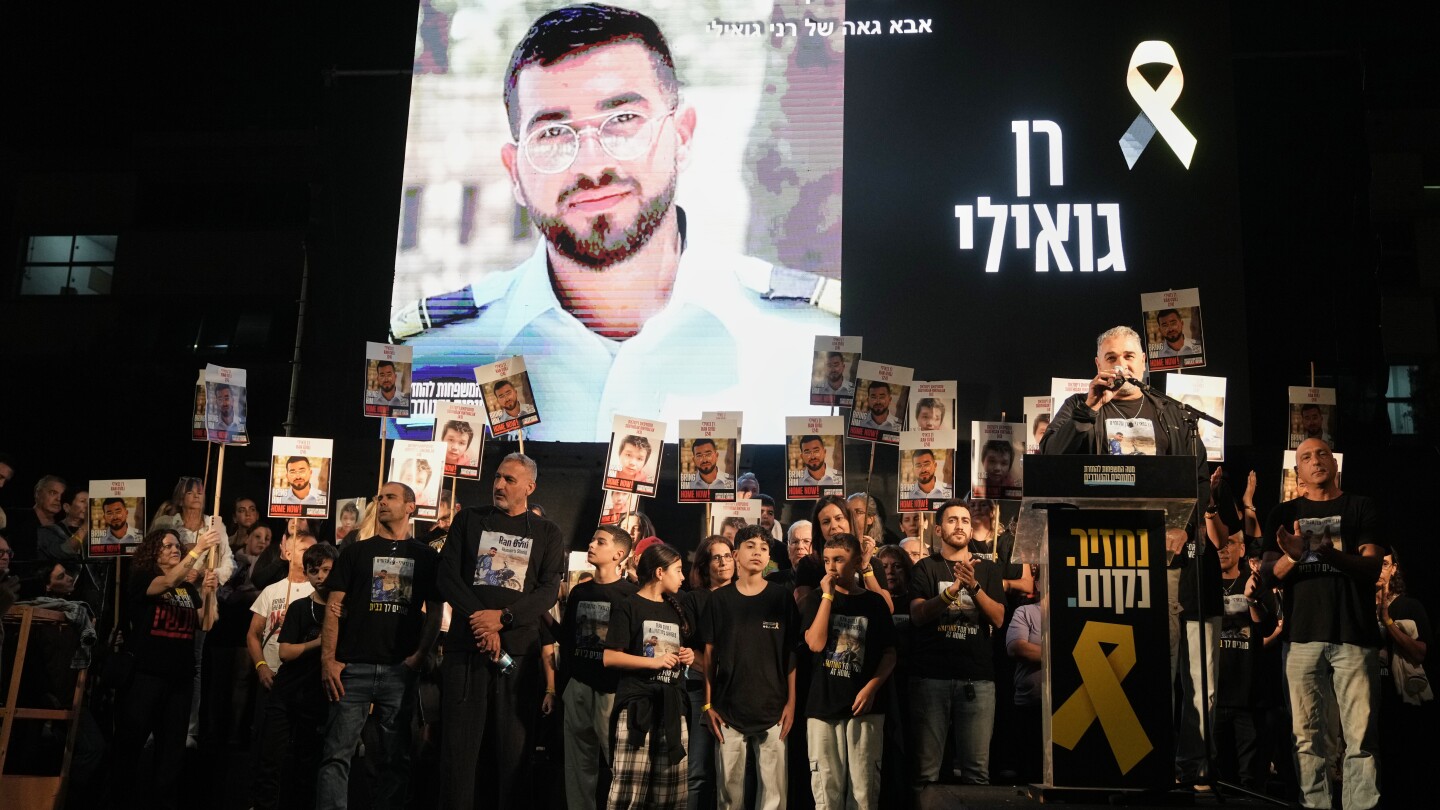
The remains of Ran “Rani” Gvili, a 24-year-old police officer killed while fighting Hamas militants during the October 7, 2023 attack, are the final Israeli hostage yet to be returned from Gaza. As Israel received remains of another hostage on Wednesday, the nation turned its attention to Gvili, whose body is still somewhere in the war-torn enclave.
“The first to go, the last to leave,” Gvili’s mother, Talik, wrote on Facebook Thursday, reflecting the family’s ongoing anguish. “We won’t stop until you come back.”
At the entrance to Kibbutz Alumim, one of the border communities targeted in the Hamas assault, a memorial sign displays Gvili’s smiling face in uniform. The inscription honors his heroism: “He fought a heroic battle, saving the lives of the kibbutz members. Since then he has been known as ‘Rani, the Shield of Alumim.'”
Unlike residents of other kibbutzim who were killed or taken hostage that day, Alumim’s residents largely survived—a fact many attribute to the defense mounted by Gvili and other security forces who repelled waves of militants. However, 22 foreign migrant workers in agricultural areas outside the kibbutz’s protective perimeter were killed during the attack, according to Israeli newspaper Haaretz.
Despite being on medical leave for a broken shoulder, Gvili rushed toward danger when he heard about the attack on the Nova Music Festival, where militants killed at least 364 people and took over 40 hostage in what became the largest civilian massacre in Israeli history.
Fellow officer Sgt. Richard Schechtman, who fought alongside Gvili, described his immediate command of the situation: “Rani was at the head of the team—because that’s who he was,” Schechtman told Israeli news site Ynet. “Rani and I were standing on the road. I saw the terrorists, but I hesitated… Then Rani pulled the pin and opened fire—and the whole team followed him.”
According to accounts from those who fought with him, Gvili moved to the western flank of the kibbutz to engage militants arriving in vehicles, despite suffering injuries to both his leg and arm. “He radioed his team to warn that more vehicles carrying terrorists were approaching,” his mother recounted. “He fought them alone, injured in both his leg and arm, and he took down those monsters.”
Israel’s military confirmed his death based on intelligence assessments four months after the attack, determining that militants had taken his body to Gaza.
The return of Gvili’s remains would complete the first phase of U.S. President Donald Trump’s 20-point ceasefire plan, which has already facilitated the exchange of other hostages for thousands of Palestinian prisoners held by Israel. The plan has also increased humanitarian aid to Gaza, where civilians have endured devastating conditions throughout the conflict.
Future phases of the ceasefire face significant challenges, including deploying an international security force in Gaza, disarming Hamas, and forming an interim Palestinian government supervised by an international board led by Trump.
For Gvili’s family—his parents, brother Omri, and sister Shira—the wait continues with mixed hope and dread. “We see all the other families whose sons came back and we see in their eyes that they have relief,” his sister said. “This is why it’s so important. Because we want to move on with our life and just remember Rani.”
She described her brother as more than just a hero—he was protective yet playful, told jokes that everyone laughed at even when they weren’t funny, loved playing guitar and singing “The House of the Rising Sun,” and had a tattoo of his dog Luna, whom the family now cares for.
Gvili’s parents worry their son’s case might follow the painful precedent of soldiers like Hadar Goldin, whose body was only returned to Israel last month after being held in Gaza since 2014, or Ron Arad, an airman captured in Lebanon in 1988 who has never been found.
“We pray, of course, that he will not be another Ron Arad or Goldin,” Itzik Gvili told Kan News. “That we don’t drag it out for many more years.”
With determination and heartache, he added: “As far as I am concerned, until Ran comes back, he is alive. I have nothing else to hope for.”
Fact Checker
Verify the accuracy of this article using The Disinformation Commission analysis and real-time sources.

8 Comments
Ran Gvili’s story is a powerful testament to the human cost of the Israel-Gaza conflict. His courageous actions highlight the need for a peaceful resolution that prevents such tragedies in the future.
This is a somber reminder of the human tragedy unfolding in the region. Ran Gvili’s heroism is inspiring, but his death is heartbreaking. I hope his family and community can find some solace in his brave sacrifice.
The loss of Ran Gvili, the ‘Shield of Alumim’, is truly devastating. His selfless actions in defending his community deserve the highest praise. I hope his remains can be repatriated soon to provide closure for his loved ones.
Ran Gvili’s story is a powerful reminder of the human cost of the conflict. His heroic defense of his community is inspiring, but also deeply saddening. I hope his family can find some comfort in his bravery.
It’s admirable that Ran Gvili sacrificed his life to save others. I hope Israel’s efforts to recover his remains and bring closure to his family are successful. This is a sad reminder of the ongoing conflict’s heavy toll.
This is a tragic story. Ran Gvili’s selfless act of heroism, defending his community, is deeply moving. I hope his remains can be returned to his family for proper burial soon.
This is a profoundly tragic story. Ran Gvili’s sacrifice to protect his fellow citizens is a testament to the human toll of the Israel-Gaza conflict. I hope his remains can be returned to his family soon.
The loss of young Ran Gvili, the ‘Shield of Alumim’, is heartbreaking. His bravery in protecting his kibbutz during the Hamas attack deserves the utmost respect and recognition.