


Listen to the article
Chilean Telescope Captures Breathtaking Image of Cosmic Butterfly
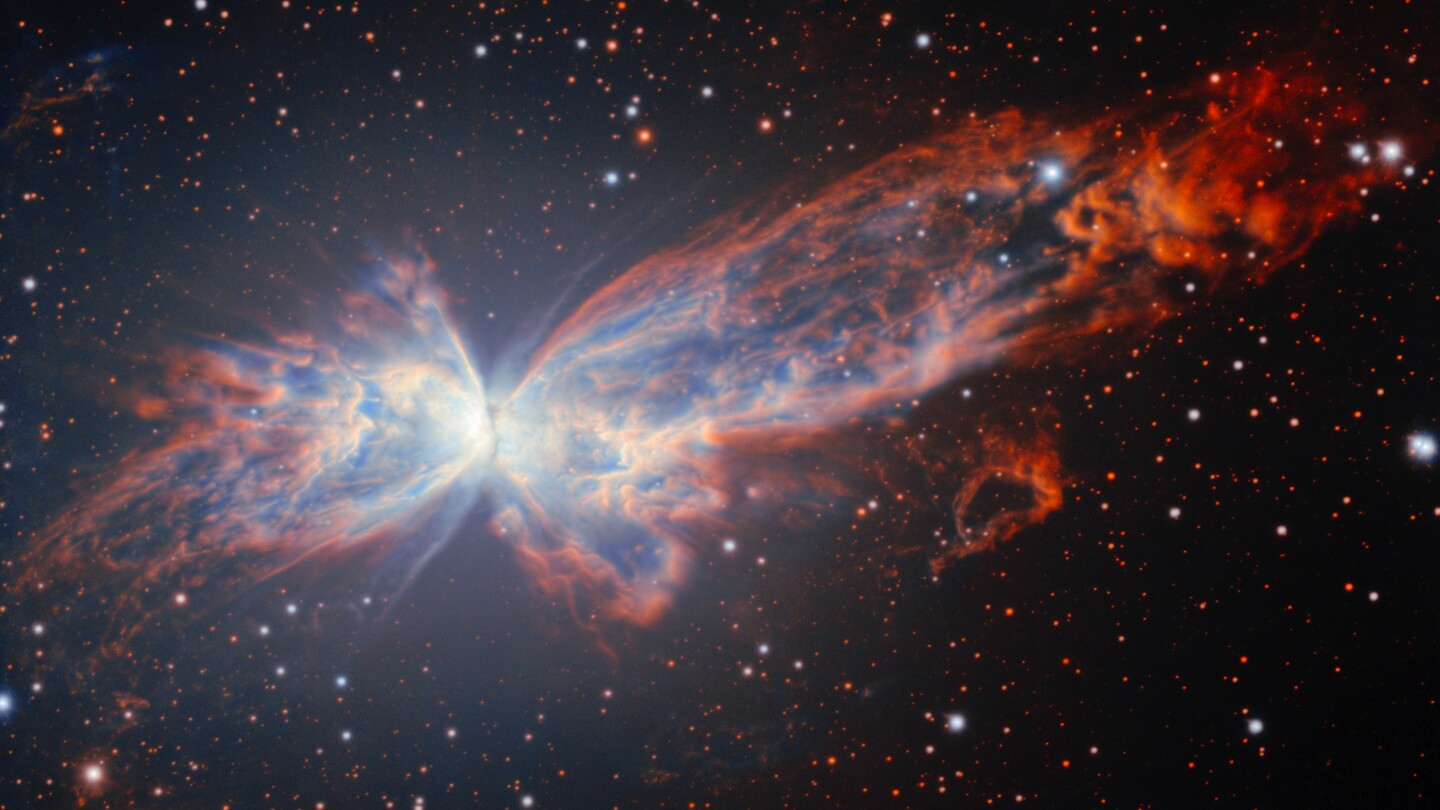
A remarkable new image of the celestial formation known as the Butterfly Nebula has been released by the National Science Foundation’s NOIRLab, showcasing one of the universe’s most elegant structures in unprecedented detail.
The striking photograph, captured last month by the Gemini South telescope in Chile, reveals the nebula’s distinctive butterfly-shaped gas clouds illuminated against the backdrop of deep space. Located between 2,500 and 3,800 light-years from Earth in the constellation Scorpius, this cosmic wonder demonstrates the extraordinary beauty that emerges during stellar evolution.
Astronomers explain that the nebula’s distinctive shape results from processes occurring around an aging white dwarf star at its center. As the star reached the end of its main lifecycle, it expelled its outer layers of gas, creating the symmetrical, wing-like formations that extend outward from the central star. The intense heat still radiating from the white dwarf causes these expelled gases to glow brilliantly, creating the luminous spectacle visible through powerful telescopes.
The bipolar structure—featuring two distinct lobes extending in opposite directions—is characteristic of certain planetary nebulae, despite their misleading name, as they have nothing to do with planets. Instead, these formations represent a relatively brief but visually spectacular phase in stellar evolution.
“Planetary nebulae like the Butterfly Nebula provide crucial windows into understanding stellar lifecycles,” explained Dr. Jennifer Lotz, Director of Gemini Observatory. “They show us the fate that awaits many stars, including potentially our own sun, billions of years from now.”
The image’s release marks a special milestone for the International Gemini Observatory, which is celebrating 25 years of astronomical observations. In a thoughtful nod to science education and community involvement, schoolchildren from Chile were given the honor of selecting this celestial target for the anniversary observation.
The International Gemini Observatory operates two 8.1-meter telescopes: Gemini South in Chile and Gemini North in Hawaii. Together, these instruments provide astronomers with comprehensive coverage of both the northern and southern skies, enabling scientific discoveries across the entire celestial sphere.
This latest image of the Butterfly Nebula builds upon previous observations by other observatories, including the Hubble Space Telescope, which has also captured images of this formation. Each new observation with different instruments reveals additional details about the nebula’s structure and composition, adding to astronomers’ understanding of these complex cosmic phenomena.
Planetary nebulae like the Butterfly remain visible for only about 10,000 years before the expelled gases disperse into the surrounding interstellar medium—a mere blink in cosmic timescales. This relatively fleeting nature makes detailed observations particularly valuable to scientists studying stellar evolution.
The exceptional clarity of the new image can be attributed to the advanced adaptive optics systems employed by the Gemini South telescope, which correct for atmospheric distortion and allow for sharper views of distant cosmic objects.
As astronomical imaging technology continues to advance, scientists anticipate even more detailed observations of nebulae and other deep space objects in the coming years, potentially revealing new insights into the processes that shape our universe.
The Associated Press Health and Science Department receives support from the Howard Hughes Medical Institute’s Department of Science Education and the Robert Wood Johnson Foundation. The AP maintains sole responsibility for all content.
Fact Checker
Verify the accuracy of this article using The Disinformation Commission analysis and real-time sources.

14 Comments
As someone fascinated by space exploration, I find this image of the Butterfly Nebula to be both beautiful and thought-provoking. It’s a reminder of the incredible complexity and diversity of our universe, and how much there is still to discover.
I couldn’t agree more. Seeing these kinds of breathtaking images really puts things into perspective and inspires a sense of wonder about the cosmos. There’s still so much left to uncover about the origins and evolution of our universe.
While the Butterfly Nebula is undoubtedly a stunning celestial sight, I can’t help but wonder about the scientific significance of this observation. What new insights might astronomers gain from studying the structure and composition of this nebula?
That’s a great point. Detailed observations of phenomena like the Butterfly Nebula can provide valuable data points for understanding the life cycles of stars and the broader processes shaping our universe. I’m sure the scientific community is eager to analyze this new image and see what it reveals.
While the Butterfly Nebula is undoubtedly a sight to behold, I’m curious to know more about the specific processes that led to its formation. What can this image tell us about the life cycle of the star at its center, and how the expelled gases create such a unique and symmetrical structure?
That’s a great question. The Butterfly Nebula is believed to be the result of a dying star expelling its outer layers, which then get shaped by the intense heat and radiation still emanating from the central white dwarf. Understanding the specific mechanisms at play here could provide valuable insights into the final stages of stellar evolution.
I’m always in awe of the incredible technological feats that allow us to capture such detailed images of distant cosmic objects. The fact that we can see the Butterfly Nebula, which is thousands of light-years away, in such vivid detail is a true testament to the advancement of modern astronomy.
Absolutely. The continued development of telescopes and imaging technologies has opened up entirely new windows into the universe. I can’t wait to see what other wonders the Gemini South telescope and other observatories uncover in the years to come.
The level of detail captured in this telescope image is truly remarkable. I can’t imagine how difficult it must be to photograph such a distant and dynamic celestial object. Kudos to the astronomers for this incredible achievement!
Absolutely. The ability of modern telescopes to reveal the hidden beauty of the cosmos is simply astounding. This image really highlights the wonders that are waiting to be discovered out there.
What an incredible image from the Gemini South telescope! The Butterfly Nebula is such a stunning example of the beauty and complexity of stellar evolution. I’m always amazed by the intricate structures that form around dying stars.
Yes, the symmetry and vibrant colors are mesmerizing. It’s fascinating to learn how the nebula’s distinctive shape is created by the star’s final stages of life.
Wow, the Butterfly Nebula is such a perfect name for this celestial formation. The way the gas clouds fan out in a symmetrical pattern is simply breathtaking. I wonder what other spectacular sights the Gemini South telescope has uncovered?
That’s a great question. The Gemini Observatory has access to some of the most advanced astronomical equipment in the world, so I’m sure they’ve captured many other stunning images of distant galaxies, nebulae, and other cosmic phenomena.