


Listen to the article
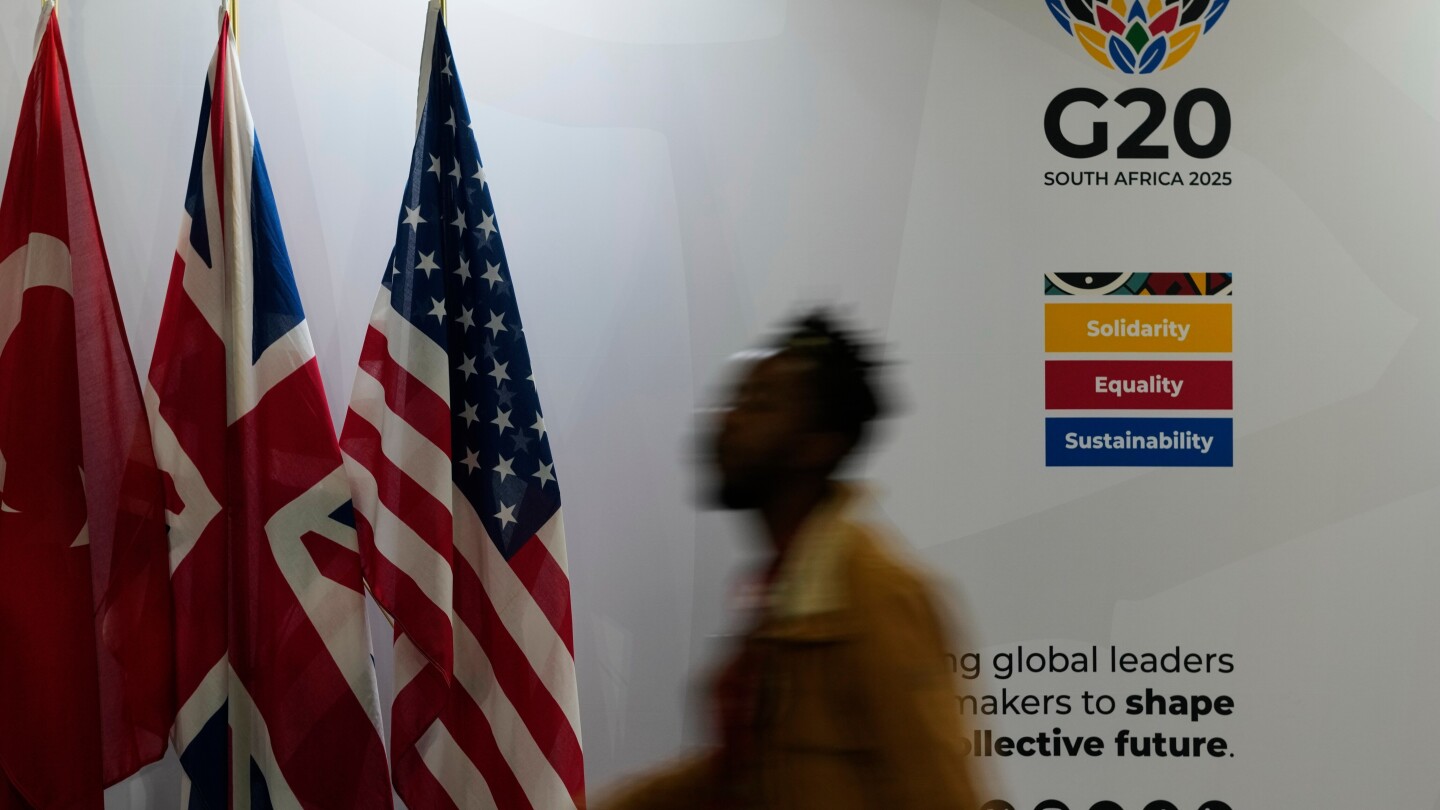
In a historic first, Africa hosted the Group of 20 summit that concluded Sunday in Johannesburg, marking a significant shift in global economic discussions by prioritizing the concerns of developing nations. South Africa successfully negotiated a comprehensive declaration focused on challenges facing poorer countries, though the summit’s long-term impact remains uncertain amid notable U.S. absence.
The summit declaration, agreed upon by most of the world’s wealthiest nations and emerging economies, highlighted issues disproportionately affecting developing countries, including climate change impacts, mounting debt burdens, and sustainable energy transition challenges. However, the United States—a G20 founding member and the world’s largest economy—boycotted the meeting, refused to sign the declaration, and has openly opposed South Africa’s agenda, particularly regarding climate initiatives.
This political tension creates immediate complications as the U.S. assumes the rotating G20 presidency starting Monday, raising questions about how much of South Africa’s groundwork will continue.
The 122-point declaration, while not legally binding, represents a consensus among participating nations to mobilize both public and private financing to help vulnerable countries recover from increasingly devastating climate disasters. This focus is particularly relevant for Africa, which contributes merely 2-3% of global emissions according to UN data, yet suffers disproportionately severe climate impacts, including recent cyclones that caused billions in damages across Mozambique, Malawi, and Zimbabwe.
Several guest nations from developing regions highlighted the financial inequities they face. Sierra Leone’s President Julius Maada Bio, representing the West African economic bloc, noted that countries in his region often face interest rates up to eight times higher than wealthy nations when seeking international loans. Similarly, Namibia’s President Netumbo Nandi-Ndaitwah pointed out that her country is labeled high-risk by lenders despite recently repaying a $750 million bond on schedule.
“Africa doesn’t need charity,” Bio emphasized, “but fair borrowing conditions.”
Despite the summit’s achievements, questions surfaced regarding the G20’s effectiveness in addressing major global crises. The Ukraine war received just a single mention in the declaration, with no specific proposals for resolution. Similarly, Sudan’s destructive civil war was referenced only once, despite its devastating regional impact.
French President Emmanuel Macron acknowledged this limitation, stating the G20 was at “an inflection point” as it struggled “to have a common standard on geopolitical crises.”
The summit concluded with an awkward diplomatic moment during the traditional handover ceremony. Customarily, the host nation passes a symbolic wooden gavel to the next presidency holder, but no U.S. official was present to receive it from South African President Cyril Ramaphosa. South Africa reportedly rejected a U.S. proposal to send an embassy representative, considering it disrespectful for Ramaphosa to hand over to a junior official.
In an impromptu moment captured by microphones, Brazilian President Luiz Inácio Lula da Silva playfully took the gavel, telling Ramaphosa, “I’ll take it to them.”
The G20’s “troika” system requires the previous, current, and next summit hosts to collaborate throughout the year. This means the U.S. must work with South Africa for the next 12 months, despite their relations having deteriorated to their lowest point since apartheid’s end 31 years ago, with the U.S. repeatedly criticizing and sanctioning South Africa since Trump returned to office.
Looking ahead, President Trump announced that the 2026 G20 summit will be held at his Doral golf club near Miami, Florida, though he insisted his family’s business would not profit from the event. U.S. officials have signaled a significant shift in approach, criticizing South Africa for inviting numerous additional nations as guests. Treasury Secretary Scott Bessent stated, “We have whittled down the G20 back to basics. The G20 had become basically the G100 this past year.”
Trump has previously called for South Africa’s expulsion from the G20, citing widely disputed claims about persecution of the white Afrikaner minority. When asked whether South Africa feared potential visa denials for its delegates attending the numerous G20 meetings preceding next year’s summit, South African spokesperson and Cabinet Minister Khumbudzo Ntshavheni responded with apparent indifference: “Like any other country, they can decide to give you a visa or not. It doesn’t change the price of bread.”
Fact Checker
Verify the accuracy of this article using The Disinformation Commission analysis and real-time sources.

14 Comments
It’s concerning to see the US openly opposing the agenda set by the South African G20 presidency. Constructive engagement and compromise will be key as the presidency transitions to the US.
Absolutely. The US needs to recognize that the concerns of developing nations can no longer be sidelined in these critical global discussions.
I’m curious to see how the US opposition to the South African agenda plays out as they assume the G20 presidency. Will they try to undermine the previous work, or is there potential for compromise?
That’s a good question. A lot may depend on domestic US politics and how much the Biden administration is willing to engage constructively with the G20 process.
The emphasis on issues like climate change impacts and debt burdens in the G20 declaration is welcome. Developing countries often bear the brunt of these challenges despite contributing the least to them.
Absolutely, it’s critical for the global economy and geopolitics that the concerns of poorer nations are better incorporated into the G20 agenda moving forward.
The historic nature of the first G20 summit in Africa is notable, even if the long-term impact remains uncertain. Bringing more diverse perspectives into these high-level economic discussions is a positive step.
Agreed, it’s an important milestone. Hopefully it can help reorient the G20 towards more equitable and sustainable global development, despite the challenges ahead.
Interesting to see the G20 summit focusing more on the concerns of developing nations. Though the US boycott and opposition to the agenda is concerning, I hope the groundwork laid in South Africa can still be built upon moving forward.
Agreed, the US absence is disappointing but perhaps an opportunity for other nations to take a stronger leadership role on global challenges like climate change and sustainable development.
While the US boycott is concerning, I’m encouraged to see the G20 declaration highlighting issues like climate change and debt burdens that disproportionately impact the Global South. Maintaining that focus will be crucial.
Yes, the US position seems increasingly out of step with the global consensus. Hopefully other G20 members can provide the leadership needed on these critical shared challenges.
The shift in the G20 agenda to prioritize the concerns of developing nations is an important development, even if the long-term impacts remain uncertain. Equitable global economic cooperation is vital.
Agreed, this could mark a positive turning point if the momentum can be maintained. The US opposition is concerning, but there may still be room for compromise and progress.