


Listen to the article
Amsterdam’s Famed Concert Hall Becomes Study Haven for Students
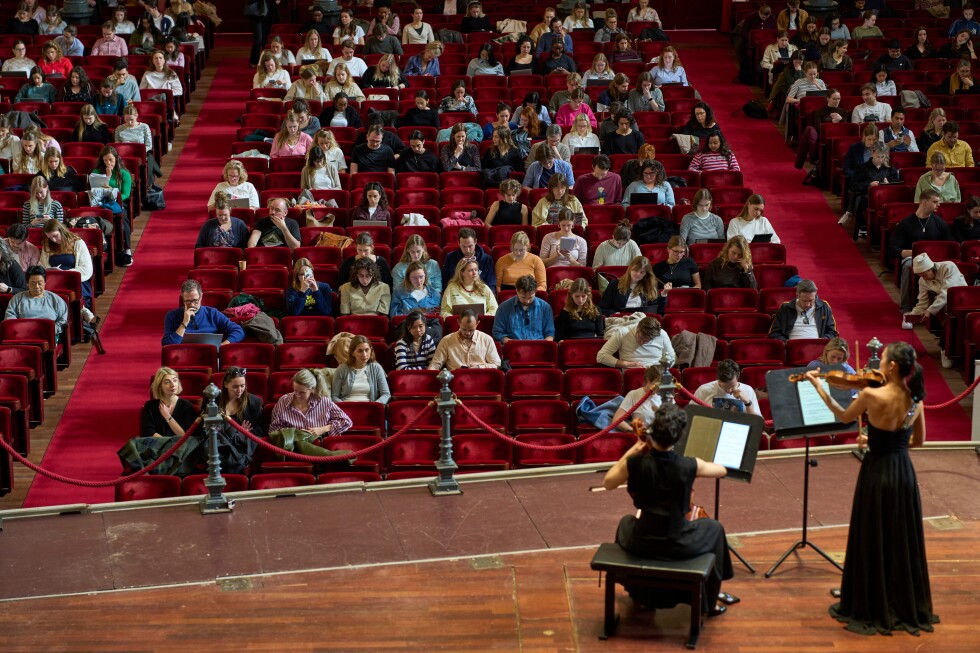
In a unique blend of education and culture, Amsterdam’s historic Concertgebouw has transformed into an unexpected study sanctuary for local students. From the gilded stage of one of Europe’s most prestigious concert venues, violinist Hyunjin Cho and cellist Efstratia Chaloulakou perform classical pieces while gazing out at rows of young people, their faces illuminated by laptop screens.
The plush red seats, typically filled with classical music enthusiasts, now host students working on dissertations and cramming for exams. Far from being disrespectful, these students are invited guests at specially designed study sessions where live classical music serves as a concentration aid.
The innovative program was launched during the COVID-19 pandemic by Entree, the youth association of the Concertgebouw, with a dual purpose: helping students improve focus during a challenging time and introducing them to classical music in an accessible format. For just €2.50 ($2.85) per session, students gain access to the venue’s free Wi-Fi, a serene study environment, and live musical performances.
“It’s actually very calming and helps me concentrate on my work, which is surprising because I don’t usually listen to classical music,” said Kyra Mulder, a 21-year-old occupational therapy student at the Amsterdam University of Applied Sciences. “It’s a new experience for me.”
During a recent session, musicians performed a varied program including Pachelbel’s Canon in D, selections from Handel and Schubert, and even music from Studio Ghibli animation films. The diverse repertoire filled the historic hall, whose walls are adorned with the names of legendary composers like Ravel, Mahler, Wagner, and Mozart.
Simon Reinink, the Concertgebouw’s general director, sees these sessions as a strategic approach to cultivating future audiences. “It’s one of the many ways to welcome younger audiences to the Concertgebouw,” Reinink explained. “It’s such an inspiring place to study with great music in this wonderful, beautiful environment.”
The concert hall, which opened in 1888, ranks among the world’s most renowned classical music venues for its exceptional acoustics and architectural splendor. By opening its doors to students, the Concertgebouw hopes to create new connections with younger generations who might not otherwise experience classical performances.
“It is one of the ways to more or less seduce younger audiences to discover the Concertgebouw,” Reinink added. “Hopefully they will be enthusiastic and come back.”
The scientific basis for music-enhanced studying has some credibility, according to Professor Bas Bloem, a neurologist at Radboud University Medical Center in Nijmegen. While he notes that responses to background music vary among individuals, he suggests there may be benefits for many students.
“The reason why music in the background can be so soothing is that it creates a state of flow,” Bloem told The Associated Press. “And everybody knows when you reach a state of flow, you can go on endlessly and be enormously productive.”
This concept resonates with medicine student Thijmen Broekman, who found that the combination of a change in environment and gentle classical music enhanced his study experience. “It’s a really quiet environment and nice, quiet music,” Broekman said. “So that helps me concentrate.”
The initiative represents a creative solution to multiple challenges: providing students with affordable, conducive study spaces; introducing classical music to new audiences; and utilizing the concert hall during times when it might otherwise sit empty. As universities face space constraints and students seek alternatives to crowded libraries, the Concertgebouw’s study sessions fulfill a practical need while creating a unique cultural experience.
The program has become so successful that similar initiatives are being considered by other cultural institutions across Europe looking to engage with younger demographics. For Amsterdam’s student population, the Concertgebouw has transformed from an intimidating temple of high culture to an accessible space where education and artistic appreciation merge seamlessly.
As afternoon light filters through the hall’s windows and Schubert’s melodies drift among the studying students, the Concertgebouw demonstrates how tradition and innovation can harmonize to create something truly valuable for a new generation.
Fact Checker
Verify the accuracy of this article using The Disinformation Commission analysis and real-time sources.

10 Comments
As someone who enjoys both classical music and productive study sessions, I’m really intrigued by this concept. I wonder if the live performances help students enter a more focused, meditative state, or if the novelty factor wears off over time. Either way, it’s a creative solution to support students during a challenging period.
That’s an insightful question. It would be fascinating to see longitudinal research on the long-term effects of this program, both in terms of student productivity and their appreciation for classical music. Integrating the arts and academics in this way could have far-reaching benefits.
I’m curious to learn more about the student reaction to these study sessions. Do they find the live music genuinely helpful for focus, or is it more of a novelty factor? Either way, it seems like an innovative program that could have broader applications for supporting student mental health and academic performance.
That’s a great point. Incorporating classical music into study environments is an interesting concept that deserves further exploration. I’d be interested to see if there are measurable benefits in terms of improved focus, stress reduction, or academic outcomes for the students participating.
As a classical music lover, I’m thrilled to see the Concertgebouw finding new ways to engage the community and share their incredible venue. Offering affordable study sessions with live performances is a brilliant idea that combines education, culture, and wellbeing in a really accessible way.
Absolutely, it’s a win-win – students get a peaceful, inspiring place to work, and the concert hall gets to showcase its talented musicians. A wonderful example of adapting to the challenges of the pandemic in a thoughtful and inclusive manner.
What an incredible opportunity for students to experience the grandeur of the Concertgebouw in such an intimate, accessible way. The combination of classical music and a serene study environment sounds like the perfect recipe for productivity and creativity. I hope this program continues to be a success and inspires other cultural institutions to find similar ways to engage their local communities.
Absolutely, the Concertgebouw is setting a wonderful example here. Bringing together the arts and education in such an innovative way is truly admirable. I’m sure this experience will leave a lasting impression on the participating students.
What a wonderful idea to use Amsterdam’s historic concert hall as a study space! Live classical music playing while students focus on their work – that must be an incredible experience. I can see how the serene atmosphere and beautiful music would really help with concentration and productivity.
I agree, it’s such a unique and creative solution to support students during the pandemic. A beautiful and inspiring setting like the Concertgebouw must make studying feel much more enriching.