


Listen to the article
Spain and Catholic Church Sign Landmark Agreement on Clergy Abuse Compensation
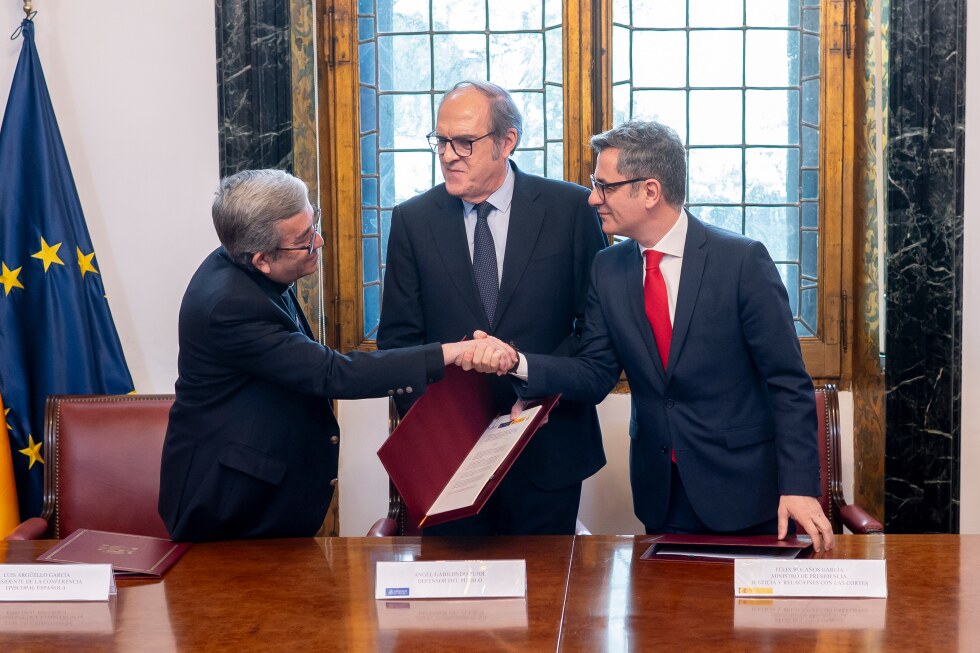
Spain’s government and Catholic bishops formalized a groundbreaking agreement Monday that establishes a new system for compensating victims of clerical sexual abuse whose cases cannot be prosecuted due to statutory limitations or the death of perpetrators.
The accord, set to take effect on April 15, grants Spain’s ombudsman final decision-making authority in determining compensation amounts for victims. This rare concession by the Catholic hierarchy comes after months of negotiations between the left-wing government and church authorities, following criticism of the church’s original in-house compensation proposal.
“We wanted to exclude references to scales and quantities; that’s not what this is about,” said Archbishop Luis Argüello, president of the Spanish Episcopal Conference, explaining that the agreement does not specify fixed compensation amounts. “We’ve planned for the teams to start working on how to do it, but the text doesn’t establish a range or a specific amount.”
Justice Minister Félix Bolaños emphasized that compensation would be determined case by case, taking into account factors such as abuse severity, the victim’s age, and whether abuse was recurring. “Criteria are set to arrive at fair compensation, which should not be determined by a single figure,” Bolaños stated.
The agreement provides victims a one-year window to file claims, starting next month. What makes the Spanish process unique compared to similar initiatives in other Western European countries is the direct involvement of the state in determining compensation outcomes.
Under the new system, victims will submit initial petitions to Spain’s Justice Ministry, which will forward them to the ombudsman for review. The ombudsman will then propose a compensation package for the church’s committee to assess. If no agreement can be reached, the case will advance to a joint committee with representatives from the church, the ombudsman’s office, and victims’ associations. Should that committee fail to reach consensus, the ombudsman’s decision will prevail.
Bolaños described the arrangement as unprecedented, calling it a world first in which “the state has the final say and the church pays the reparations due to each victim.”
Spain, once considered a Catholic stronghold, has in recent years begun confronting its legacy of clerical abuse, largely due to investigative reporting by the newspaper El País. The country’s Parliament tasked the ombudsman with conducting a comprehensive investigation, which culminated in a damning 800-page report released in 2023.
The report examined 487 known cases of sexual abuse and included survey data suggesting the total number of victims could reach into the hundreds of thousands. Spain’s bishops rejected this estimate, countering that their own investigation had identified 728 sexual abusers within the church since 1945. The bishops noted that most offenses occurred before 1990 and that approximately 60 percent of the perpetrators are now deceased.
The agreement represents a significant shift in Spain’s approach to addressing historical clerical abuse. Unlike traditional church-run compensation programs in other countries, Spain’s system incorporates state oversight with binding authority to ensure victims receive appropriate redress.
This development comes amid growing pressure across Europe for religious institutions to acknowledge and make amends for past abuses. While compensation plans exist in several Western European nations, Spain’s model establishes a new precedent for government intervention in ecclesiastical matters related to abuse.
As the April implementation date approaches, both government officials and church representatives express hope that the new system will provide long-overdue justice for victims while acknowledging the grave harm inflicted by clergy members over decades.
Fact Checker
Verify the accuracy of this article using The Disinformation Commission analysis and real-time sources.

9 Comments
Clergy abuse is a tragic issue that has affected many countries. I hope this agreement in Spain sets a positive precedent for how the church and authorities can work together to support victims.
The lack of fixed compensation amounts seems wise, as every case is unique. I trust the ombudsman will carefully consider all factors to determine fair compensation.
While the church’s original proposal was criticized, I’m glad they’ve now agreed to give the ombudsman final decision-making power on compensation. This should help ensure victims’ interests are prioritized.
It’s encouraging to see the government and church collaborating on this sensitive issue. Hopefully this leads to meaningful justice and closure for the victims.
This is a complex and sensitive situation, but I’m glad to see progress being made. Giving the ombudsman final decision-making power is a meaningful concession by the church.
Determining compensation on a case-by-case basis seems like the fairest approach. I hope the process is transparent and provides a sense of justice for the victims.
While the details still need to be worked out, this agreement between Spain and the Catholic Church is an important step forward. Clergy abuse victims deserve compensation and closure.
This is an important agreement to provide compensation and justice for victims of clergy abuse in Spain. It’s good to see the government and church working together, even if the details are still being worked out.
Determining compensation on a case-by-case basis seems like the fairest approach, rather than a one-size-fits-all scale. I hope the process is transparent and victim-centered.