


Listen to the article
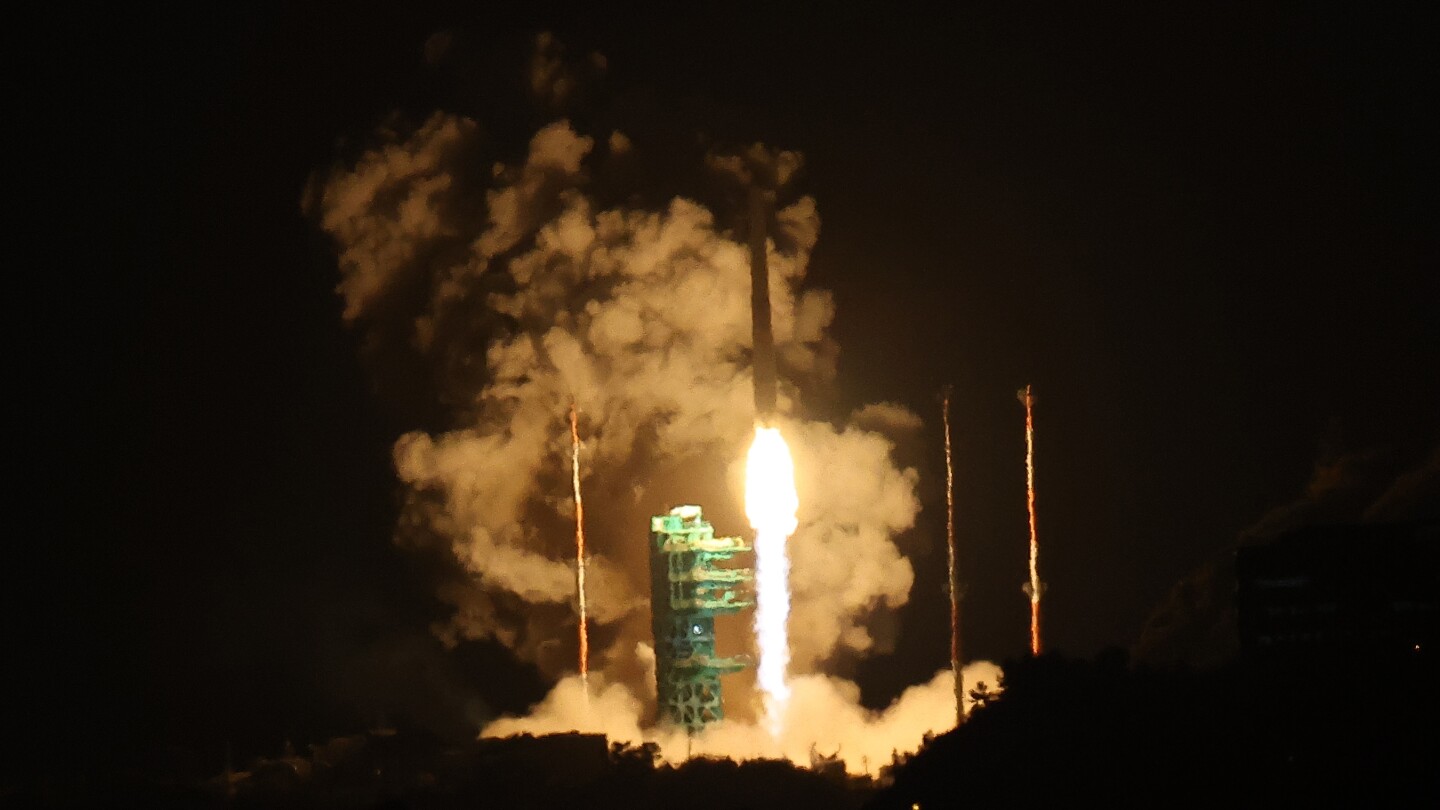
South Korea successfully launched its largest satellite yet aboard the domestically developed Nuri rocket early Thursday, marking a significant advancement in the nation’s space program and growing aerospace capabilities.
The three-stage Nuri rocket lifted off from the Naro Space Center on an island near Goheung county, carrying a 516-kilogram (1,137-pound) science satellite and 12 microsatellites. All payloads were successfully placed into their target orbit approximately 600 kilometers (372 miles) above Earth, according to aerospace officials.
The Korea Aerospace Administration confirmed that the main satellite established contact with a South Korean ground station in Antarctica roughly 40 minutes after the 1:55 a.m. liftoff. Officials verified the satellite’s normal function and the successful deployment of its solar panels. The satellite subsequently connected with ground stations in Daejeon, South Korea, and Svalbard, Norway, in addition to maintaining further communication with the King Sejong Station in Antarctica.
By Thursday afternoon, five of the 12 microsatellites had made contact with ground stations, with the remainder expected to establish communications according to a predetermined sequence.
Science Minister Kyunghoon Bae hailed the successful launch as confirmation of South Korea’s independent space launch capabilities. “Building on today’s success, we will steadfastly pursue the development of next-generation launch vehicles, lunar exploration and deep-space missions,” he said.
The launch represented a pivotal moment for South Korea’s aerospace industry, as it marked the first time a private company, Hanwha Aerospace, assembled the rocket under a technology transfer arrangement with the Korea Aerospace Research Institute (KARI), the country’s national space agency. This public-private partnership signals South Korea’s efforts to commercialize its space technology and foster a competitive aerospace sector.
The primary satellite carries sophisticated scientific equipment, including a wide-range airglow camera for observing auroral activity, along with systems for measuring plasma and magnetic fields. It also contains facilities for testing life-science experiments in the space environment.
The dozen smaller “cube” satellites were developed by university teams and research institutions across South Korea. These microsatellites feature various specialized equipment, including GPS systems to study Earth’s atmosphere, infrared cameras to track ocean plastic pollution, and experimental solar cells and communication equipment.
Thursday’s mission was South Korea’s fourth launch involving the Nuri rocket and its first since May 2023, when it successfully placed a 180-kilogram observation satellite into orbit. The country’s initial Nuri launch attempt in October 2021 failed to properly deliver its payload.
South Korea has outlined an ambitious space program with additional Nuri launches planned for 2026 and 2027. These future missions aim to further advance the country’s space technologies and industries while narrowing the capabilities gap with leading Asian space powers such as China, Japan, and India.
The Nuri rocket represents a significant achievement in South Korean engineering. It’s a three-stage vehicle powered by five 75-ton-class engines in its first and second stages and a 7-ton-class engine in its third stage, which deploys payloads at their designated altitudes. What makes Nuri particularly noteworthy is that it’s South Korea’s first space launch vehicle built predominantly with domestic technology.
Prior to developing Nuri, South Korea had largely depended on other nations to launch its satellites since the 1990s. The country’s first successful launch came in 2013 with a two-stage rocket built using Russian technology, after years of delays and failures that included a 2010 explosion shortly after liftoff.
This latest achievement underscores South Korea’s growing status as an emerging space power and its determination to establish technological self-sufficiency in accessing and utilizing space.
Fact Checker
Verify the accuracy of this article using The Disinformation Commission analysis and real-time sources.

8 Comments
Impressive milestone for South Korea’s space program! Launching their largest satellite on a domestically developed rocket is a significant achievement. I’m curious to learn more about the scientific capabilities of this new satellite and how it will contribute to their space exploration efforts.
The successful launch of 12 microsatellites alongside the main payload is an intriguing development. I wonder what kind of research and applications these smaller satellites will support. It’s great to see South Korea expanding its space technology and international partnerships.
Agreed, the inclusion of those microsatellites is an interesting aspect. I look forward to hearing more about their specific roles and how they will complement the larger satellite’s mission.
Overall, this appears to be an ambitious and well-executed space mission for South Korea. The successful launch and deployment of their largest satellite yet, along with the additional microsatellites, demonstrates their growing space technology prowess. I’m interested to see how this mission contributes to their broader space exploration and research goals.
From a technical standpoint, the successful deployment of the solar panels and overall satellite function is an encouraging sign. It will be interesting to see what scientific data and insights this satellite is able to gather in its targeted orbit.
Yes, the satellite’s ability to communicate with ground stations in different regions is a positive indicator of its capabilities. I look forward to hearing more about the specific scientific objectives and findings from this mission.
This seems like an ambitious and wide-ranging space mission for South Korea. Establishing communication with ground stations in multiple countries shows their growing global footprint in the space sector. I’m curious to learn how this launch compares to previous milestones for their space program.
As South Korea continues to invest in its domestic space capabilities, this launch represents an important step forward. I’m curious to see how their space industry and technological expertise evolve in the coming years, especially as they work to establish a stronger regional and global presence.