


Listen to the article
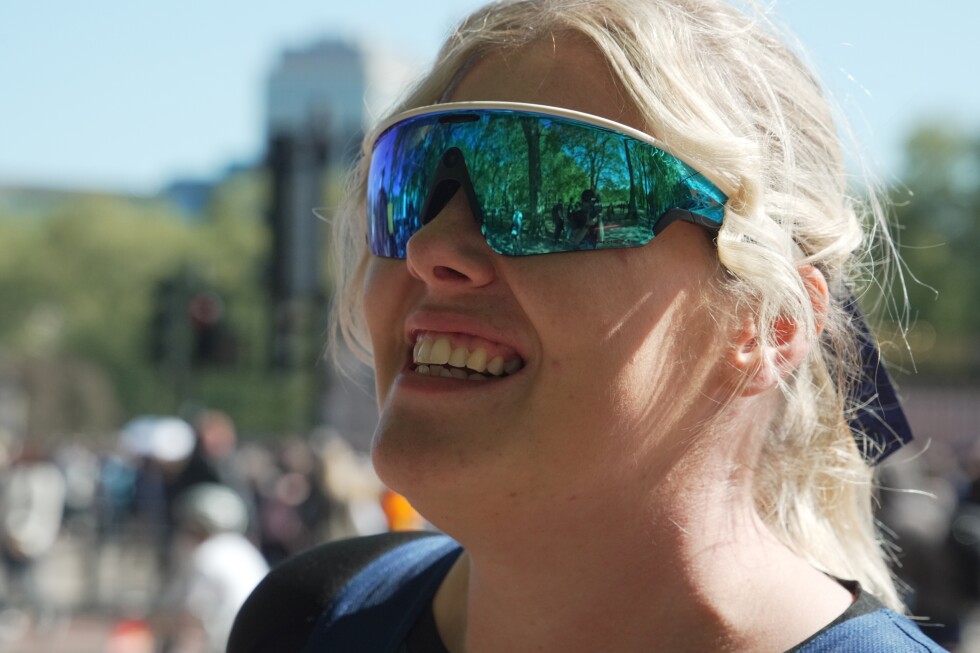
Running past Buckingham Palace during training, Tilly Dowler is closing in on a goal she once thought out of reach. Dowler, who has Stargardt disease and retains only about 10% useful vision, began her running journey just last year with a basic couch-to-5K program before gradually building up to marathon distance.
Now she’s preparing to tackle the London Marathon with her boyfriend serving as her guide, using AI-powered Oakley Meta Vanguard smart glasses to help navigate the challenging 26.2-mile urban course.
“They are AI assisted,” she explained. “While running, I can ask for live cues, such as what landmarks are around me and how far I have run.”
The technology allows Dowler to multitask effectively during her runs. “I can put my music on but still be able to listen to my guide runner,” she said, highlighting how the system complements rather than replaces human guidance.
For Dowler, the upcoming marathon represents more than personal achievement. “My mission was to inspire other people with sight loss and people going through something really tough and inspire them to believe in themselves,” she said.
Dowler joins a growing community of visually impaired athletes leveraging AI-enabled smart glasses. These wearable devices integrate standard eyewear with cameras, microphones, and speakers that allow users to interact through voice commands, buttons, or simple gestures. The AI interprets the surrounding environment and provides real-time audio feedback.
The most recognizable products in this category come from Meta, which collaborates with Ray-Ban and Oakley. With more than 7 million pairs of Meta Ray-Bans sold last year, the technology’s popularity is evident, though not without controversy. Privacy advocates have raised concerns about surreptitious recording and Meta’s practice of sending video footage to human reviewers for AI training purposes.
Sha Khan, who lost approximately 90% of his vision in 2021 due to retinitis pigmentosa and Stargardt disease, has incorporated the technology into both his daily routine and training regimen.
“It’s like literally a part of me now,” Khan said. “If I step out the front door, I wouldn’t do that without my glasses on.”
In addition to the smart glasses, Khan relies on his guide dog, Moby, for everyday navigation. The hands-free nature of the glasses proves particularly valuable, allowing him to focus on working with Moby without the distraction of handling a smartphone.
Khan began running in 2022 following encouragement from a Guide Dogs UK volunteer after experiencing significant mental health challenges related to his sudden vision loss. During training sessions with guide runners, he uses voice commands to interact with his glasses.
“If they say that’s Big Ben ahead of us I can just say ‘hey Meta take a picture,'” he explained, emphasizing how the technology eliminates the need to “fumble with a mobile phone.”
The technology works by using a front-facing camera to capture visual information, which artificial intelligence then analyzes and converts into audio descriptions delivered through speakers built into the frame.
Chris Lewis, a technology analyst with visual impairment who has used smart glasses while skiing, described how the system provides “an additional layer of awareness.”
“The AI is taking the images coming in, analyzing it and giving you the information about what’s in front of you, what might be moving and what might be changing,” Lewis said. This allows users to receive crucial information without losing environmental awareness—a critical factor for activities like running.
However, Lewis noted potential challenges in marathon settings, where large crowds can strain mobile networks and potentially compromise the glasses’ real-time information delivery.
Guide Dogs UK, which provides various services supporting independent living for visually impaired individuals, emphasizes that smart glasses should supplement rather than replace traditional support systems.
“These glasses can really support and enhance somebody’s independence but they’re not there to be relied upon or replace core independent skills,” said Tommy Dean, a technology specialist at the charity. He stressed that guide dogs, mobility training, and human support remain essential, particularly in complex environments.
Ben Hatton, an analyst at CCS Insight studying emerging consumer technologies, identified reliability as a fundamental challenge. “If you’re going to allow visually impaired people to walk down the street or cross busy roads with the technology then it has to be perfectly reliable every single time,” Hatton observed, adding that accuracy, connectivity, and cost will determine the technology’s broader adoption.
Despite these limitations, experts recognize that advances in artificial intelligence are enabling mainstream devices to play an increasingly important role in accessibility.
“The fact that consumer technology can enhance the experience of someone with a sight problem adds to the potential to be more and more independent,” Lewis noted.
More than 59,000 runners are expected to participate in Sunday’s London Marathon, following a route that begins in Greenwich and concludes near Buckingham Palace—where Dowler has been training, preparing to complete a journey that represents both personal triumph and technological innovation.
Fact Checker
Verify the accuracy of this article using The Disinformation Commission analysis and real-time sources.

10 Comments
This is a great example of how AI and wearable tech can empower those with disabilities. The ability to get live cues and information while running is hugely beneficial for visually impaired athletes.
Agreed. The smart glasses complement the human guide runner’s assistance, allowing for more independence and multitasking. A really impressive integration of technology.
What an inspiring story! Using smart glasses to help visually impaired runners like Tilly Dowler participate in events like the London Marathon is a game-changer. Technology can truly make a difference in people’s lives.
Absolutely. Dowler’s mission to inspire others with sight loss is so admirable. Cutting-edge assistive tech is opening up new possibilities for the visually impaired community.
This is a wonderful example of how technology can be a great equalizer, enabling people with disabilities to take on feats they may have thought impossible. The smart glasses seem like a game-changer for visually impaired athletes.
Absolutely. Assistive tech like this has the potential to transform the lives of many. It’s inspiring to see visually impaired runners like Tilly Dowler achieve their goals with the help of innovative solutions.
I’m really interested to see how this assistive tech continues to evolve and open up new possibilities for the visually impaired. Enabling more people to pursue athletic passions is such an important step.
Definitely. As the technology improves, we’ll likely see it become more accessible and widespread. It’s great to see innovative solutions empowering those with visual impairments.
Kudos to Tilly Dowler and the growing community of visually impaired athletes using AI-powered smart glasses. Overcoming such challenges to participate in events like the London Marathon is incredibly inspiring.
The London Marathon is a notoriously challenging course, so for visually impaired runners to be able to participate with the help of smart glasses is really remarkable. Kudos to the engineers and researchers behind this technology.