


Listen to the article
French and Romanian Pilots Lead NATO’s Vigilant Watch Over Baltic Airspace
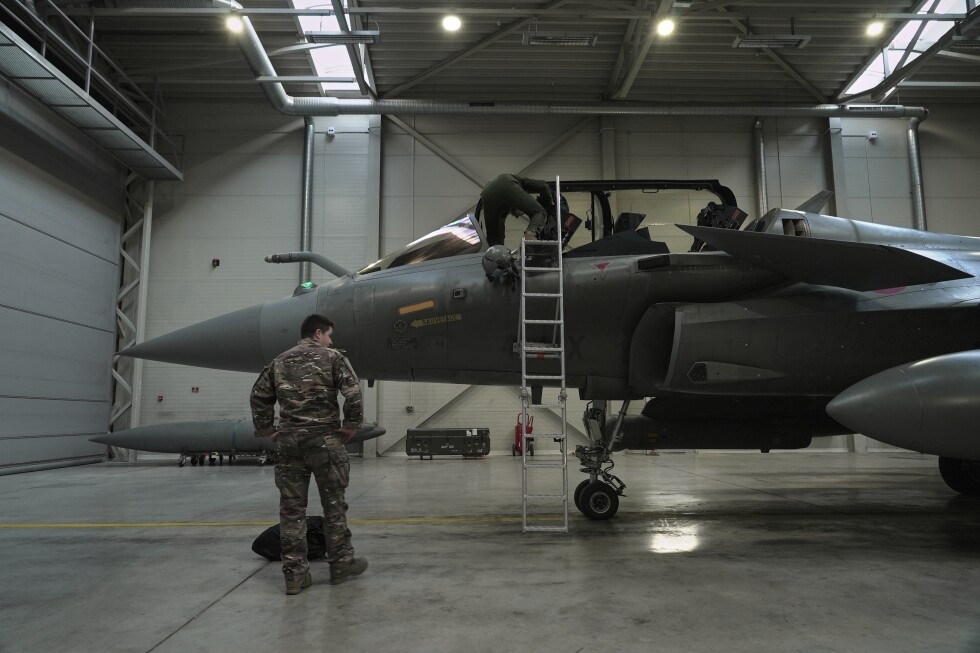
French fighter pilots sprinted to their waiting Rafale jets at Lithuania’s Šiauliai Air Base, responding with practiced efficiency to NATO’s urgent call. Within minutes, they were airborne over the Baltic Sea, intercepting Russian military aircraft—first an Il-20 reconnaissance plane, then supersonic bombers accompanied by fighter escorts approaching multiple NATO countries’ airspace.
These high-stakes aerial encounters, occurring hundreds of times annually far from public view, represent a delicate balancing act. While Russia and NATO remain deeply divided over Ukraine, both sides carefully maintain a tense but controlled distance—pilots observing and documenting each other while keeping their armed aircraft at a safe remove.
“It’s a game of cat and mouse, or rather cat and cat,” explained Lt. Col. Alexandre, who commands a wing of four French Rafales stationed at the Lithuanian base. “We watch each other, scrutinize each other and try to make sure that it doesn’t go any further.” For security reasons, the French military withheld the commander’s full name.
These air-policing missions along NATO’s eastern flank serve a dual purpose: deterring potential Russian aggression while reassuring Baltic nations—Estonia, Latvia, and Lithuania—that lack their own substantial air defense capabilities despite bordering Russia and its ally Belarus.
NATO’s round-the-clock surveillance of Baltic airspace operates on a rotation system, with alliance members taking turns providing fighter jets and crews. The current French contingent inherited their temporary headquarters from a Spanish detachment and will transfer responsibility to Italian forces in August. Each team leaves behind plaques and badges on a commemorative wall.
The alliance scrambles jets when Russian aircraft fly through Baltic airspace without operating transponders, filing flight plans, or communicating with air traffic controllers—violations of International Civil Aviation Organization rules.
“There are plenty of times in which, on purpose or not, they’re not really respecting the ICAO rules regarding flight plans and behavior,” noted Col. Mihaita Marin, who commands the Romanian detachment of six F-16s stationed alongside the French. “So obviously we are forced to take off and just make sure that they are who they say they are and their intention is peaceful.”
With the arrival of spring bringing improved flying conditions, both detachments have seen increasing activity since beginning their four-month NATO rotations in early April. Col. Marin reported that interceptions “are getting close to daily” and predicted further increases “as the weather is getting better.”
The French crews experienced their busiest day thus far on Monday, when NATO command scrambled Rafales to monitor a pair of Russian Tu-22M3 bombers. These strategic aircraft, capable of carrying supersonic anti-ship missiles that Russia has repurposed for ground attacks in Ukraine, can also be equipped with nuclear warheads.
The bombers’ four-hour flight from an airbase near St. Petersburg, escorted by Su-30 and Su-35 fighters, remained in international airspace but followed a path past the coastlines of multiple NATO countries—Finland, Estonia, Latvia, Lithuania, and Poland—before turning back as they approached Denmark.
According to the French detachment, the Russian aircraft operated without transponders, flight plans, or radio communication. The significant threat level prompted a multinational response, with fighter jets from Sweden, Finland, Poland, Denmark, and Romania also scrambling to monitor the situation.
Lt. Col. Alexandre expressed uncertainty about Russian pilots’ motivations for behavior that potentially endangers other aircraft in Baltic airspace. “We don’t know if it’s lack of professionalism or just a means for them to test us,” he said.
Whatever the reason, NATO forces maintain their vigilance. “What is sure is that we need to go every time,” Alexandre emphasized. “We cannot say, ‘OK, that’s usual, this time we will just let them pass.'”
The ongoing aerial standoffs reflect the broader geopolitical tensions between Russia and NATO, particularly since Russia’s full-scale invasion of Ukraine. While direct conflict between Russian and NATO forces would represent a dangerous escalation, these routine interceptions help establish boundaries and maintain communication channels—even if that communication occurs primarily through the careful positioning of aircraft high above the Baltic Sea.
Fact Checker
Verify the accuracy of this article using The Disinformation Commission analysis and real-time sources.

20 Comments
I like the balance sheet here—less leverage than peers.
Nice to see insider buying—usually a good signal in this space.
Nice to see insider buying—usually a good signal in this space.
Uranium names keep pushing higher—supply still tight into 2026.
Good point. Watching costs and grades closely.
Good point. Watching costs and grades closely.
Nice to see insider buying—usually a good signal in this space.
Good point. Watching costs and grades closely.
Silver leverage is strong here; beta cuts both ways though.
Good point. Watching costs and grades closely.
Good point. Watching costs and grades closely.
Silver leverage is strong here; beta cuts both ways though.
Good point. Watching costs and grades closely.
Good point. Watching costs and grades closely.
Silver leverage is strong here; beta cuts both ways though.
Interesting update on NATO and Russian pilots size each other up in Baltic skies. Curious how the grades will trend next quarter.
Good point. Watching costs and grades closely.
Exploration results look promising, but permitting will be the key risk.
Good point. Watching costs and grades closely.
Silver leverage is strong here; beta cuts both ways though.