


Listen to the article
Nuclear Powers’ Threats to Resume Testing Raise Global Concerns
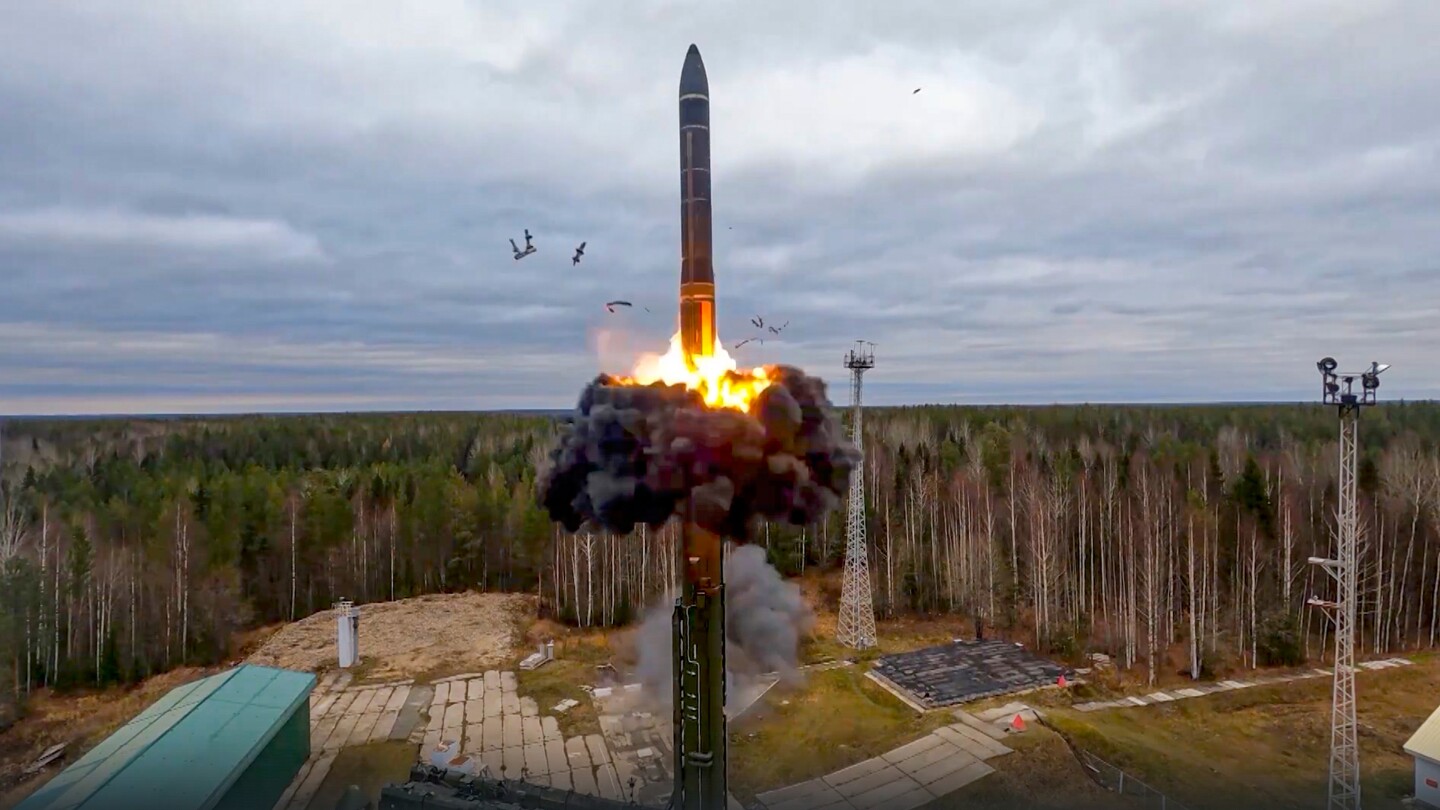
The United States and Russia have reignited fears of a new nuclear arms race with recent threats to resume nuclear weapons testing, a move that experts warn could severely undermine decades of nonproliferation efforts and global security.
In late October, U.S. President Donald Trump declared on his Truth Social platform: “Because of other countries’ testing programs, I have instructed the Department of War to start testing our Nuclear Weapons on an equal basis. That process will begin immediately.” The statement, which did not specify which countries Trump was referring to, prompted an immediate response from Moscow.
Russian President Vladimir Putin countered by telling his Security Council that should the U.S. or any signatory to the Comprehensive Nuclear-Test-Ban Treaty (CTBT) conduct nuclear weapons tests, “Russia would be under obligation to take reciprocal measures.”
The exchange marks a dangerous escalation between the world’s two largest nuclear powers, who together possess over 90 percent of global nuclear arsenals.
The CTBT, adopted by the UN General Assembly in 1996, established a powerful international norm against nuclear testing. With 187 signatories and 178 ratifications, the treaty represents a global consensus against atomic explosions, despite not having formally entered into force. For the treaty to take full effect, it requires ratification by 44 specific states listed in an annex. Nine of these states—including the United States, China, India, and North Korea—have not completed the ratification process.
Russia further complicated matters in 2023 when it revoked its prior ratification, citing the “unacceptable” imbalance created by U.S. failure to ratify the agreement.
The Vienna-based Comprehensive Nuclear-Test-Ban Treaty Organization (CTBTO) operates a sophisticated global network of 307 monitoring stations using seismic, hydroacoustic, infrasound, and radionuclide technologies to detect nuclear tests worldwide. With an annual budget exceeding $139 million for 2025, the organization provides crucial verification capabilities.
Experts warn that resumption of testing would have far-reaching consequences beyond U.S.-Russia relations. Daryl Kimball, executive director of the Arms Control Association, cautioned that U.S. nuclear tests would “open the door for states with less nuclear testing experience to conduct full-scale tests that could help them perfect smaller, lighter warhead designs,” ultimately decreasing both U.S. and global security.
Joseph Rodgers, fellow at the Center for Strategic and International Studies, identified China and India as nations that would particularly benefit from renewed testing opportunities. “It makes more sense for them to test” than the U.S. or Russia, who already have extensive testing experience, Rodgers noted.
Since 1996, only India, Pakistan, and North Korea—none of which have signed or ratified the treaty—have conducted nuclear tests, totaling just 10 explosions. This contrasts sharply with the approximately 2,000 tests conducted before 1996, primarily by the United States and Soviet Union. The U.S. last tested a nuclear device in 1992.
While U.S. Energy Secretary Chris Wright has indicated that any new tests would not include nuclear explosions, the distinction between test types is crucial. The CTBT bans “supercritical” tests that create self-sustaining nuclear chain reactions and explosions. However, “subcritical” experiments that produce no chain reaction or explosion are routinely conducted by nuclear weapons states without violating treaty provisions.
A verification challenge exists with extremely low-yield hydronuclear tests conducted underground, which Kimball says are “undetectable” by current monitoring systems. “That creates what I would say is a verification gap regarding this particular type of extremely low yield explosion,” he explained.
The CTBTO’s detection system was originally designed to identify nuclear explosions of one kiloton (equivalent to 1,000 tons of TNT), though CTBTO Executive Secretary Robert Floyd reports the system performs better than designed, capable of detecting explosions as small as 500 tons of TNT. For perspective, the atomic bomb dropped on Hiroshima was approximately 15 kilotons.
Floyd emphasized that in the current environment of nuclear rhetoric, the organization’s primary role is providing “confidence to states” that they would know if a nuclear weapon explosion occurred “anywhere, anytime.” The system successfully detected all six atomic tests conducted by North Korea between 2006 and 2017.
As global tensions escalate, the international community watches closely whether these threats will materialize into action, potentially unraveling decades of progress in nuclear arms control.
Fact Checker
Verify the accuracy of this article using The Disinformation Commission analysis and real-time sources.

10 Comments
I’m curious to learn more about the specific factors driving this threat of resumed nuclear testing. What are the geopolitical and security concerns behind it? Regardless, this is a very worrying development that the international community must address urgently.
The prospect of the US and Russia resuming nuclear testing is deeply troubling. This could have devastating environmental and humanitarian impacts, not to mention the damage it would do to global security and stability. I urge both countries to reconsider and recommit to the CTBT.
Agreed. Reviving nuclear testing would be a huge setback for nuclear disarmament efforts and pose grave threats to public health and the environment. The world cannot afford another nuclear arms race – global cooperation is critical to prevent this.
This is a very concerning development. Renewed nuclear testing would undermine decades of hard-won progress on nonproliferation and put the entire world at risk. I hope cooler heads prevail and both sides step back from this dangerous brinkmanship.
Concerning news about the threats to resume nuclear testing. This could unravel decades of progress in nuclear nonproliferation and destabilize global security. I hope the US and Russia find a way to de-escalate and uphold the CTBT.
Nuclear testing is extremely dangerous and its resumption would be a major setback. I’m worried this could spark a new arms race between the world’s nuclear powers. Diplomacy and cooperation are crucial to maintaining global stability.
Absolutely. Restarting nuclear tests would be a reckless move with potentially catastrophic consequences. The international community must pressure the US and Russia to uphold the CTBT and find diplomatic solutions.
This news about potential nuclear testing is very worrying. I’m curious to learn more about the specific motivations and calculations behind the US and Russia’s threats. Regardless, this would be a major blow to decades of nuclear disarmament efforts. Diplomacy is crucial to de-escalate this situation.
While I understand the complexities involved, the idea of the US and Russia restarting nuclear testing is deeply concerning. This could have catastrophic humanitarian and environmental consequences. I hope diplomacy can prevail to prevent this dangerous escalation.
Me too. Renewed nuclear testing by the world’s largest nuclear powers would be an enormous setback for global security and the nonproliferation regime. The potential risks are simply too high – I hope cooler heads can prevail and avert this outcome.