


Listen to the article
Rubio Takes Tough Stance on Iran at G7 as Allies Seek Diplomatic Path
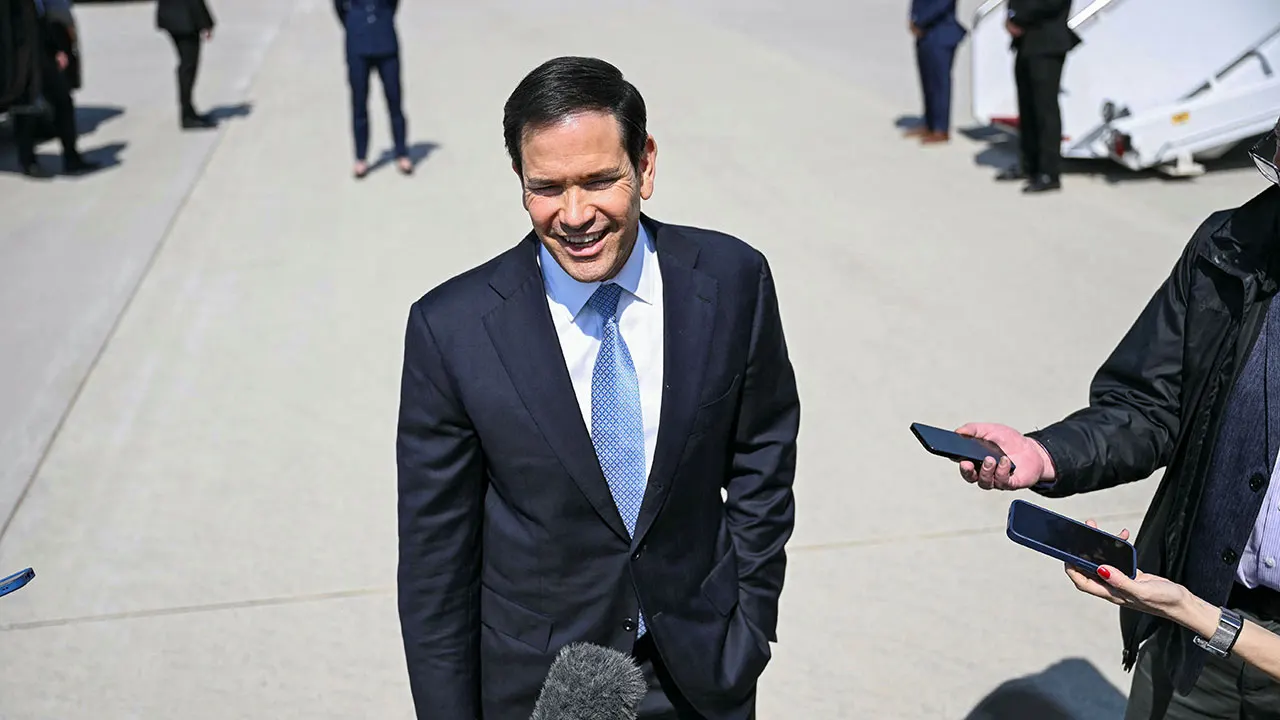
Secretary of State Marco Rubio arrived in France Friday for the G7 foreign ministers meeting, setting the stage for what could be a contentious gathering as the U.S. and its allies remain divided over the approach to the ongoing war with Iran.
The divergence in strategy has become increasingly apparent in recent weeks, with Rubio signaling a defiant approach before his departure. “I don’t work for France or Germany or Japan… the people I’m interested in making happy are the people of the United States. I work for them,” he declared in a video posted on social media.
Nearly all of Washington’s G7 partners — Britain, Canada, France, Germany, Italy and Japan — have responded cautiously to the U.S.-Israeli military campaign against Iran. While condemning Iranian actions, these nations have largely declined to participate in offensive operations, creating tension within the alliance.
President Donald Trump has expressed frustration over this hesitancy, pressing allies to contribute more, particularly in securing critical maritime routes like the Strait of Hormuz. The strategic waterway serves as a vital global shipping lane, especially for energy supplies.
“The U.S. is constantly asked to help in wars and we have. But when we had a need, it didn’t get positive responses from NATO. A couple leaders said that Iran was not Europe’s war. Well, Ukraine isn’t our war, yet we’ve contributed more to that fight than anyone,” Rubio remarked before departing for France.
He added pointedly: “The Strait of Hormuz could be open tomorrow if Iran stops threatening global shipping, which is an outrage and a violation of international law. For all these countries that care about international law, they should be doing something about it.”
European officials, meanwhile, have emphasized de-escalation and diplomatic solutions. Vice President of the European Commission Kaja Kallas articulated this position clearly: “We need to exit from the war, not escalate this further, because the consequences for everybody around the world are quite severe.”
Kallas further highlighted the interconnected nature of the crisis, noting, “Russia is helping Iran with intelligence… and also supporting Iran now with drones,” linking the Iran conflict to the ongoing war in Ukraine.
France’s foreign minister, Jean-Noël Barrot, acknowledged the need to address Iran’s actions while focusing on securing global shipping routes. He indicated the G7 discussions would build on previous joint statements condemning Iranian attacks, while also exploring “an international mission… to ensure the smooth flow of maritime traffic in a strictly defensive posture.”
According to a State Department spokesperson, Rubio’s agenda extends beyond Iran. He plans to advance discussions on the conflicts in Ukraine and the Middle East, international burden-sharing, and the overall effectiveness of the G7 as a forum for coordinating international policy.
The stark difference in approach has led to the unusual step of dropping plans for a unified final communiqué, according to Reuters, as officials seek to avoid publicly exposing these divisions.
Analysts suggest the disagreement reflects deeper structural tensions in the transatlantic alliance. Barak Seener, senior research fellow at the Henry Jackson Society, told Fox News Digital: “Europe has criticized Donald Trump’s ‘maximum pressure’ strategy towards Iran while pursuing a failed diplomatic approach that has enabled the regime to expand its terrorist networks and edge closer to nuclear threshold status.”
Seener added that this reflects “a lack of European capability to project power in the region, particularly in safeguarding the Strait of Hormuz.”
The situation is further complicated by years of European reliance on American security guarantees. “Years of underinvestment in defense and reliance on the United States have created a dependency that Washington increasingly views as a betrayal of the peace it has guaranteed Europe since the Second World War,” Seener explained.
Jacob Olidort, chief research officer at the America First Policy Institute, emphasized the strategic disconnect: “The failure of Western Europe to participate in securing the Strait of Hormuz is particularly egregious because those countries depend on it more than we do.”
As the G7 meetings unfold in the coming days, the ability of these key allies to bridge their differences on Iran will serve as an important test for the future of transatlantic cooperation in an increasingly complex global security environment.
Fact Checker
Verify the accuracy of this article using The Disinformation Commission analysis and real-time sources.

8 Comments
Securing critical maritime routes like the Strait of Hormuz is a key priority, but getting G7 allies to contribute more may prove challenging given their more cautious approach. Trump’s frustration is understandable, but maintaining unity within the alliance is also important.
Rubio’s declaration that he works for the American people first and foremost is a bold statement. It will be interesting to see how the G7 ministers respond and whether they can find common ground on the path forward with Iran.
The strategic importance of the Strait of Hormuz is undeniable, but getting G7 allies to contribute more to securing it may prove challenging. The divergent priorities and risk tolerances of the various nations involved will need to be carefully navigated.
The geopolitical tensions surrounding the Iran situation are complex, with the US and its allies seemingly at odds over the best course of action. Maintaining a united front within the G7 will be crucial, even as individual nations pursue their own interests.
The divergence in strategy between the US and its allies on Iran is concerning. While condemning Iran’s actions, the allies seem reluctant to get directly involved in offensive operations. This could create further strains within the G7 alliance.
Rubio’s tough stance on Iran suggests the US is taking a more assertive approach, which could further strain relations with its allies. It will be important to watch whether the G7 can find a way to reconcile their differences and present a unified front.
Interesting update on the tensions between the US and its G7 allies over the Iran situation. Rubio seems to be taking a tough stance, prioritizing US interests over diplomacy. It will be worth watching how the other G7 ministers respond.
Rubio’s comments about working for the American people first, rather than for other G7 nations, reflect the complex geopolitical landscape. Balancing national interests with the need for international cooperation will be a key challenge in the coming negotiations.