


Listen to the article
U.S. and Australian Officials Hold Talks on Indo-Pacific Security Amid Chinese Assertiveness
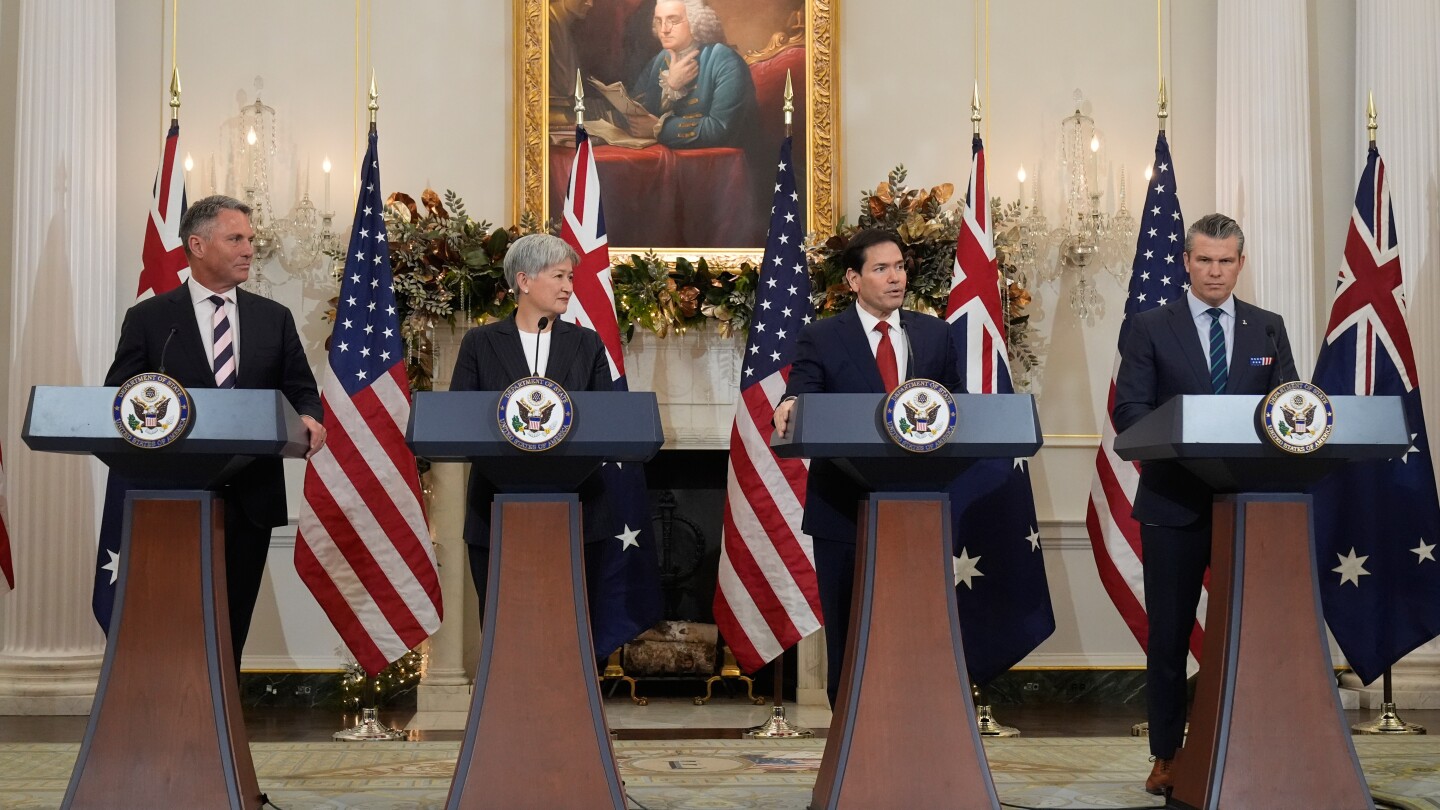
Secretary of State Marco Rubio and Defense Secretary Pete Hegseth welcomed their Australian counterparts to Washington on Monday for annual security talks centered on challenges in the Indo-Pacific region, particularly China’s growing assertiveness.
The high-level meeting at the State Department brought together Rubio, Hegseth, Australian Foreign Minister Penny Wong and Defense Minister Richard Marles at a time of heightened global tensions. While China wasn’t explicitly named in their opening remarks, Beijing’s activities in the South China Sea and toward Taiwan formed a central focus of discussions.
“This is a very strong partnership, it’s a strong alliance, and what we want to do is continue to build on it. We think we have a lot of momentum behind this alliance,” Rubio said during the opening session. He highlighted the countries’ cooperation on critical minerals, defense production and troop deployments as key elements strengthening bilateral relations.
The meeting occurred against a backdrop of multiple global crises, including the ongoing Russia-Ukraine war, a tentative ceasefire in Gaza, and recent U.S. military actions against alleged drug traffickers in the Western Hemisphere that have raised questions about use of force protocols.
Following the four-way talks, Rubio and Wong held separate discussions where they emphasized their “shared commitment to a free and open Indo-Pacific” and cooperation on combating online scams and supporting strategic infrastructure projects across the Pacific region, according to a State Department readout.
Critical minerals emerged as a significant topic during the discussions. President Donald Trump and Australian Prime Minister Anthony Albanese signed an important agreement on critical minerals at the White House in October, a move that came after China imposed tighter export restrictions on these essential materials used in technologies ranging from smartphones to fighter jets.
“We have to have critical mineral supplies and supply chains that are reliable, and that are diverse, and not overly invested in one place where they can be used as leverage against us or our partners of the world,” Rubio emphasized, highlighting the strategic importance of reducing dependence on Chinese sources.
Beijing temporarily paused its restrictive export rules for a year following a meeting between Trump and Chinese leader Xi Jinping, but concerns remain about China’s dominance in critical minerals production and processing.
The AUKUS security pact, established during the Biden administration, featured prominently in the discussions. The agreement between the United States, United Kingdom, and Australia focuses on building an Australian fleet of submarines powered by U.S. nuclear technology.
“The alliance has always been to ensure it delivers concrete benefits for our security and prosperity and for that of the United States. And AUKUS is central to that: a win for Australia, a win for the U.S. and a win for the United Kingdom,” Wong stated. “We are full steam ahead.”
Hegseth welcomed Australia’s upcoming contribution of an additional $1 billion to expand U.S. submarine production capacity, reinforcing the trilateral security arrangement’s importance to all parties involved.
Later Monday, Rubio met with British Foreign Secretary Yvette Cooper, further strengthening the AUKUS partnership, though neither made public statements following their discussions.
Marles underscored the significance of the U.S.-Australia alliance in the current geopolitical landscape, noting, “We are living in a much more contested world, where it really matters to be doubling down with friends and allies and, obviously, America is front and center and foremost for Australia in that respect.”
The annual security talks reflect the enduring partnership between Washington and Canberra, which has taken on renewed importance as both nations navigate increasing tensions in the Indo-Pacific region and seek to counter China’s growing influence through diplomatic, economic, and security cooperation.
Fact Checker
Verify the accuracy of this article using The Disinformation Commission analysis and real-time sources.

24 Comments
Interesting update on Rubio and Hegseth discuss Indo-Pacific security with Australian counterparts. Curious how the grades will trend next quarter.
Good point. Watching costs and grades closely.
Good point. Watching costs and grades closely.
Silver leverage is strong here; beta cuts both ways though.
Good point. Watching costs and grades closely.
Production mix shifting toward World might help margins if metals stay firm.
Good point. Watching costs and grades closely.
Interesting update on Rubio and Hegseth discuss Indo-Pacific security with Australian counterparts. Curious how the grades will trend next quarter.
Good point. Watching costs and grades closely.
If AISC keeps dropping, this becomes investable for me.
Silver leverage is strong here; beta cuts both ways though.
Good point. Watching costs and grades closely.
Interesting update on Rubio and Hegseth discuss Indo-Pacific security with Australian counterparts. Curious how the grades will trend next quarter.
Good point. Watching costs and grades closely.
Good point. Watching costs and grades closely.
Nice to see insider buying—usually a good signal in this space.
Silver leverage is strong here; beta cuts both ways though.
Production mix shifting toward World might help margins if metals stay firm.
Good point. Watching costs and grades closely.
Good point. Watching costs and grades closely.
I like the balance sheet here—less leverage than peers.
Good point. Watching costs and grades closely.
Good point. Watching costs and grades closely.
Interesting update on Rubio and Hegseth discuss Indo-Pacific security with Australian counterparts. Curious how the grades will trend next quarter.