


Listen to the article
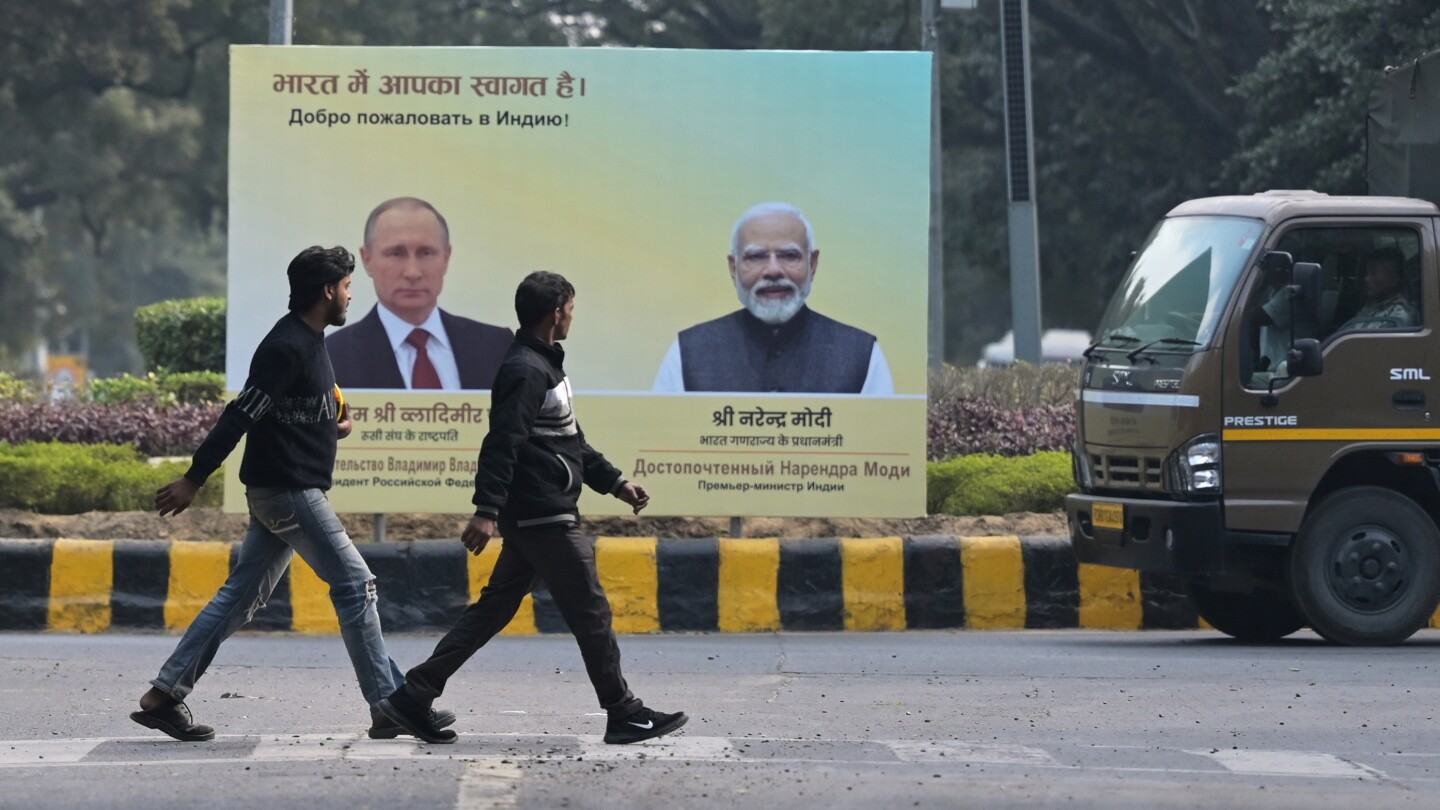
Russian President Vladimir Putin arrived in New Delhi Thursday for a state visit aimed at strengthening the longstanding relationship between Russia and India amid complex global dynamics.
Indian Prime Minister Narendra Modi personally welcomed Putin at the airport with a warm embrace, highlighting the close personal rapport between the two leaders. Modi will host the Russian leader for a private dinner at his official residence before formal bilateral discussions begin Friday as part of the 23rd India-Russia Summit.
The timing of Putin’s visit is particularly significant, occurring as the United States pushes for a potential peace deal in the Russia-Ukraine war, now approaching its fourth year. The visit underscores India’s delicate balancing act between maintaining its historic ties with Russia while developing strategic relationships with Western powers.
This marks Putin’s first visit to India since 2021, though the two leaders met briefly in China last September during a Shanghai Cooperation Organization summit. Modi also traveled to Moscow in 2023, demonstrating the consistent high-level engagement between the nations.
In a pre-visit interview with Indian media, Putin emphasized Russia’s intention to cooperate with India in “cutting-edge technology, space exploration and nuclear energy.” Despite acknowledging the “certain difficulties” caused by international sanctions against Russia, Putin projected confidence in finding solutions, asserting that countries attempting to hinder trade with third parties would “ultimately suffer losses themselves.”
“India is a great power, not a British colony. And everyone will have to accept that,” Putin stated, referring to Modi as a friend in comments reported by Russian state news agency Tass.
Economic ties between the two nations have grown substantially, with bilateral trade reaching $68.7 billion in the fiscal year ending March 2024, according to Indian government data. Both countries aim to increase this figure to $100 billion by 2030. However, the trade relationship remains heavily imbalanced, with India’s exports to Russia amounting to just $4.88 billion against imports of $63.84 billion, dominated by Russian crude oil.
Indian officials indicated they are working with Moscow to address this trade deficit by boosting exports across multiple sectors including marine products, agriculture, automobiles, and pharmaceuticals. Multiple agreements are expected to be signed Friday in shipping, healthcare, fertilizers, connectivity, and labor mobility to strengthen bilateral relations and trade.
Defense cooperation remains a cornerstone of India-Russia relations, with Russia continuing to serve as India’s largest supplier of military hardware despite New Delhi’s efforts to diversify its defense procurement sources in recent years.
Before Putin’s arrival, Russian Defense Minister Andrei Belousov met with his Indian counterpart Rajnath Singh to co-chair an intergovernmental commission on military and technical cooperation. Singh emphasized new opportunities for collaboration on niche technologies, while Belousov offered support for India’s self-reliance in defense production.
A key focus of the defense discussions is expected to be the expedited delivery of two remaining S-400 surface-to-air missile systems, following the three already received under a $5.4 billion deal signed in 2018. Delays attributed to supply chain disruptions linked to the Ukraine war have affected the timeline. Indian authorities are also reportedly considering acquiring additional S-400 units or upgraded variants.
The summit comes amid tensions with the United States over India’s purchase of discounted Russian oil, which Washington claims helps finance Moscow’s war effort. In August, the U.S. imposed additional 25% tariffs on Indian imports, raising total duties to 50% in a retaliatory move. Further complicating matters, in October the U.S. sanctioned two of Russia’s largest oil producers in an effort to pressure countries like India to reduce imports.
India has consistently defended its oil purchases as essential to meeting the energy needs of its 1.4 billion population, while maintaining that it adheres to international sanctions. Indian officials have indicated they will continue to source oil from non-sanctioned entities.
Praveen Donthi, senior analyst for India at the International Crisis Group, noted that the summit provides an opportunity for both nations to reaffirm their relationship amid increasing pressure from the U.S. “While this pressure has succeeded in getting New Delhi to reduce its crude oil imports from Russia, it will continue to uphold defense ties with Moscow, especially amid tensions with China and Pakistan,” Donthi observed.
As global geopolitical tensions continue to evolve, this summit represents a critical juncture for Indo-Russian relations and India’s navigation of complex international alliances.
Fact Checker
Verify the accuracy of this article using The Disinformation Commission analysis and real-time sources.

22 Comments
This visit highlights the complexities of global geopolitics and the delicate balancing act India must perform in maintaining its historic ties with Russia while engaging with the West.
Indeed, India’s position is crucial, as it seeks to navigate these shifting power dynamics and pursue its own strategic interests on the world stage.
India’s balancing act between Russia and the West is a delicate diplomatic dance. This visit showcases their continued commitment to the longstanding Russia-India partnership.
Indeed, India’s ability to maintain its autonomy and pursue its interests amid these great power rivalries will be closely watched by the global community.
This visit underscores the strategic importance of the Russia-India relationship, even as the West pushes for a Ukraine peace deal. Their continued high-level engagement is noteworthy.
Absolutely. The timing is significant given the global tensions, making India’s role as a bridge between East and West all the more crucial.
The personal rapport between Putin and Modi is clearly an important factor in the Russia-India relationship. Their continued high-level engagement is a testament to its strategic significance.
Absolutely. The strong personal bonds between the leaders can help drive the bilateral agenda and deepen cooperation, even in challenging geopolitical circumstances.
Putin’s warm welcome by Modi highlights the close personal rapport between the two leaders. This will likely be a key factor in strengthening Russia-India cooperation.
Yes, the personal chemistry between the heads of state is important in driving the bilateral agenda, especially in complex geopolitical circumstances.
As the Russia-Ukraine conflict drags on, India’s delicate balancing act becomes even more critical. Maintaining its historic ties with Russia while engaging with the West is a tricky tightrope to walk.
Indeed, India’s position is nuanced and will be closely watched. Its ability to navigate these shifting global dynamics could have significant implications.
It will be fascinating to see how India navigates the complex geopolitical landscape, particularly in its approach to the Russia-Ukraine conflict and its energy security needs.
Yes, India’s position on these issues will be closely scrutinized, as it seeks to balance its relationships with both Russia and the West.
Interesting to see Russia and India bolstering their ties amid the complex global dynamics. India’s balancing act between Russia and Western powers is an intriguing geopolitical challenge.
Yes, India’s position is critical as these major powers jostle for influence. Their historic Russia ties and growing Western relationships require deft diplomacy.
The high-level engagement between Putin and Modi demonstrates the importance both countries place on their strategic relationship, despite the evolving global dynamics.
Absolutely. Their consistent interactions highlight the enduring nature of the Russia-India partnership, even as the world order undergoes significant shifts.
It will be interesting to see how the discussions between Putin and Modi unfold, particularly on issues like the Ukraine conflict and India’s energy security concerns.
Yes, their talks will likely touch on a range of strategic and economic topics, including the potential impact of the war on global energy and commodity markets.
The timing of Putin’s visit to India is intriguing, coming as the US pushes for a potential peace deal in the Russia-Ukraine war. This underscores the complex geopolitical context.
Absolutely. India’s role as a neutral broker could be crucial in finding a diplomatic solution, given its relationships with both Russia and the West.