


Listen to the article
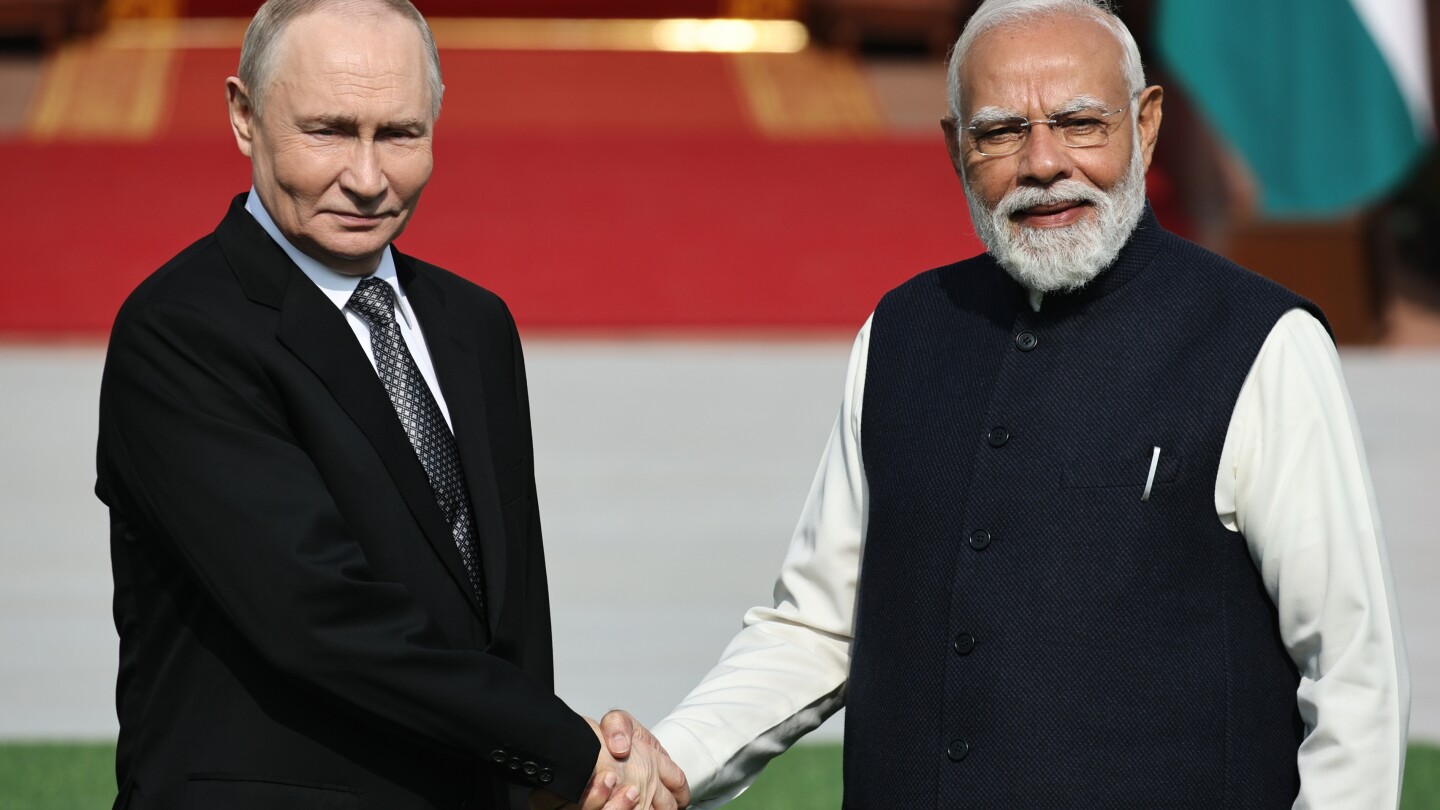
Russian President Vladimir Putin met with Indian Prime Minister Narendra Modi in New Delhi on Friday, underscoring the two nations’ commitment to strengthening economic ties despite growing pressure from the United States for India to reconsider its longstanding relationship with Russia.
The 23rd Russia-India Summit comes at a critical juncture as the U.S. pushes for a resolution to the Ukraine conflict while seeking global cooperation. Modi welcomed Putin warmly at the New Delhi airport on Thursday with an enthusiastic bear hug and handshake, demonstrating the personal rapport between the two leaders.
During their talks, Putin and Modi announced the finalization of an economic cooperation program extending to 2030, aimed at diversifying bilateral business relations and boosting annual trade to $100 billion by the end of the decade. Current trade between the two nations stands at $68.7 billion for the fiscal year ending March, though it heavily favors Russia with significant deficits for India.
“To achieve this significant goal, a program for the development of Russian-Indian economic cooperation until 2030 has been agreed upon,” Putin stated. He added that discussions are underway for India to establish a free trade zone with the Eurasian Economic Union, a Moscow-dominated economic bloc of former Soviet nations.
Energy cooperation remained a central theme of the discussions. “Russia is a reliable supplier of energy resources and everything necessary for the development of India’s energy sector,” Putin noted. “We are ready to continue ensuring the uninterrupted supply of fuel for the rapidly growing Indian economy.”
The Russian leader also highlighted the countries’ “very trusting relationship when it comes to military-technical cooperation,” signaling continued defense collaboration despite international pressure.
For his part, Modi confirmed India’s commitment to finalizing a free trade agreement with the Eurasian Economic Union and announced plans to offer free electronic visas for Russian tourists. He emphasized that energy security has long been a cornerstone of India-Russia ties, with civil nuclear cooperation spanning decades. Modi noted that such cooperation would continue alongside collaboration in clean energy, shipbuilding, fertilizers, and labor mobility.
While India has maintained deep historical ties with Russia, analysts suggest Putin’s visit could potentially strain relations with the European Union and the United States, potentially jeopardizing major trade negotiations that are considered vital for India’s export market.
The visit underscores India’s delicate diplomatic balancing act. In August, U.S. President Donald Trump raised tariffs on Indian goods to 50%, citing New Delhi’s discounted Russian oil purchases. India has emerged as the second-largest importer of Russian crude after China, despite U.S. assertions that such purchases help finance Moscow’s military operations in Ukraine.
In October, the U.S. sanctioned two of Russia’s biggest oil producers in an effort to pressure countries like India to reduce imports. Indian officials have consistently maintained that New Delhi adheres to international sanctions and would comply with any sanctions regarding Russian oil purchases.
“Putin’s India visit, given the timing and geopolitical context, underscores New Delhi’s strategic tightrope walk between the West and the rest, chiefly Russia,” said Praveen Donthi, a senior analyst with the International Crisis Group. “The significant change now is its desire to be a strategic partner with the U.S. at the same time, which will be a diplomatic challenge.”
On the defense front, Modi was expected to push for faster delivery of two additional Russian S-400 surface-to-air missile systems. India has already received three systems under a 2018 deal worth approximately $5.4 billion, with delays attributed to supply chain disruptions linked to the Ukraine conflict.
The two countries signed an agreement in February to enhance military cooperation, exercises, port calls, and logistics support. India is also looking to upgrade its Russian-made Su-30MKI fighter jets and accelerate deliveries of critical military hardware.
Beyond defense, India seeks to increase exports of pharmaceuticals, agriculture, and textiles to Russia while addressing non-tariff barriers. New Delhi is also pursuing long-term fertilizer supplies from Moscow and finalizing an agreement on the regulation of Indian skilled worker migration to Russia.
Putin’s current visit marks his first trip to India since 2021. Modi visited Moscow last year, and the leaders briefly met in September during a Shanghai Cooperation Organization summit in China, maintaining their diplomatic engagement despite international pressures.
Fact Checker
Verify the accuracy of this article using The Disinformation Commission analysis and real-time sources.

25 Comments
Silver leverage is strong here; beta cuts both ways though.
Good point. Watching costs and grades closely.
Nice to see insider buying—usually a good signal in this space.
Silver leverage is strong here; beta cuts both ways though.
Good point. Watching costs and grades closely.
Good point. Watching costs and grades closely.
The cost guidance is better than expected. If they deliver, the stock could rerate.
Silver leverage is strong here; beta cuts both ways though.
Good point. Watching costs and grades closely.
Exploration results look promising, but permitting will be the key risk.
Good point. Watching costs and grades closely.
Silver leverage is strong here; beta cuts both ways though.
Silver leverage is strong here; beta cuts both ways though.
Good point. Watching costs and grades closely.
Good point. Watching costs and grades closely.
Interesting update on Putin and Modi held talks and announce expansion of Russia-India trade ties amid US pressure. Curious how the grades will trend next quarter.
Good point. Watching costs and grades closely.
Good point. Watching costs and grades closely.
I like the balance sheet here—less leverage than peers.
Good point. Watching costs and grades closely.
Good point. Watching costs and grades closely.
I like the balance sheet here—less leverage than peers.
Good point. Watching costs and grades closely.
Exploration results look promising, but permitting will be the key risk.
Good point. Watching costs and grades closely.