


Listen to the article
Russian feminist groups stage protest at Venice Biennale against Russia’s participation
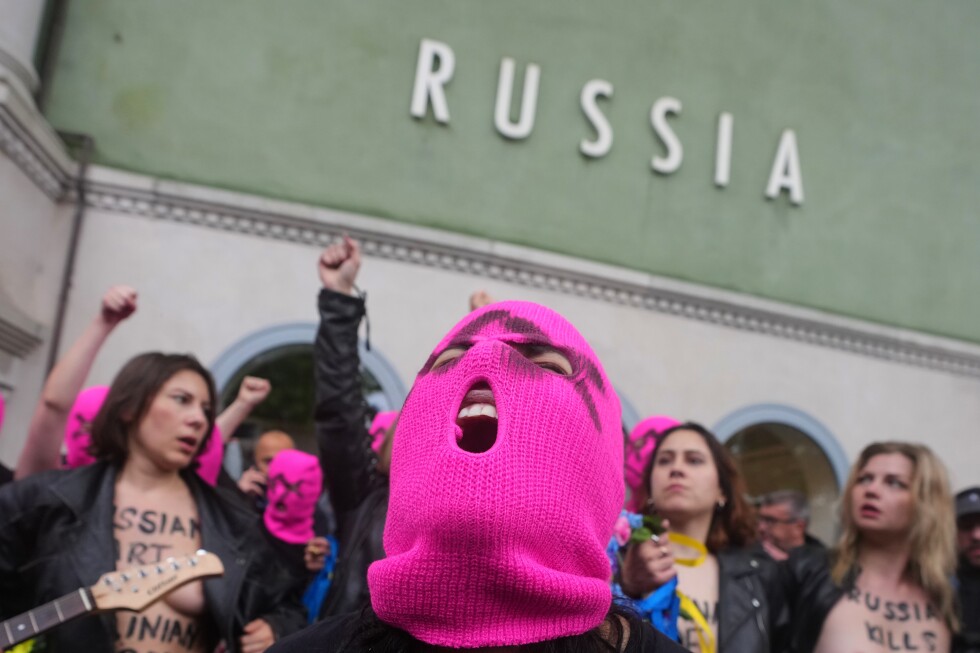
Feminist activists from Pussy Riot and FEMEN blockaded the Russian Pavilion at the Venice Biennale on Wednesday, creating a spectacle of pink, blue, and yellow smoke as they protested Russia’s inclusion in the prestigious international art exhibition.
Approximately 50 members wearing pink balaclavas chanted “Blood is Russia’s art” and “Disobey” as they surrounded the controversial pavilion for about 30 minutes. Italian police prevented them from entering the building while protesters played punk rock music before dispersing peacefully.
Pussy Riot founder Nadya Tolokonnikova criticized the Biennale organizers for allowing Russian participation, saying they had failed to understand the importance of “soft power” in international relations.
“After years of war, you guys just opened the door to them,” Tolokonnikova said. She argued that the only Russian art that should be displayed is work by dissidents who have been jailed “for mostly ridiculous charges.”
The protest highlights the significant controversy surrounding this year’s Venice Biennale, which marks Russia’s return to the international art exhibition after its absence following the 2022 full-scale invasion of Ukraine. The decision to allow Russian participation has already cost the Biennale 2 million euros ($2.3 million) in EU funding.
The controversy deepened when the Biennale’s five-woman jury took the unprecedented step of resigning in protest over both Russia’s and Israel’s participation, citing ongoing investigations by the International Criminal Court for human rights abuses. The jury had announced it would not award the prestigious Golden Lion prizes to countries under such investigation.
British artist Anish Kapoor praised the jury’s decision as “courageous,” telling The Associated Press that “culture has a language that speaks to politics that is enrolled, embedded in political discourse, even if it’s invisible.” He suggested the United States should have been included in the list of excluded countries due to its own controversial foreign policies.
The Russian Pavilion, which features a series of musical performances, is scheduled to close before the official Biennale opening on May 9. The performances are being recorded to play through the window during the remainder of the exhibition, which runs until November 22. Currently, visitors can select discarded clothing from a bin inside the sparsely decorated pavilion and access an open bar serving champagne and Prosecco next to a large floral arrangement visible from outside the Giardini walls.
Tolokonnikova revealed that attempts to contact Biennale organizers to express concerns had failed, and she had to use an assumed name to enter the Giardini venue.
The Biennale has defended its decision to include Russia, stating that any country with diplomatic relations with Italy is permitted to participate in the exhibition, despite opposition from Italian Prime Minister Giorgia Meloni’s government.
In Russia, Mikhail Shvydkoy, President Vladimir Putin’s special envoy for international cultural cooperation, has welcomed Russia’s return to the Biennale, telling Russia’s news outlet RBC that “Russian culture can’t be canceled.”
Meanwhile, Russia’s Antiwar Committee, a group of Kremlin critics and opposition activists in exile that has been banned in Russia and declared a “terrorist organization,” praised the EU’s decision to withdraw funding from the Biennale. The group stated that “the participation of Putin’s representatives at one of the world’s foremost cultural forums is neither a gesture of openness nor a celebration of artistic freedom. It is a source of shame for Europe and a gift to the Russian propaganda machine.”
The Venice Biennale, founded in 1895, is the world’s oldest international art exhibition. Russia has maintained one of the 29 national pavilions in the historic Giardini venue since 1914. This year’s 61st edition officially opens to the public on Saturday.
Fact Checker
Verify the accuracy of this article using The Disinformation Commission analysis and real-time sources.

9 Comments
While I admire the protesters’ passion, I’m not sure disrupting the Russian pavilion is the best way to achieve their goals. Constructive dialogue and collaboration may be more effective in the long run.
The use of pink balaclavas and smoke bombs certainly made for a visually striking protest. However, I wonder if this approach will be seen as more disruptive than constructive by the Biennale organizers.
That’s a good point. Striking the right balance between making a statement and allowing the art exhibition to proceed is key. Peaceful dialogue may be more effective in this case.
This protest highlights the sensitive political dynamics surrounding major international art events like the Venice Biennale. It will be interesting to see how the organizers respond and if any policy changes result from this incident.
Interesting protest against Russia’s participation in the Venice Biennale. Raising awareness of human rights issues through art is important, though the tactics used may be controversial.
I agree, it’s a complex situation with valid concerns on both sides. Peaceful protest can be a powerful tool, but it’s important to balance that with respecting the artistic process.
The Venice Biennale is such an iconic event, and this protest certainly made waves. However, I worry that the spectacle may overshadow the underlying message the protesters are trying to convey.
Protests like this raise important questions about the role of politics in the art world. Where should the line be drawn between artistic expression and geopolitical statements? It’s a complex issue without easy answers.
While I understand the protesters’ motivations, I’m not sure disrupting the Russian pavilion is the best approach. Highlighting the work of jailed Russian dissidents could be a more constructive way to draw attention to human rights issues.