


Listen to the article
Outsider Artist Takes Center Stage at Venice Biennale Amid Selection Controversy
U.S. artist Alma Allen finds himself in an unexpected spotlight as he prepares for the prestigious Venice Biennale, having had just months to create his exhibition after a contentious selection process that came down to the wire.
The self-taught sculptor from Utah, who now works in Mexico, is acutely aware of his outsider status within the elite art world. As he prepares to showcase his work on one of contemporary art’s most influential stages, Allen braces himself for the intense scrutiny that comes with such visibility.
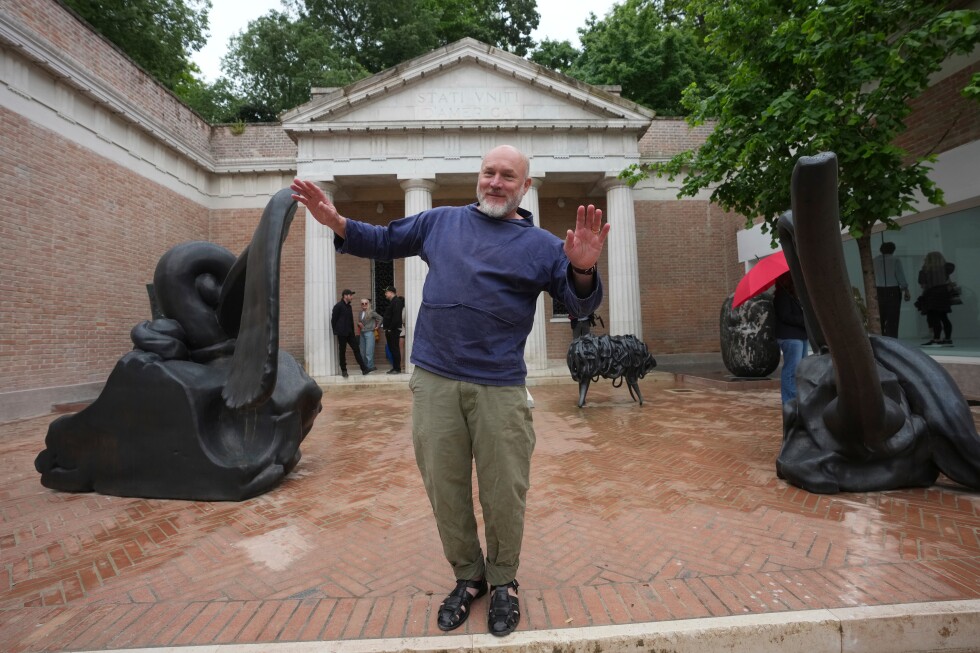
“This is really the first circumstance in my life as an artist where I felt the need to defend myself, or my work,” Allen told The Associated Press during a walk-through of the U.S. Pavilion. Having operated largely outside the critical eye for three decades “has been actually a pleasure,” he admitted.
The selection process for this year’s U.S. representation has been described as “opaque,” casting a shadow over the exhibition’s opening. Many institutions that typically compete for the coveted Biennale commission reportedly stepped back due to concerns about political interference. The open call for submissions had removed language focusing on diversity, equity and inclusion, replacing it with requirements to promote “American values.”
In what he describes as an “ironic act,” Allen created a bronze evil eye to hang on the exterior of the brick, Jeffersonian-style U.S. Pavilion—a talisman to ward off bad energy. It’s one of a dozen new pieces created specifically for this exhibition, which will likely mark a defining moment in his 30-year career. Just days before the Biennale’s opening, the protective charm had yet to arrive.
Biomorphic Visions
Allen specializes in creating biomorphic sculptures in wood, stone, and bronze. He intentionally avoids naming his abstract pieces, preferring to give viewers “a moment of creation when they can decide what it is” themselves.
His Biennale exhibition, titled “Call Me the Breeze,” features works spanning the last two decades alongside new creations. Allen chose the title to reflect his ability to navigate around obstacles throughout his career.
“That’s been my necessity, and it’s also because of being self-taught and not having any institutional support very often in life,” he explained.
Jeffrey Uslip, the pavilion’s commissioner, highlighted Allen’s institutional independence as a key factor in his selection. “I am deeply interested and invested in artists who are not, I guess, academicized… or lobotomized,” Uslip noted.
Controversial Selection
The path to Allen’s appointment was unconventional and controversial. A previously approved proposal for artist Robert Lazzarini, curated by art historian John Ravenal, collapsed in September after the project’s required institutional sponsor withdrew, despite having secured State Department approval.
A subsequent attempt to link the Lazzarini project to the newly formed American Arts Conservancy failed. Shortly afterward, the new project with the AAC as sponsor, Uslip as curator, and Allen as artist was announced.
When asked about the selection process, Uslip declined to comment. Ravenal, however, called it “highly unusual,” noting there was no apparent committee vetting or application process despite the application deadline having expired in July.
“It’s really a loss of a 40-year history of open call and peer review,” Ravenal told AP by telephone, describing Allen as “a pawn in this whole thing.”
Allen acknowledges that his willingness to mount the show has generated some backlash, but he insists the Trump administration has not interfered with the exhibition. “My art is not propaganda,” he emphasized.
From Homelessness to Venice
In the pavilion’s courtyard stands a headless, directionless sheep—Allen’s self-portrait as an outsider. He described it as “a bit shunned because it’s the wrong sheep.”
His recent works include bronze wall sculptures treated with chemicals in a form of painting, handling the hard metal “as an instantaneous material, like watercolor,” according to the artist.
Allen’s journey to the Biennale includes a period of homelessness in New York City, during which he sold his creations from atop an ironing board. This act of “admitted desperation” inadvertently launched his artistic career by establishing his first collectors.
His work is now included in the collections of the Los Angeles County Museum of Art and the Palm Springs Art Museum, and he participated in the prestigious 2014 Whitney Biennial. He made his European debut in Brussels in 2022.
After receiving the Biennale commission, Allen visited Venice for the first time in November to view the U.S. Pavilion—a neoclassic brick building built around a courtyard and rotunda. A painting by Hieronymus Bosch titled “The Visions of Hereafter” at Venice’s Accademia, depicting heaven, hell, and purgatory, inspired the show’s organizing principle.
“I wanted there to be a bit of the chaos that we go through,” Allen explained.
Beyond his artistic merit, Allen attributes his selection partly to his willingness to embrace last-minute challenges. “I’m just ready to do things at the last minute,” he said. “When they do, I’m prepared to try it, and fail at it. That’s fine.”
Fact Checker
Verify the accuracy of this article using The Disinformation Commission analysis and real-time sources.

12 Comments
Glad to see the Biennale selection process is sparking some debate and controversy. That often leads to more interesting, diverse artistic voices getting a platform. Alma Allen’s background as an outsider artist should make for a refreshing change of pace.
Fascinating to see an outsider artist like Alma Allen get this kind of prestigious platform at the Venice Biennale. His bronze ‘evil eye’ sculpture sounds intriguing – I’d love to see how he interprets that symbolism in his work.
Agreed, the selection process for the US pavilion seems to have been quite contentious. But Allen’s unique perspective and self-taught style could make for a refreshing contrast to the usual Biennale fare.
The Venice Biennale can feel like an insular, elite event at times. So it’s good to see an artist like Alma Allen, with his unorthodox background, getting a chance to showcase his work on that global stage. Looking forward to seeing how his ‘evil eye’ sculpture is interpreted.
The Venice Biennale can sometimes feel like an insular, elite bubble. So it’s great to see an outsider artist like Alma Allen get a chance to showcase his work on that global stage. His bronze ‘evil eye’ sculpture sounds like it could be a thought-provoking centerpiece.
As an outsider artist, Alma Allen must have mixed feelings about this high-profile exhibition at the Venice Biennale. On one hand, it’s a huge opportunity. On the other, he seems apprehensive about the intense scrutiny that comes with it. Curious to see how he navigates that dynamic.
I agree, the selection process for the US pavilion sounds quite controversial. That could work in Allen’s favor, drawing more attention to his unconventional approach and perspective as an artist.
The art world can be quite insular, so it’s great to see a maverick like Alma Allen get his moment in the spotlight. His background as a self-taught sculptor from Utah, now based in Mexico, definitely gives him an outsider’s view.
I’m curious to see how Allen’s ‘evil eye’ sculpture will be received. That’s a powerful, almost primal symbol that could resonate strongly at the Biennale. Sounds like a thought-provoking exhibition.
Very interesting to see an ‘outsider artist’ like Alma Allen get a platform at the prestigious Venice Biennale. His bronze ‘evil eye’ sculpture sounds like a bold, thought-provoking work. I’m curious to see how it’s received within the elite art world context.
Alma Allen’s background as a self-taught sculptor from Utah, now working in Mexico, gives him a really unique outsider perspective. That could make his contribution to the Venice Biennale quite refreshing and provocative compared to the usual fare. Looking forward to seeing his ‘evil eye’ piece.
Agree, the selection process for the US pavilion seems to have been quite contentious. But that controversy could actually end up working in Allen’s favor, drawing more attention to his unconventional approach and artistic vision.