


Listen to the article
Protesters Target Japan’s Fossil Fuel Investments at UN Climate Summit
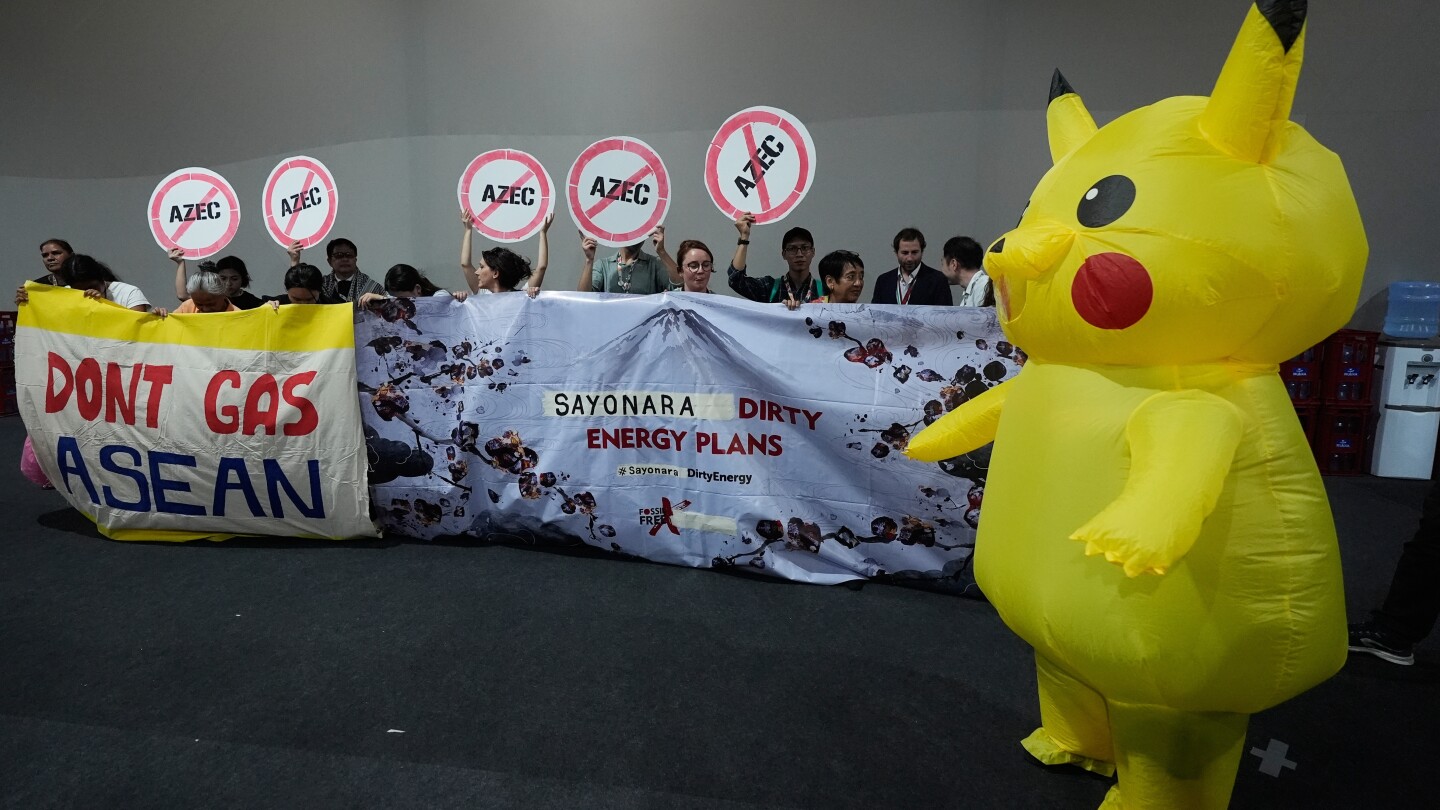
Demonstrators in Pokemon costumes took center stage at the United Nations climate conference in Belem, Brazil, on Friday, calling for Japan to end its financing of coal and natural gas projects across Southeast Asia and other developing regions.
The colorful protest, featuring activists dressed as Pikachu characters, coincided with the energy-focused thematic day at COP30, being held on the edge of the Brazilian Amazon. Organizers aimed to highlight what they describe as Japan’s contradictory position as a self-proclaimed decarbonization leader while continuing to fund fossil fuel developments abroad.
“Japan is actually delaying the fossil fuel phase-out across Asia” by funding energy projects, primarily liquefied natural gas developments, in countries like Thailand, Malaysia, Indonesia and the Philippines, said Hiroki Osada with Friends of the Earth Japan, one of the protest organizers.
“It’s so important for our Global South comrades to voice their concerns in Belem, so that they can actually demand the Japanese government to do something about this,” he added.
According to a 2025 study by the Philippines-based research organization Center for Energy, Ecology and Development, the government-owned Japan Bank for International Cooperation provided $6.4 billion in loans for coal projects and $874 million for gas projects between 2016 and 2024. The study was based on public government and banking data.
When contacted by The Associated Press, the Japanese delegation at COP30 declined to directly address the protesters’ claims. Instead, they stated that Japan’s cooperation with Southeast Asian nations aims to achieve “decarbonization, economic growth and energy security simultaneously through varies pathways” with the support of those countries.
The protest featured two people wearing life-sized, inflatable Pikachu costumes who flanked several activists. Protesters carried banners reading “Don’t gas ASEAN,” referring to the Association of Southeast Asian Nations, home to multiple Japan-backed fossil fuel projects. Ian Rivera, national coordinator at Philippine Movement for Climate Justice, led chants of “Only Pokemon, no fossil fuels” and “Sayonara fossil fuels.”
The demonstrators later visited the country pavilions of India, Indonesia and Malaysia “to reveal how Japan is exporting its fossil agenda.”
“If Global North countries, like Japan, decide to double down on fossil fuel production and export, that is going to make it impossible for countries across the Global South to make the just energy transition,” said Amiera Sawas, head of research and policy at the Fossil Fuel Non Proliferation Treaty Initiative.
The Pikachu protest was one of several anti-fossil fuel demonstrations at the conference. Earlier Friday, activists blocked the main entrance to the venue, prompting increased security measures. They also hosted a “Kick Out the Suits” event demanding the removal of fossil fuel lobbyists, whom environmentalists accused of undermining negotiations.
Larger protests are expected Saturday to mark the midpoint of COP30, including a march featuring a “funeral for fossil fuels” where giant coffins symbolizing coal, oil, and gas will be carried through the streets of Belem.
The global transition away from fossil fuels remains a central topic at COP30. Brazilian President Luiz Inácio Lula da Silva set the tone during last week’s Leaders’ Summit when he called for world leaders to prepare a roadmap to “overcome dependence on fossil fuels.” Several nations, including Denmark, the United Kingdom, Kenya, France, and Germany, supported Lula’s call.
At the previous climate summit in Dubai (COP28), nearly 200 countries agreed to move away from fossil fuels – the first such pledge in decades of UN climate talks. However, many experts warned that the agreement still contained significant shortcomings.
“At COP30, we need an actionable outcome, not another road map to nowhere,” said Jasper Inventor, deputy program director with Greenpeace International. “While it’s positive to see progression in Belem, we must ensure that this actually leads towards a clear plan to phase out fossil fuels and one that fast-tracks renewables.”
The protests highlight growing tensions between developed and developing nations regarding responsibility for climate action and the pace of energy transition. Environmental advocates argue that continued fossil fuel investments by wealthy countries undermine global climate goals while locking developing regions into carbon-intensive development paths.
As COP30 enters its second week, negotiators will face increased pressure to produce concrete actions rather than aspirational declarations on fossil fuel reduction and renewable energy adoption.
Fact Checker
Verify the accuracy of this article using The Disinformation Commission analysis and real-time sources.

15 Comments
The protesters make a fair point. If Japan wants to be seen as a climate leader, it needs to align its international investments with its domestic decarbonization goals. Continuing to fund fossil fuel projects abroad is hypocritical and counterproductive.
The use of Pikachu costumes is a clever tactic to engage the public and draw attention to this important issue. Financing fossil fuel projects undermines global climate efforts, so Japan should heed the protesters’ calls to end this contradictory practice.
The Pikachu costumes certainly make for a memorable protest. But the underlying message is an important one – Japan must practice what it preaches when it comes to climate action. Ending fossil fuel financing abroad should be a priority for the government.
Clever use of Pikachu costumes to draw attention to this important issue. Japan’s continued financing of fossil fuel projects abroad, even as it promotes its climate leadership, is undoubtedly hypocritical. The protesters are right to demand policy changes from the Japanese government.
Kudos to the protesters for bringing attention to this issue. Japan’s continued fossil fuel financing, even as it positions itself as a climate leader, is troubling. The country needs to align its international investments with its domestic climate commitments.
While the Pikachu costumes are eye-catching, the underlying message about Japan’s fossil fuel financing is a serious one. Developing countries need support to transition away from dirty energy, not more investments that lock in emissions. Japan should reconsider its priorities.
You raise a good point. Developing nations often lack the resources to rapidly shift to clean energy on their own. Japan could play a more constructive role by redirecting its financing towards renewable infrastructure and climate adaptation in the Global South.
The protesters raise a valid point about the contradiction between Japan’s climate leadership rhetoric and its continued financing of fossil fuel projects abroad. Transitioning away from fossil fuels will require difficult choices, but leadership means making tough decisions.
Japan positioning itself as a decarbonization leader while still funding fossil fuel development in other countries is certainly hypocritical. The activists are right to call out this disconnect and demand more ambitious climate action from the Japanese government.
Agreed. If Japan wants to be taken seriously on climate, it needs to align its international investments with its domestic climate goals. Putting pressure through creative protests is one way to push for that accountability.
While the Pikachu costumes are attention-grabbing, the activists are right to call out Japan’s climate policy contradictions. Providing financial support for fossil fuel infrastructure in other countries runs counter to the global emissions reductions needed. Japan should heed this protest and change course.
I agree. Japan has an opportunity to demonstrate real climate leadership by redirecting its international financing away from fossil fuels and towards renewable energy and climate adaptation solutions in the developing world.
It’s good to see activists using creative tactics to highlight Japan’s contradictory climate policies. Financing fossil fuel projects in developing countries undermines global emissions reduction efforts. Japan needs to walk the talk on its climate commitments.
Interesting protest tactic using Pikachu costumes to call attention to Japan’s fossil fuel financing. It’s a creative way to engage the public and put pressure on the government to align its climate commitments with its investment decisions.
I agree, the Pikachu costumes are an eye-catching way to raise awareness. It will be important to see if this protest leads to any concrete policy changes from the Japanese government.