


Listen to the article
Pope Leo XIV concluded his visit to Cameroon on Saturday, calling for “structures of solidarity” to assist those on the margins before departing for Angola as part of his four-nation African tour.
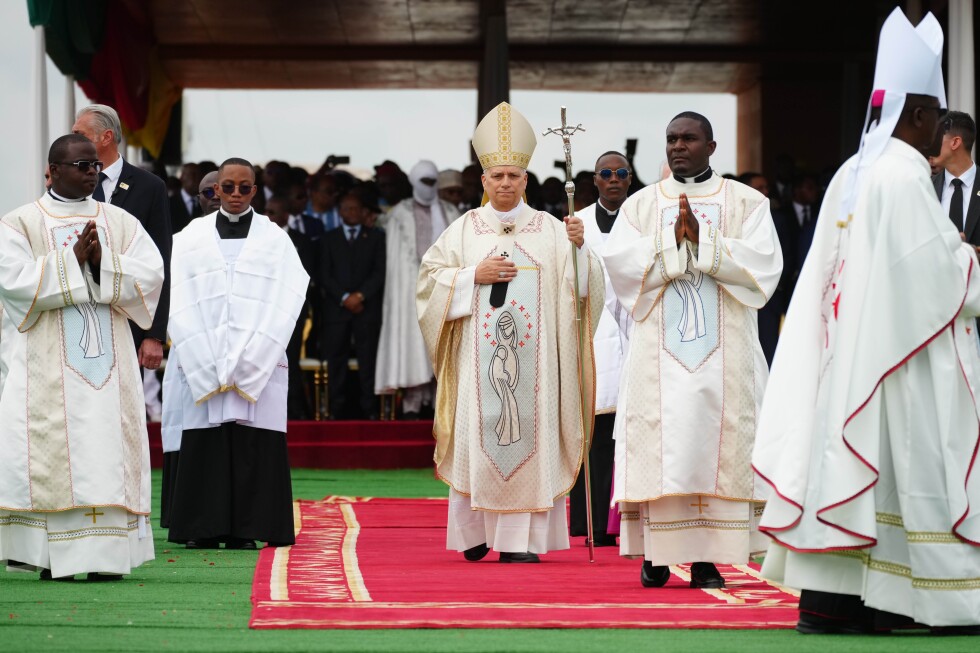
The Pope celebrated Mass at Yaounde Airport before an estimated crowd of 200,000 people, including 93-year-old President Paul Biya, the world’s oldest head of state. The enthusiastic atmosphere highlighted the significance of the papal visit to this former French colony, where approximately one-third of the population identifies as Catholic.
Family members pushed some mobility-challenged attendees to the Mass in wheelbarrows, demonstrating the determination of many to witness the historic event. Leo XIV is the third pope to visit Cameroon.
During his homily, delivered in French, the pontiff emphasized that respect for human dignity must be foundational to every society. “Every community has the obligation to create and sustain structures of solidarity and mutual aid in which, when faced with crises — be they social, political, medical or economic — everyone can give and receive assistance according to their own capacity and needs,” he stated.
Throughout his Cameroon visit, Pope Leo focused on encouraging youth to maintain hope despite feelings of disillusionment. He also challenged elites to stop exploiting the land and its people purely for profit, condemning the “chains of corruption” hampering development and criticizing “tyrants” who damage the Earth through war and exploitation.
Following the Mass, Leo departed for Luanda, Angola’s capital, where he is scheduled to meet with President Joao Lourenco and deliver an address to government authorities.
Angola, home to approximately 38 million people, gained independence from Portugal in 1975 but immediately plunged into a devastating civil war that continued intermittently for 27 years until 2002. The conflict, which claimed an estimated 500,000 lives, was for years a Cold War proxy battle with the United States and apartheid South Africa supporting one side while the Soviet Union and Cuba backed the other.
“I would like to hear a message of peace, a message of reconciliation,” said Luanda resident Sergio Jose, expressing hopes for the papal visit. “I would also like to hear good political messages and that the pope would also talk about the upcoming elections in Angola.”
Despite being Africa’s fourth-largest oil producer, the world’s third-largest diamond producer, and possessing significant deposits of gold and critical minerals, Angola faces substantial economic inequality. The World Bank estimated in 2023 that more than 30% of the population lived on less than $2.15 per day.
The country has struggled with corruption, particularly during the 38-year rule of former President Jose Eduardo dos Santos from 1979 to 2017. President Lourenco’s administration has estimated that at least $24 billion was misappropriated during the dos Santos era and has pledged to combat corruption. However, critics question whether these efforts genuinely address systemic issues or merely target political rivals.
Angola holds particular historical significance as the epicenter of the transatlantic slave trade during Portuguese colonization. More than 5 million of the approximately 12.5 million enslaved Africans were transported across the Atlantic on ships departing from Angola—more than from any other country.
A highlight of Pope Leo’s Angola visit will be Sunday’s journey to Muxima, south of Luanda, where he will pray the Rosary at the Church of Our Lady of Muxima. Built by Portuguese colonizers in the late 16th century as part of a fortress complex, the shrine became integral to the slave trade and represents the historical connection between Catholicism and exploitation of the African continent.
This visit carries personal significance for Leo XIV, history’s first American-born pope, whose ancestry reportedly includes both enslaved people and slave owners, according to genealogical research. The Muxima site has become a popular pilgrimage destination since believers reported an appearance of the Virgin Mary around 1833.
The Pope’s four-nation African journey continues to address themes of reconciliation, economic justice, and the Church’s complicated historical legacy on the continent, while offering messages of hope to millions of African Catholics.
Fact Checker
Verify the accuracy of this article using The Disinformation Commission analysis and real-time sources.

11 Comments
The large crowds and mobility-challenged attendees pushed in wheelbarrows highlight the deep connection between the Cameroonian people and the Catholic Church. This visit must be tremendously meaningful for the faithful there. I hope the Pope’s message of solidarity leaves a lasting impact.
The enthusiastic welcome and large crowds at the Pope’s Mass highlight the significance of this visit to Cameroon. It’s a powerful symbol of the country’s Catholic faith and community. I hope the Pope’s message of human dignity resonates and leads to positive change.
Agreed. The Pope’s moral authority can help shine a light on important issues and mobilize support. It will be interesting to see what concrete initiatives emerge from this visit.
It’s great to see the Pope focusing on issues of social justice and community support during his visit to Cameroon. Addressing the needs of the marginalized is crucial, and faith-based organizations can play a pivotal role. I’m curious to see how this translates into on-the-ground change.
Agreed. The Pope’s moral authority and platform provide an important opportunity to shine a light on critical social challenges. Tangible programs and policy changes will be the true test of the impact.
The Pope’s emphasis on human dignity as the foundation for every society is a powerful and timely message. In a world facing so much division and inequality, promoting mutual respect and assistance is essential. I’m curious to see how this resonates in Cameroon.
Absolutely. Upholding human dignity should be a core principle for all communities. It will be interesting to monitor whether the Pope’s visit catalyzes any policy changes or grassroots initiatives in that direction.
The Pope’s call for ‘structures of solidarity’ in Cameroon is a timely and important message. Building resilient community support systems is essential, especially in the face of economic and social crises. I hope this vision resonates and leads to positive change.
It’s encouraging to see the Pope advocating for ‘structures of solidarity’ to help those on the margins in Cameroon. Developing strong social safety nets and community support systems is crucial, especially in challenging economic times. I hope this message takes root.
Interesting to see the Pope focusing on structures of solidarity and mutual aid during his visit to Cameroon. It’s an important message of community support, especially for the most vulnerable. I wonder how the local Catholic community will put these ideas into practice going forward.
Yes, the emphasis on creating systems to assist those in need is commendable. Faith-based organizations can play a vital role in addressing societal challenges in places like Cameroon.