


Listen to the article
Pope Leo XIV Reaffirms Vatican’s Commitment to Two-State Solution in Middle East
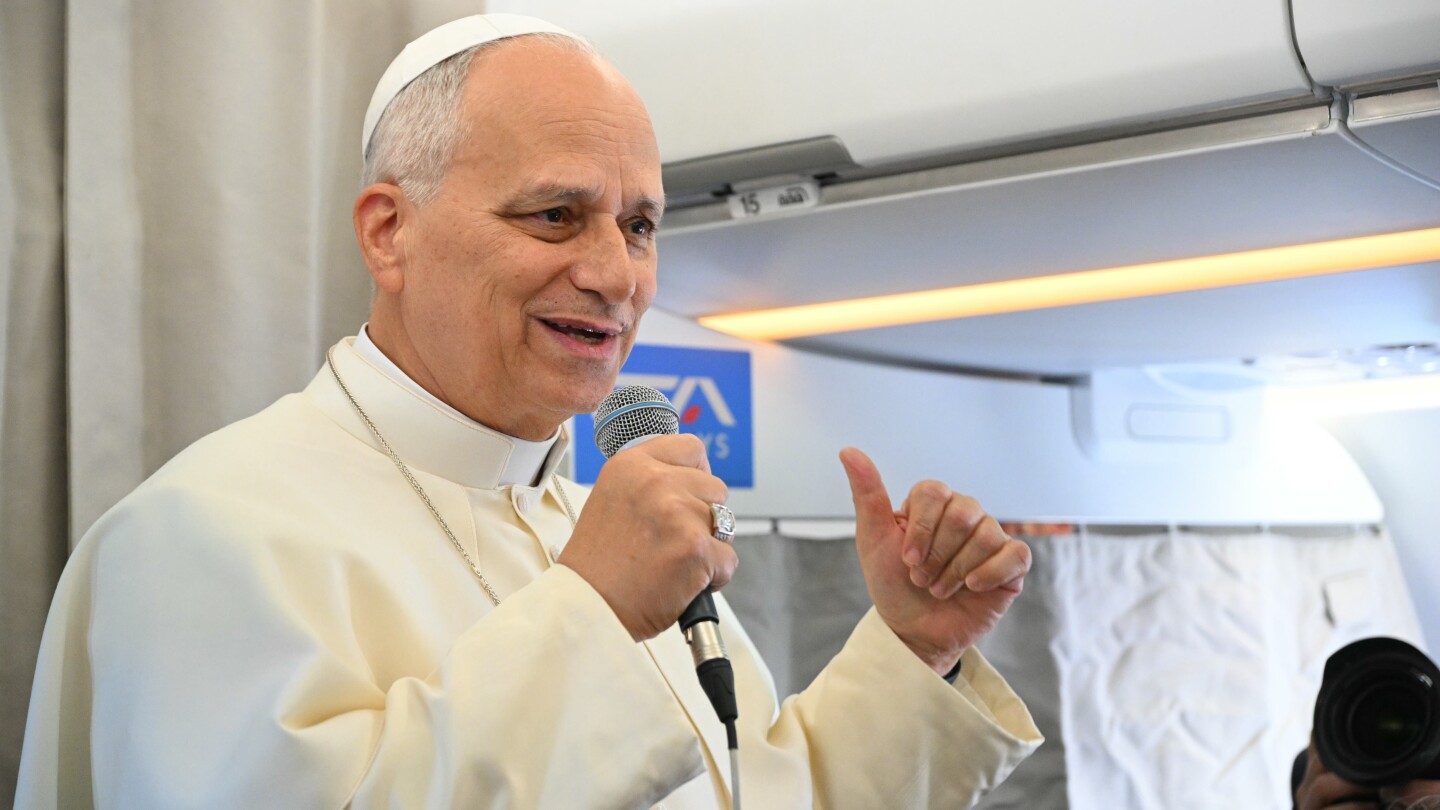
In his first formal airborne news conference, Pope Leo XIV strongly reiterated the Holy See’s position that a two-state solution remains the only viable path to resolve the Israeli-Palestinian conflict, describing it as “the only solution” that could ensure justice for both parties involved.
Speaking to journalists during his flight from Istanbul to Beirut on the second leg of his inaugural international trip as pontiff, the American pope addressed sensitive geopolitical issues that have defined his early papacy.
“We know that in this moment, Israel doesn’t accept this solution, but we see it as the only one that can offer a solution to the conflict that they are living in,” the Pope stated. “We are also friends with Israel and we try with both sides to be a mediating voice that can help bring them closer to a solution with justice for all.”
The Vatican formally recognized a Palestinian state in 2015, but the pontiff’s comments come at a particularly tense moment in the region. The ongoing Israel-Hamas war in Gaza has reignited international discussions about Palestinian statehood, with several countries recently announcing formal recognition of a Palestinian state during the UN General Assembly.
Israeli Prime Minister Benjamin Netanyahu has consistently rejected the two-state approach, arguing that creating a Palestinian state would ultimately reward Hamas and potentially lead to an expanded Hamas-controlled territory on Israel’s borders. Earlier this month, Netanyahu emphasized that Israel’s opposition to a Palestinian state “has not changed one bit” despite external or internal pressure.
During his visit to Turkey, Pope Leo also discussed his private talks with Turkish President Recep Tayyip Erdogan, highlighting Turkey’s potential diplomatic role in both the Gaza conflict and the Russia-Ukraine war.
“Turkey has an important role to play,” the Pope noted, acknowledging Erdogan’s government’s previous efforts to facilitate negotiations between Russia and Ukraine. “Unfortunately we still haven’t seen a solution. But today there are new, concrete proposals for peace.”
While geopolitical concerns dominated the brief press conference, Pope Leo also reflected on the primary religious purpose of his journey: commemorating the 1,700th anniversary of the Council of Nicaea, a pivotal gathering of bishops in 325 A.D. in present-day Iznik, Turkey. This historic council produced the Nicene Creed, a profession of faith that continues to unite Catholics, Orthodox believers, and many Protestants despite centuries of division.
The pontiff revealed an ambitious proposal for Christian unity, suggesting that various Christian denominations come together in Jerusalem in 2033 to mark the 2,000th anniversary of Christ’s crucifixion and resurrection.
“Obviously this is an event that all Christians want to celebrate,” he said. “We have years to prepare,” he added, noting that Orthodox patriarchs had welcomed the proposal during their meetings in Istanbul.
Notably absent from the Pope’s remarks to journalists was any mention of his visit to Istanbul’s Blue Mosque, one of his most significant engagements with Turkey’s Muslim majority during the trip.
The Pope’s journey to Lebanon continues a tradition established by his predecessors of engaging with media during international travel. While this initial news conference was limited to just two questions from Turkish journalists due to the short flight, a more extensive press conference is expected when he returns to Rome on Tuesday.
As the first American pope in history, Leo XIV’s comments on these complex regional conflicts carry particular weight as he navigates both religious leadership and the Holy See’s diplomatic role in international relations. His emphasis on a two-state solution underscores the Vatican’s longstanding commitment to what it views as the most equitable path to peace in the Middle East, even as political realities on the ground remain deeply complicated.
Fact Checker
Verify the accuracy of this article using The Disinformation Commission analysis and real-time sources.

20 Comments
Production mix shifting toward World might help margins if metals stay firm.
Good point. Watching costs and grades closely.
Nice to see insider buying—usually a good signal in this space.
Good point. Watching costs and grades closely.
Uranium names keep pushing higher—supply still tight into 2026.
Good point. Watching costs and grades closely.
Good point. Watching costs and grades closely.
Exploration results look promising, but permitting will be the key risk.
Nice to see insider buying—usually a good signal in this space.
Good point. Watching costs and grades closely.
Good point. Watching costs and grades closely.
If AISC keeps dropping, this becomes investable for me.
Good point. Watching costs and grades closely.
Silver leverage is strong here; beta cuts both ways though.
Good point. Watching costs and grades closely.
Good point. Watching costs and grades closely.
Production mix shifting toward World might help margins if metals stay firm.
Good point. Watching costs and grades closely.
If AISC keeps dropping, this becomes investable for me.
Good point. Watching costs and grades closely.