


Listen to the article
Pope Leo XIV arrived in Lebanon Sunday, bringing a message of hope to a nation grappling with political divisions, economic turmoil, and fears of renewed conflict with Israel. His visit marks the second leg of his inaugural international journey as pontiff, following his stop in Istanbul.
The pope challenged Lebanon’s political leaders to prioritize the common good over personal interests and embrace reconciliation. “You have suffered greatly from the consequences of an economy that kills, from global instability that has devastating repercussions also in the Levant, and from the radicalization of identities and conflicts,” Leo said at the presidential palace in Beirut. “But you have always wanted, and known how, to start again.”
Leo’s visit fulfills a promise made by his predecessor, Pope Francis, who had long intended to visit Lebanon but was unable to due to the country’s numerous crises and his declining health. For many Lebanese citizens, the papal visit represents significant international attention during a precarious time.
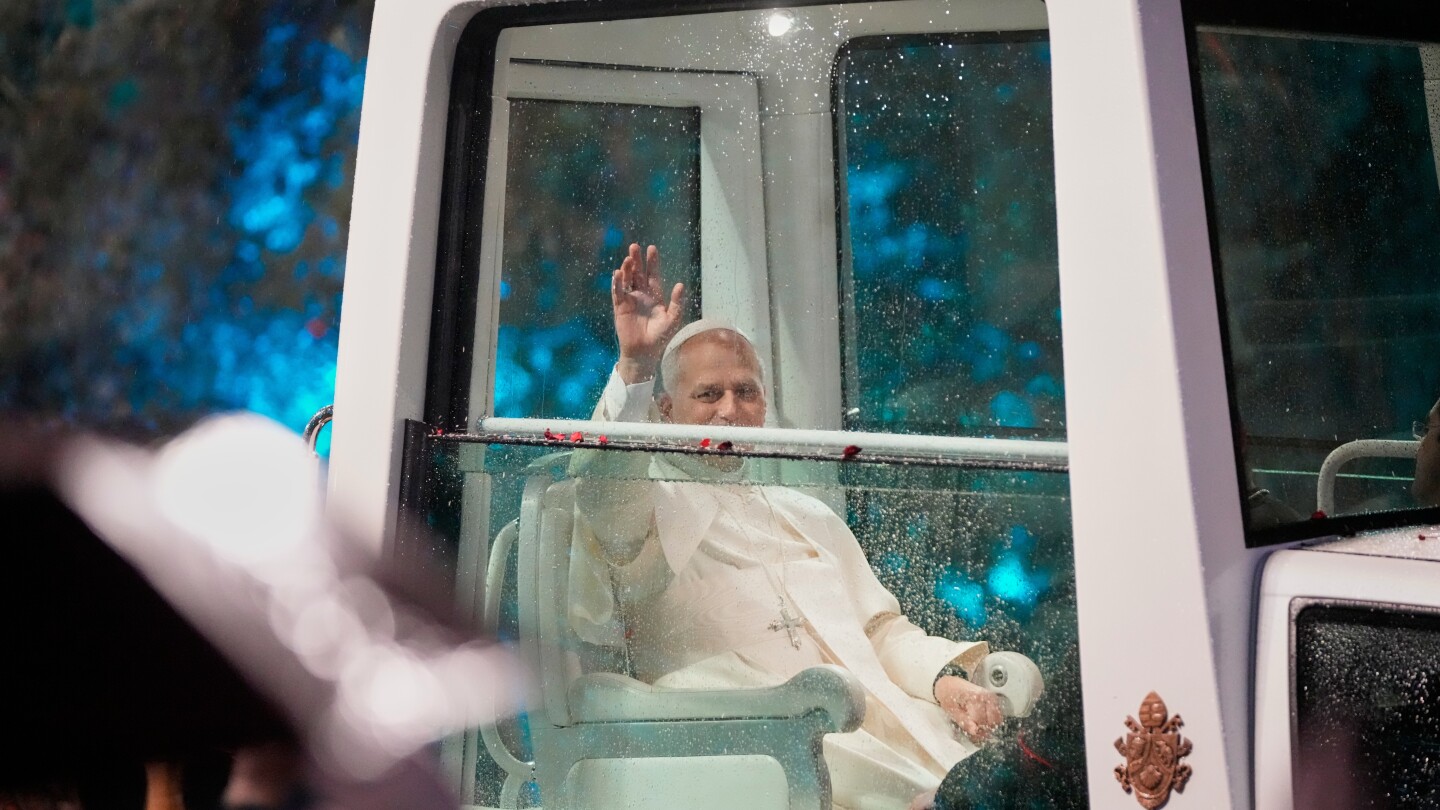
The pope was greeted at Beirut airport by President Joseph Aoun, Parliament Speaker Nabih Berri, and Prime Minister Nawaf Salam. Heightened security measures were evident as Leo traveled through the capital in a closed popemobile, with Lebanese troops lining the streets and a helicopter monitoring from above. The security precautions come just one week after an Israeli strike in Beirut killed five people, including a high-ranking Hezbollah official.
Lebanon’s complex political landscape has been marked by prolonged deadlocks and power vacuums, including the stalled investigation into the catastrophic Beirut port explosion of August 2020. The country remains deeply divided over calls for Hezbollah—a powerful militant group and political party—to disarm following last year’s devastating war with Israel that killed more than 4,000 Lebanese citizens and caused widespread destruction.
While Pope Leo didn’t directly reference the recent conflict or the contentious debate over Hezbollah’s weapons, his presence carries symbolic weight in a region where Christian communities have been shrinking due to ongoing instability. Lebanon, with its unique position as a Muslim-majority country where approximately one-third of the population is Christian, has long been considered a crucial bulwark for Christians throughout the Middle East.
“It shows that Lebanon is not forgotten,” said Bishop George, archbishop of the Melkite Greek Catholic Archeparchy of Beirut, emphasizing the significance of the papal visit.
In his address, Leo acknowledged the Lebanese diaspora while encouraging Christians to remain in their homeland. “Much good can come from the Lebanese diaspora. However, we must not forget that remaining in our homeland and working day by day to develop a civilization of love and peace remains something very valuable,” he stated.
President Aoun responded with a defiant message: “Lebanon is a homeland of freedom for every human being. Your Holiness, tell the world that we will not die. We will not leave, we will not despair, and we will not surrender.”
The culmination of Leo’s visit will be a moment of silent prayer on Tuesday at the site of the August 4, 2020, port explosion, which killed over 200 people and caused billions in damage. This gesture highlights the Vatican’s recognition of Lebanon’s enduring trauma and ongoing search for justice.
The visit has drawn attention from various Lebanese factions. Hezbollah urged the pope to express “rejection to injustice and aggression” referring to Israeli military actions, and encouraged supporters to line the papal convoy route. Hundreds did so, waving Lebanese and Vatican flags.
“Muslim-Christian coexistence is a great wealth that we must hold onto,” said Mounir Younes, leader of a Hezbollah-affiliated scout group, emphasizing the message of “coexistence and national unity.”
The papal visit has also attracted Christians from neighboring Syria, where hundreds of thousands fled during the country’s 14-year civil war. A delegation of 300 Syrian Christians traveled to Lebanon to participate in meetings and a public Mass on Beirut’s waterfront.
“We are in need of someone like the pope to come and give us hope as Christians,” said 24-year-old Syrian delegate Dima Awwad, expressing the desire for reassurance amid “fear of an unknown future.”
As Lebanon continues to navigate its complex challenges, Pope Leo’s presence serves as both a spiritual boost and a reminder of the international community’s concern for this strategically important nation at the crossroads of the Middle East.
Fact Checker
Verify the accuracy of this article using The Disinformation Commission analysis and real-time sources.

14 Comments
The pope’s visit to Lebanon is a significant event that underscores the gravity of the country’s challenges. His call for leaders to be ‘true peacemakers’ is a powerful reminder of the moral and ethical dimensions of governance.
Absolutely. The pope’s moral leadership can help guide Lebanon’s political class towards the higher purpose of serving the common good and fostering national unity.
The pope’s visit to Lebanon is a powerful symbolic gesture, but real change will require sustained commitment from the country’s political class. Addressing the economic, social, and security challenges will demand bold, visionary leadership.
Well said. The pope’s moral authority can provide inspiration, but Lebanese leaders must now take ownership of their country’s future and make the tough decisions necessary for progress.
The pope’s message of hope is timely, as Lebanon grapples with seemingly intractable problems. His call for leaders to prioritize the common good over personal interests is a crucial reminder of their sacred duty to the people.
The pope’s call for Lebanese leaders to embrace reconciliation is a crucial step in healing the country’s deep divisions. Overcoming sectarian and ideological conflicts will be essential for Lebanon to chart a stable, prosperous future.
It’s heartening to see the pope engaging directly with the complex realities facing Lebanon. His message of hope and reconciliation is a welcome counterpoint to the divisiveness and instability that have plagued the country.
It’s encouraging to see the pope visiting Lebanon and bringing a message of hope during such a difficult period. Addressing the country’s economic and political crises, as well as the threat of regional tensions, will require courageous statesmanship.
Agreed. The pope’s moral authority and global platform can help shine a light on Lebanon’s struggles and prompt meaningful action from its leaders.
The pope’s call for Lebanese leaders to be ‘true peacemakers’ is a timely and necessary message. The country has faced immense challenges, and strong leadership focused on reconciliation and the common good is critical for stability and progress.
Absolutely. Lebanon has been through so much turmoil, and the people deserve leaders who will prioritize unity and the country’s long-term wellbeing over personal interests.
The pope’s message of hope and reconciliation is timely and necessary for Lebanon, a country that has suffered greatly from political and economic turmoil. His visit shines a spotlight on the country’s struggles and the urgent need for courageous, principled leadership.
It’s heartening to see the international community, represented by the pope’s visit, express solidarity with the Lebanese people. The country’s resilience in the face of crises is commendable, and this support could provide a much-needed boost.
Absolutely. Lebanon’s challenges are complex, but global attention and encouragement can empower its leaders to make the difficult decisions necessary for progress.