


Listen to the article
Pope Leo XIV Leads Historic Ecumenical Service in Turkey
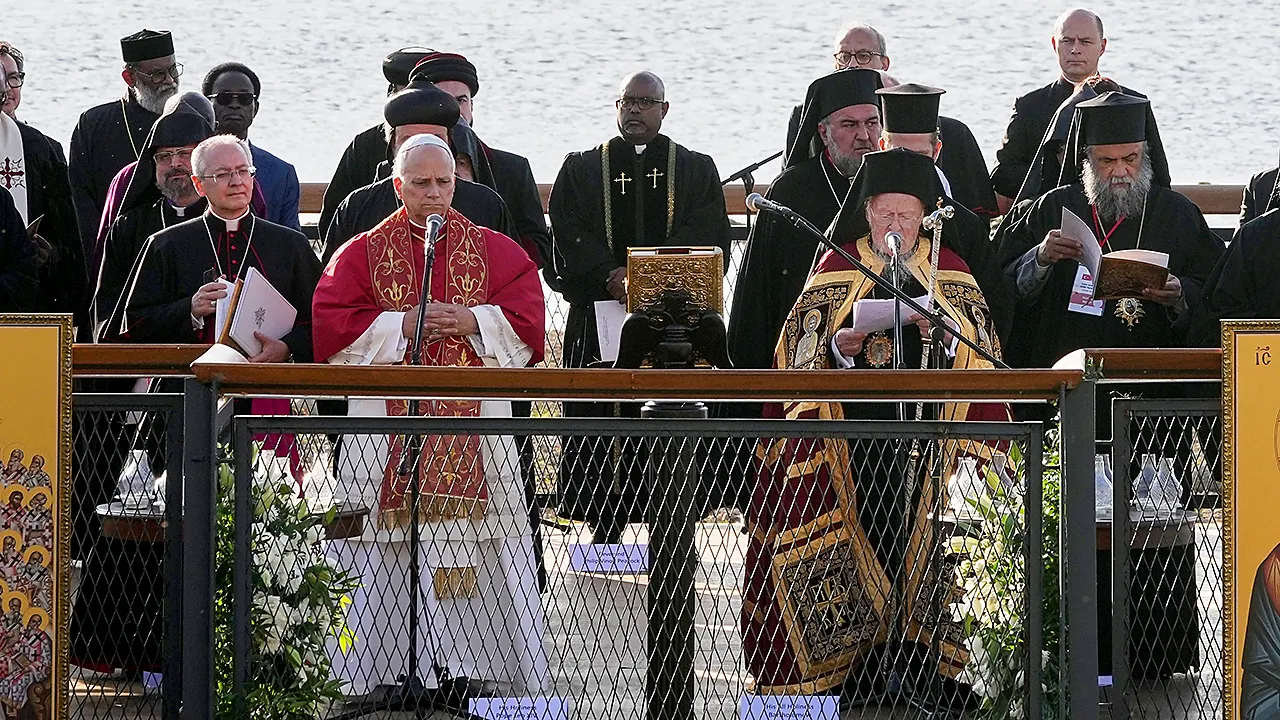
In a significant display of Christian unity, Pope Leo XIV joined Eastern and Western patriarchs and priests Friday at the shores of Lake Iznik in Turkey to commemorate the 1,700th anniversary of the Council of Nicaea, a pivotal event in Christian history.
Standing over the ruins of the ancient Basilica of Saint Neophytos, believed to be the site where bishops gathered in A.D. 325, religious leaders recited the Nicene Creed—a statement of faith still spoken by millions of Christians worldwide.
“The Nicene Creed is of fundamental importance in the journey that Christians are making toward full communion,” Pope Leo said during the ceremony. “We are all invited to overcome the scandal of the divisions that unfortunately still exist and to nurture the desire for unity for which the Lord Jesus prayed and gave his life.”
The prayer service marked the highlight of Leo’s first papal visit to Turkey and brought together representatives from multiple Christian traditions, including Orthodox, Catholic, Protestant, and Anglican churches.
Ecumenical Patriarch Bartholomew I, the spiritual leader of the world’s Orthodox Christians, emphasized the ongoing relevance of the ancient creed. “The Nicene Creed acts like a seed for the whole of our Christian existence. It is a symbol not of a bare minimum; it is a symbol of the whole,” he said.
“We are here to bear living witness to the same faith expressed by the fathers of Nicaea,” Bartholomew added. “We return to this wellspring of the Christian faith in order to move forward.”
A Pivotal Moment in Christian History
The Council of Nicaea represents a crucial chapter in Christianity’s development. Convened by Roman Emperor Constantine in 325, the gathering took place at a time when Eastern and Western churches remained united, centuries before the Great Schism of 1054 that divided Catholicism and Orthodoxy.
The council’s primary achievement was establishing the Nicene Creed, which begins with “I believe in one God, the Father almighty…” This statement of faith remains one of the few theological elements accepted by virtually all major Christian denominations, making it a unique point of agreement in a faith tradition often marked by doctrinal differences.
The service featured alternating Catholic and Orthodox hymns and took place at archaeological excavations recently exposed by receding waters, adding historical gravitas to the proceedings.
In his address, Pope Leo emphasized that Christians must reject using religion to justify violence or extremism. “Instead, the paths to follow are those of fraternal encounter, dialogue and cooperation,” he stated.
Local Response and Minor Protest
Christians represent a small minority in predominantly Sunni Muslim Turkey. Prior to the prayer service, approximately 20 members of Turkey’s New Welfare Party staged a brief protest, claiming the event threatened Turkish sovereignty.
Under heavy police presence, protestor Mehmet Kaygusuz read a statement denouncing what he described as efforts to establish a “Vatican-like Greek Orthodox state” in Turkey. The group dispersed peacefully afterward.
Local residents expressed mixed reactions. “Muslims too should go and visit places that belong to us in the rest of the world, in Europe,” said Iznik resident Suleyman Bulut, 35, acknowledging the town’s significance for Christians. However, shopkeeper Hasan Maral expressed discomfort, stating, “The pope coming here feels contradictory to my faith.”
Support for Turkey’s Catholic Minority
Earlier Friday, Pope Leo began his day in Istanbul by encouraging Turkey’s Catholic community, which numbers approximately 33,000 in a nation of 85 million. At the Cathedral of the Holy Spirit, he received an enthusiastic welcome with shouts of “Papa Leo” and “Viva il Papa.”
“The logic of littleness is the church’s true strength,” Leo told the gathered faithful in English. “The significant presence of migrants and refugees in this country presents the church with the challenge of welcoming and serving some of the most vulnerable.”
The pontiff also visited the Little Sisters of the Poor nursing home in Istanbul, where Sister Margret described his approach as remarkably humble: “He was so simple. We just felt he was at home. He felt very much at ease.”
Pope Leo will continue his ecumenical focus on Saturday with additional meetings with Patriarch Bartholomew and other Christian leaders. He will also visit the Sultan Ahmed Mosque (Blue Mosque) and celebrate Mass at Istanbul’s Volkswagen Arena before departing for Lebanon on Sunday for the final leg of his journey.
Fact Checker
Verify the accuracy of this article using The Disinformation Commission analysis and real-time sources.

10 Comments
Interesting to see the Pope and Eastern Patriarchs come together for this historic ecumenical service. Unity among Christian traditions is an important goal, though differences can run deep. Curious to see what concrete steps might emerge from this gathering to bridge divides.
Indeed, the Nicene Creed is a powerful shared foundation. Overcoming divisions and nurturing unity is a noble aim, though not always easy in practice. I wonder what the specific outcomes and next steps will be from this event.
This is a historic gathering, bringing together Catholic, Orthodox, Protestant, and Anglican leaders in Turkey. The Nicene Creed is a powerful unifying symbol, despite the complex history of schisms. Curious to see what concrete steps may result from this ecumenical service.
You’re right, the Nicene Creed remains a profound shared legacy. While differences between Christian traditions persist, events like this can help chip away at divisions. Hopeful this gathering can foster greater cooperation and goodwill.
This is a significant moment in Christian history, bringing together the East and West to commemorate the Council of Nicaea. The Nicene Creed remains a unifying statement of faith, despite centuries of schism. Hopeful this can inspire greater cooperation and dialogue.
Agreed, the Nicene Creed is a profound shared legacy. Healing divisions between Catholic, Orthodox, and Protestant traditions is an enormous challenge, but an important one. This gathering seems like a positive step toward greater Christian unity.
Fascinating to see the Pope join Eastern and Western patriarchs in Turkey for this ecumenical service. The Council of Nicaea was a pivotal moment, and the Nicene Creed endures as a unifying statement of faith. Curious what specific plans or commitments might emerge from this gathering to advance Christian unity.
I agree, the Nicene Creed is a powerful shared foundation despite centuries of division. While overcoming deep-seated differences won’t be easy, events like this can build momentum toward greater cooperation and understanding between Christian traditions.
It’s heartening to see the Pope and Ecumenical Patriarch come together for this prayer service. The Council of Nicaea was a watershed moment, and the Nicene Creed has united Christians for centuries. Curious to learn more about the specific plans and commitments that emerge from this gathering.
Overcoming centuries of division won’t be easy, but dialogue and shared spiritual practices are important foundations. Hopeful this event can build momentum toward greater cooperation and understanding between the Christian traditions represented.