


Listen to the article
Pope Leo XIV Celebrates Lebanon’s Interfaith Tradition as Sign of Hope Amid Regional Tensions
Pope Leo XIV praised Lebanon’s tradition of religious coexistence Monday, describing it as a crucial model for the conflict-plagued Middle East during an interfaith gathering with the country’s Christian and Muslim leaders.
The first American pope in history received an enthusiastic welcome on his first full day in Lebanon, with thousands of citizens lining the streets despite steady rain to catch a glimpse of the pontiff. Many threw flower petals and rice as his motorcade passed, while billboards bearing his image decorated highways throughout Beirut.
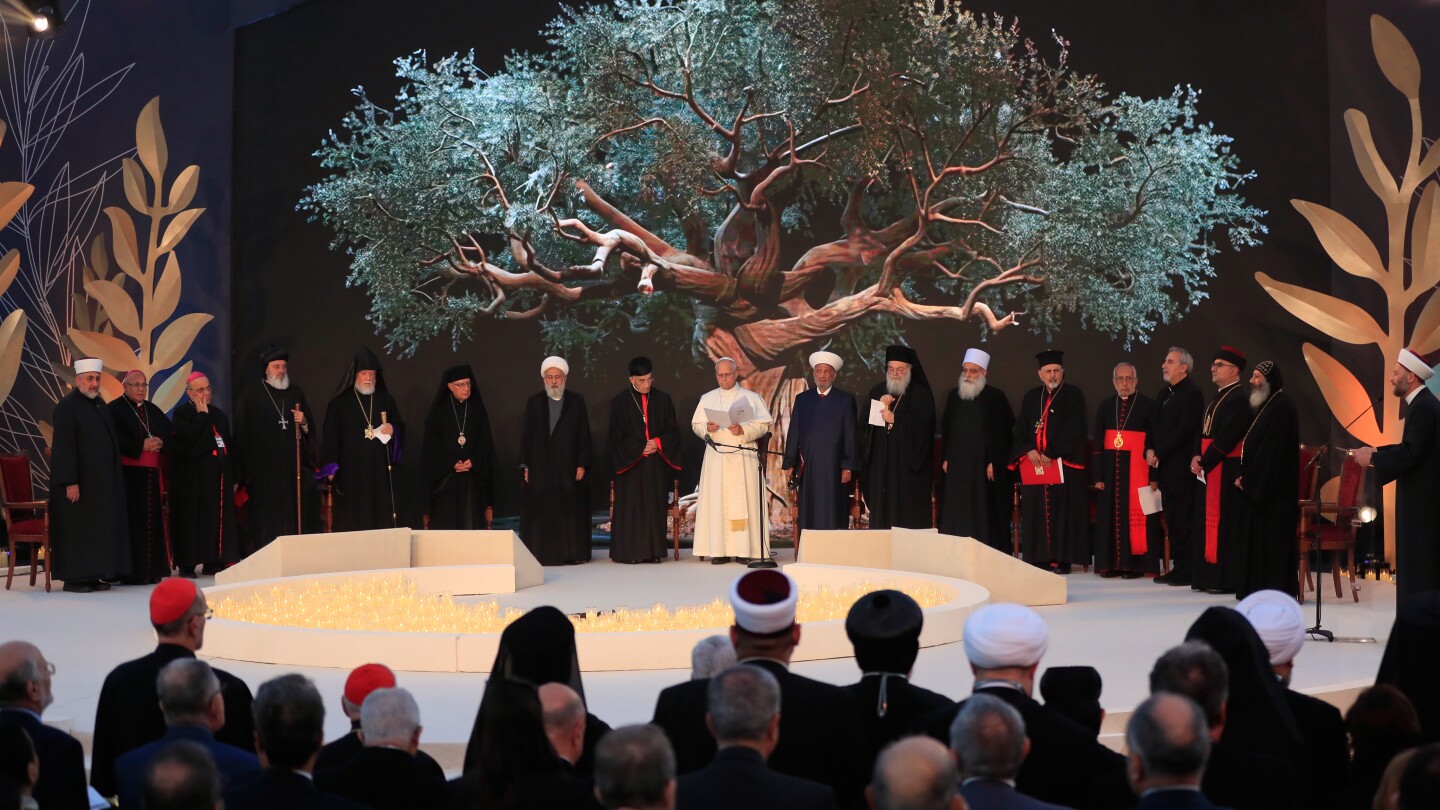
“In an age when coexistence can seem like a distant dream, the people of Lebanon, while embracing different religions, stand as a powerful reminder that fear, distrust and prejudice do not have the final word, and that unity, reconciliation, and peace are possible,” Leo said during the interfaith meeting at Beirut’s Martyr’s Square.
The gathering brought together the country’s Christian patriarchs alongside Sunni, Shiite, and Druze spiritual leaders under a single tent. After listening to readings from both the Bible and Quran, Leo emphasized Lebanon’s significance as a beacon for “the divine gift of peace” in a region often defined by conflict. The religious leaders concluded the ceremony by planting an olive sapling as a symbol of peace.
Leo’s visit comes at a particularly delicate moment for Lebanon, a nation still struggling to recover from years of economic crisis, political deadlock, and the devastating 2020 Beirut port explosion. The country also remains deeply divided over calls for Hezbollah, a powerful Lebanese militant group and political party, to disarm following last year’s war with Israel.
Despite a ceasefire, Israel has continued to carry out near-daily airstrikes targeting Hezbollah members, raising fears of a wider conflict. Ali al-Khatib, deputy head of the Supreme Islamic Shiite Council, directly addressed these concerns during the interfaith event, appealing to the pope: “We put Lebanon in your hands so that maybe the world helps us.”
The Grand Sunni Muslim Mufti of Lebanon, Abdul-Latif Derian, also welcomed Leo, noting Lebanon’s role as “the land of this message” of interfaith harmony. He referenced the groundbreaking 2019 human fraternity document signed by Pope Francis and the grand imam of Al-Azhar, highlighting Lebanon’s significance as a model for religious cooperation.
Earlier in the day, Leo visited the hilltop monastery of St. Maroun at Annaya to pray at the tomb of St. Charbel Makhlouf, a Lebanese saint venerated by both Christians and Muslims. The site attracts hundreds of thousands of pilgrims annually from various faiths, underscoring Lebanon’s unique religious landscape.
Unlike his predecessor Pope Francis, Leo traveled throughout Lebanon in a closed, bulletproof popemobile, with Lebanese troops deployed along all motorcade routes. Despite these security measures, the warm reception highlighted the significance of his visit to a nation seeking reassurance of international support.
Many Lebanese shared footage of Leo’s welcome alongside a viral video from October showing Queen Rania of Jordan asking Leo at the Vatican if Lebanon was safe to visit. His response – “Well, we’re going” – had resonated positively with Lebanese citizens who felt vindicated by his confidence in their country.
Christians currently comprise about a third of Lebanon’s 5 million people, representing the largest percentage of Christians in any Middle Eastern country. The nation’s unique power-sharing agreement, in place since independence from France, mandates that the president be a Maronite Christian, making Lebanon the only Arab country with a Christian head of state.
The Vatican views this Christian presence as vital for the Church’s regional influence, especially following the exodus of Christians from Iraq and Syria after the rise of ISIS. During an evening rally with Lebanese youth in Bkerki, the seat of the Maronite Church, Leo encouraged young people to remain in their homeland despite economic challenges that have prompted many to emigrate.
“We will stay here,” declared May Noon, a pilgrim waiting for Leo outside St. Charbel Monastery. “No one can uproot us from this country. We must live in it as brothers because the church has no enemy.”
Bishop Antoine-Charbel Tarabay, who accompanied 60 members of the Lebanese diaspora from Australia, emphasized this commitment: “Even though we live abroad, we feel that we need to support young people and the families to stay here. We don’t like to see more and more people leaving Lebanon, especially Christians.”
As Leo continues his maiden papal voyage through the cradle of Christianity, his presence offers a symbolic boost to a nation struggling to maintain its unique identity amid regional turmoil and economic hardship.
Fact Checker
Verify the accuracy of this article using The Disinformation Commission analysis and real-time sources.

10 Comments
Encouraging to see the Pope highlighting Lebanon’s religious diversity and calling for peace. Interfaith dialogue is vital for conflict resolution in the Middle East.
I agree, the Pope’s message of unity and reconciliation is an important one for the region. Promoting coexistence is crucial.
It’s heartening to see the Pope emphasize Lebanon’s tradition of interfaith cooperation. Preserving religious diversity is key to lasting peace in the region.
I’m curious to see if the Pope’s message resonates and inspires further interfaith cooperation in Lebanon and beyond.
Lebanon’s religious diversity is indeed a model for the region. The Pope’s visit and call for peace are a positive step towards greater stability.
I hope the Pope’s message inspires further efforts to build bridges between communities in Lebanon and the wider Middle East.
The Pope’s visit and call for peace in Lebanon is a timely gesture, given the ongoing regional tensions. Fostering religious understanding can help bring stability.
Absolutely. Lebanon’s history of religious pluralism offers a model for the rest of the Middle East to emulate.
The Pope’s praise for Lebanon’s religious coexistence is a welcome reminder of the power of dialogue and mutual understanding to overcome division.
Agreed. Promoting interfaith initiatives can help counter the rise of extremism and intolerance in the Middle East.