


Listen to the article
Amazon Turtle Hatchlings Released in Brazilian Conservation Effort
Environmental agents from Brazil’s Chico Mendes Institute have successfully released thousands of giant Amazon River turtle hatchlings into the waters of the Abufari Biological Reserve in Tapaua, Amazonas state, marking another milestone in the country’s ongoing conservation efforts for this iconic species.
The release, part of a long-running program dedicated to protecting the podocnemis expansa turtle, took place this week in a specially designated egg-laying area within the reserve’s integral protection zone.
The giant Amazon River turtle, known locally as “tartaruga-da-amazônia,” is one of the largest freshwater turtles in South America and plays a crucial ecological role in the Amazon River basin. These turtles can grow to impressive sizes, with females reaching up to 90 centimeters in length and weighing as much as 65 kilograms.
Conservation experts from the Chico Mendes Institute carefully monitored the turtle nests throughout their incubation period before collecting the hatchlings that emerged. The tiny turtles were then transported to the release site in specially designed containers that protected them during their journey to the water.
“This program represents one of our most successful conservation initiatives in the Amazon region,” said Maria Santos, a biologist with the Chico Mendes Institute who has worked with the project for eight years. “The protection of these nesting sites and the controlled release of hatchlings has significantly improved the species’ chances of survival.”
The conservation effort at Abufari is particularly important as the giant Amazon River turtle has faced severe population declines over the decades. Historically, the species has been threatened by overhunting for their meat and eggs, habitat destruction, and illegal wildlife trafficking.
During the release, environmental agents were assisted by local students who participated in the conservation activity as part of an educational outreach program that teaches the importance of biodiversity preservation. The students helped transport the hatchlings and release them at the water’s edge, where the tiny turtles instinctively made their way into the river.
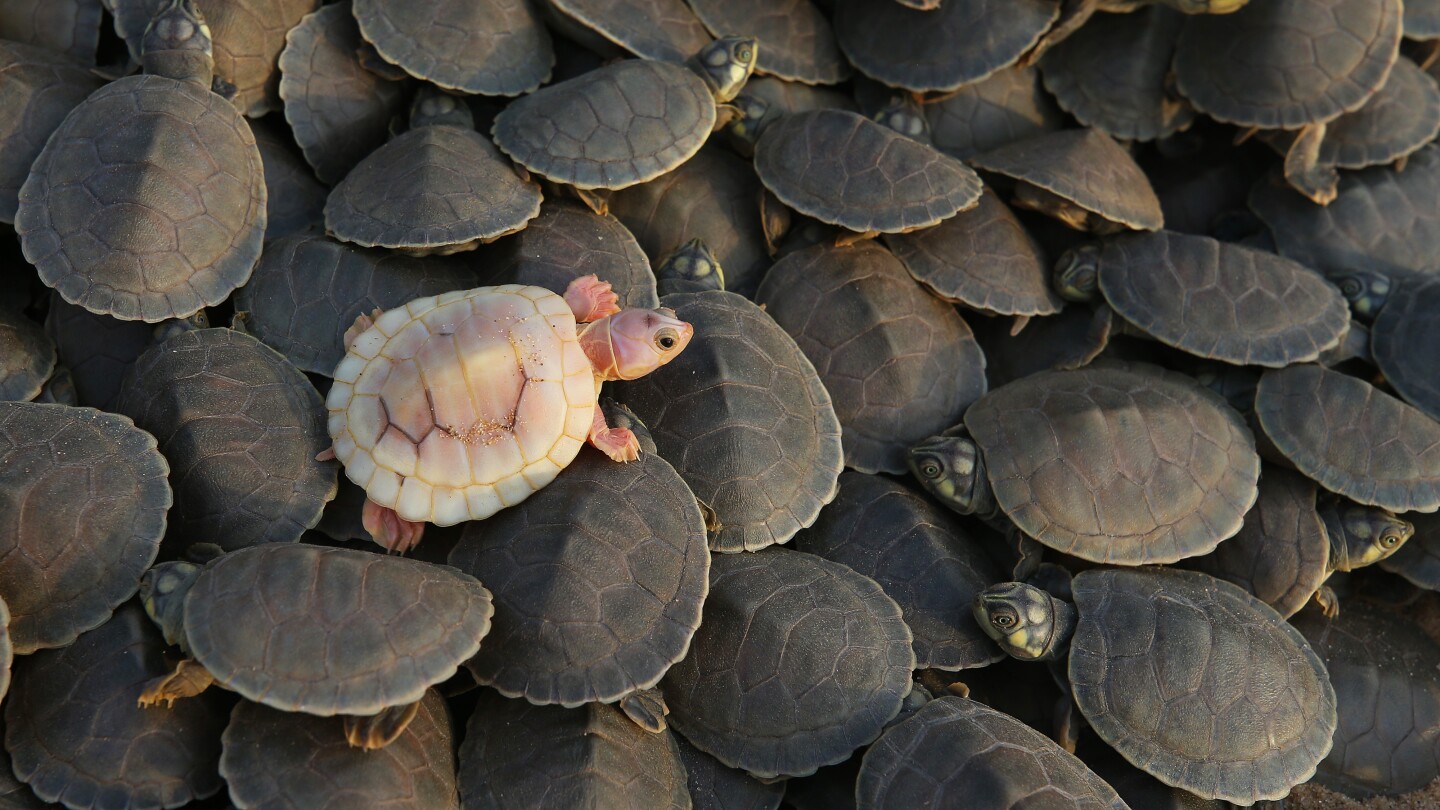
Biologists noted the presence of a rare albino turtle hatchling among this year’s group, a genetic anomaly that occurs in approximately one out of every 5,000 births. The albino turtle, lacking the normal pigmentation, has distinctive pink-white coloration and red eyes.
“Finding an albino hatchling is extremely rare and always exciting,” explained Carlos Mendes, head of the turtle monitoring program. “While these individuals face additional challenges in the wild due to their lack of camouflage, we give them the same opportunity as their siblings to contribute to the population.”
The Abufari Biological Reserve, established in 1982, encompasses approximately 288,000 hectares of protected land in Brazil’s Amazonas state. The reserve contains diverse ecosystems including flooded forests, lakes, and river beaches that provide crucial habitat for numerous endangered species.
The turtle conservation program involves year-round monitoring of nesting beaches, protection against poachers, and scientific research on population dynamics. Environmental agents patrol known nesting sites during the egg-laying season, which typically occurs during the dry season when river beaches are exposed.
According to the Chico Mendes Institute, the conservation program has helped stabilize turtle populations within the reserve over the past decade, though the species remains vulnerable throughout much of its range. The institute estimates that approximately 80% of hatchlings released through the program would not survive without human intervention.
Brazil’s environmental protection efforts have faced significant challenges in recent years, with budget cuts and policy changes affecting conservation work throughout the Amazon. However, the turtle program at Abufari has maintained consistent support, partly due to its visibility and educational value.
As the newly released hatchlings disappeared into the waters of the Abufari reserve, environmental agents expressed cautious optimism about the future of the species while acknowledging the ongoing challenges of conservation work in the rapidly changing Amazon basin.
Fact Checker
Verify the accuracy of this article using The Disinformation Commission analysis and real-time sources.

14 Comments
This is fantastic news, but it also highlights the ongoing threats these turtles face. I hope the Brazilian government continues to strengthen protection measures for the Abufari Biological Reserve.
Absolutely. Preserving the Amazon’s fragile ecosystems should be a top priority, not just for Brazil but for the entire global community.
Releasing thousands of hatchlings is an impressive accomplishment. I wonder what other steps are being taken to monitor and protect the turtle population in the Abufari Reserve.
Great question. Comprehensive monitoring and enforcement efforts are crucial to the success of these types of conservation programs.
As an investor in mining and commodities, I’m always mindful of the potential environmental impacts. It’s heartening to see that steps are being taken to safeguard sensitive species like the Amazon river turtle.
Wonderful to see these giant Amazon river turtles being protected and released back into their natural habitat. Safeguarding endangered species like this is so important for the health of the entire ecosystem.
Agreed, these conservation efforts are critical. The Amazon basin is a true treasure trove of biodiversity that needs to be preserved.
As a mining investor, I’m curious to know more about the potential impact of mining activities in the Amazon on sensitive species like these turtles. What steps are taken to mitigate environmental risks?
That’s a good question. Responsible mining companies should work closely with environmental agencies to ensure mining operations don’t disrupt critical habitats and species.
The photos of the tiny hatchlings being released are truly inspiring. I hope this conservation program continues to thrive and serve as a model for protecting other endangered species in the Amazon.
Agreed, these types of initiatives are vital for preserving the incredible biodiversity of the Amazon basin for generations to come.
The giant Amazon river turtle is such a unique and fascinating species. I’m glad to see these conservation efforts underway to ensure its long-term survival.
The photos of the tiny hatchlings being released are simply adorable. I hope this program continues to be successful in boosting the turtle population in the region.
Yes, it’s heartwarming to see these efforts in action. Protecting iconic species like the Amazon river turtle helps safeguard the entire ecosystem.