


Listen to the article
Ancient Rome’s Architectural Heritage Unveiled from Above
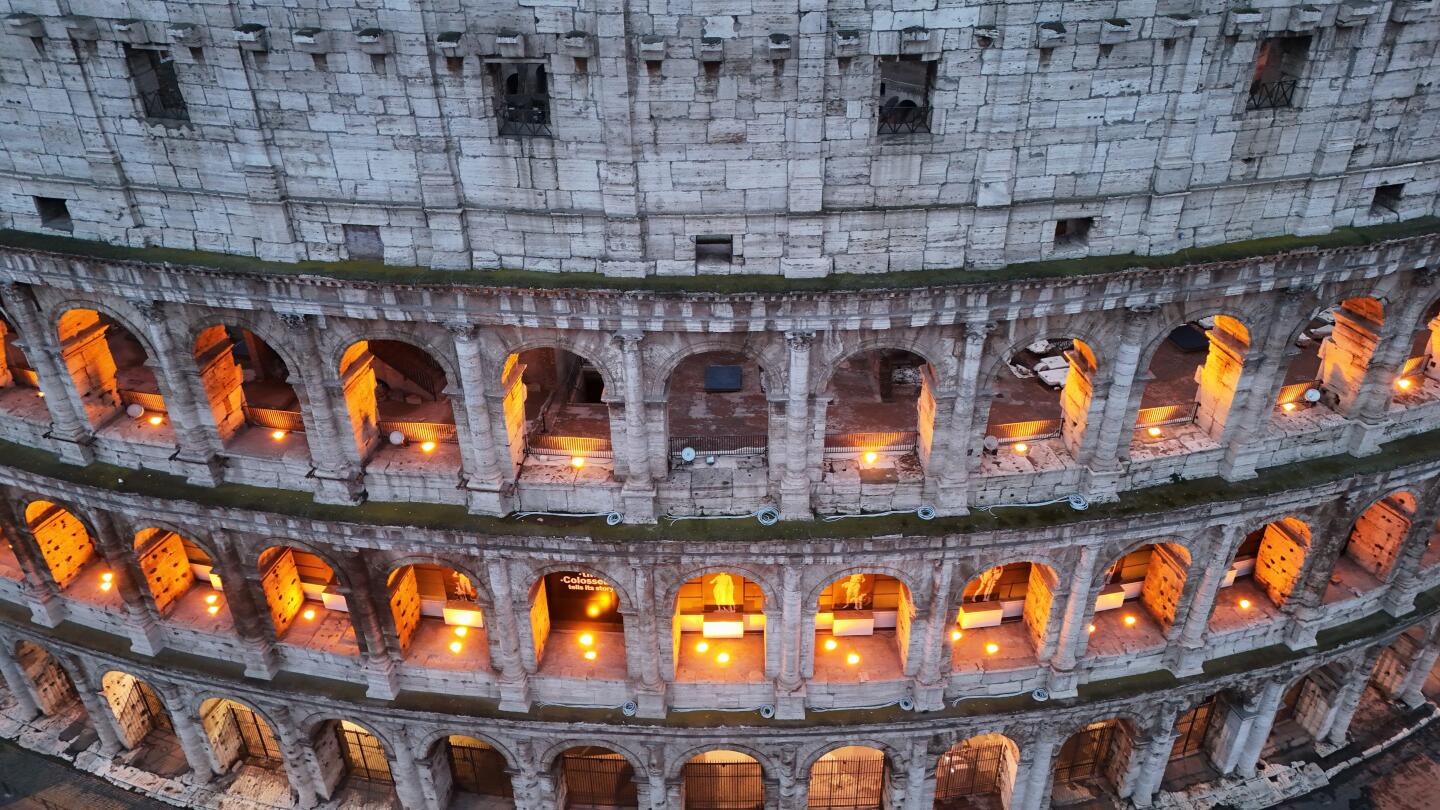
Recent aerial photographs of Rome’s historic center have provided a stunning new perspective on the iconic Colosseum and Roman Forum, showcasing the remarkable juxtaposition of ancient architecture within the modern cityscape.
The images, captured by AP photographers Alessandra Tarantino and Andrew Medichini, offer a rarely seen bird’s-eye view of these archaeological treasures that have defined Rome’s skyline for nearly two millennia. The photographs reveal the impressive scale and intricate design of these monuments that continue to draw millions of visitors annually.
The Colosseum, officially known as the Flavian Amphitheatre, stands as the largest amphitheater ever built during the Roman Empire. Constructed between 70-80 CE under emperors Vespasian and Titus, the structure could host an estimated 50,000 to 80,000 spectators who gathered for gladiatorial contests, mock sea battles, animal hunts, and other public spectacles. The aerial perspective highlights its distinctive elliptical shape and the complex network of underground chambers and tunnels that once housed animals and performers.
Nearby, the Roman Forum spreads across the valley between the Palatine and Capitoline Hills, representing the commercial, political, and religious center of ancient Rome. The aerial photographs capture the dense concentration of temples, basilicas, and government buildings that once served as the heart of Roman civic life. Particularly visible are the remains of the Temple of Saturn, the Arch of Septimius Severus, and the Curia, where the Roman Senate convened.
These historical landmarks are seamlessly integrated within the fabric of modern Rome. The photographs demonstrate how contemporary development has occurred around these protected sites, creating a unique urban landscape where past and present coexist. Major thoroughfares like the Via dei Fori Imperiali, constructed under Mussolini’s fascist regime in the 1930s, can be seen cutting through these archaeological zones, highlighting the ongoing dialogue between preservation and urban development.
The timing of these images at sunrise captures the monuments bathed in golden light, emphasizing their architectural details and the warm-toned travertine limestone and concrete materials that have withstood the test of time. Particularly striking is the view of the Arch of Titus, constructed in 81 CE to commemorate Emperor Titus’ victories, including the Siege of Jerusalem.
Italy’s cultural heritage authorities have worked diligently over decades to preserve these monuments while making them accessible to the public. The Colosseum alone attracts approximately 7 million visitors annually, making it one of the world’s most visited archaeological sites. Recent restoration projects, including a €25 million cleaning and structural reinforcement of the Colosseum completed in 2016, have helped ensure these landmarks remain intact for future generations.
The aerial perspective also reveals ongoing archaeological excavations, particularly in the Forum area, where experts continue to uncover new information about ancient Roman life. These discoveries continually enhance our understanding of Roman engineering, urban planning, and daily life in what was once the capital of an empire spanning three continents.
As Rome continues to balance modern urban needs with heritage preservation, these photographs serve as a powerful reminder of the extraordinary architectural and cultural legacy that defines the Eternal City, where visitors can walk through millennia of human history within the space of a few city blocks.
Fact Checker
Verify the accuracy of this article using The Disinformation Commission analysis and real-time sources.

11 Comments
If AISC keeps dropping, this becomes investable for me.
The cost guidance is better than expected. If they deliver, the stock could rerate.
Good point. Watching costs and grades closely.
Good point. Watching costs and grades closely.
Uranium names keep pushing higher—supply still tight into 2026.
The cost guidance is better than expected. If they deliver, the stock could rerate.
Good point. Watching costs and grades closely.
Good point. Watching costs and grades closely.
Uranium names keep pushing higher—supply still tight into 2026.
Good point. Watching costs and grades closely.
Good point. Watching costs and grades closely.