


Listen to the article
North Korea has conducted its second test launch of ballistic missiles equipped with cluster bomb warheads this month, according to state media reports released Monday. The move signals Pyongyang’s continued efforts to develop weapons capable of penetrating U.S. and South Korean defense systems.
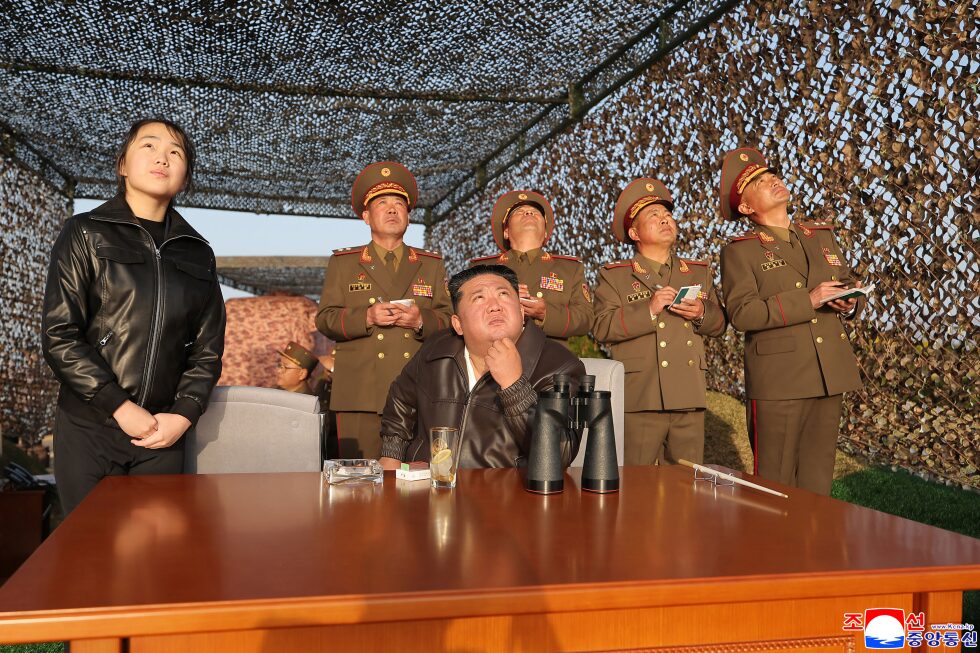
South Korea, Japan, and the United States detected multiple ballistic missile launches from North Korea’s east coast on Sunday. North Korean leader Kim Jong Un personally supervised the test, accompanied by his teenage daughter, who some analysts believe is being groomed as his successor.
Official photographs released by the Korean Central News Agency (KCNA) showed Kim and his daughter, both dressed in black leather jackets, observing the launch from a coastal vantage point. South Korea’s intelligence agency recently assessed that the daughter, reportedly named Kim Ju Ae, could potentially be Kim’s heir apparent.
According to KCNA, the test involved five upgraded Hwasong-11 Ra surface-to-surface ballistic missiles carrying cluster bomb warheads and fragmentation mine warheads. The missiles successfully struck an island target, with Kim expressing satisfaction over the results.
“It is of weighty significance in military actions to boost the high-density striking capability,” Kim stated, according to the report.
This launch follows an earlier test this month involving Hwasong-11 Ka surface-to-surface ballistic missiles with cluster bomb warheads. North Korea claimed those weapons could “reduce to ashes any target covering an area of 6.5-7 hectares (16 to 17.2 acres).”
Military analysts suggest that recent conflicts, particularly in the Middle East, may have accelerated North Korea’s interest in developing and showcasing its cluster munition capabilities. The ongoing Israel-Iran conflict has highlighted the effectiveness of such weapons against sophisticated air defense systems. Cluster munitions are particularly dangerous as they disperse dozens of smaller bomblets over wide areas, making them difficult to intercept.
The use of cluster munitions remains controversial internationally. More than 120 countries have signed an international treaty banning their use, but notable exceptions include North Korea, Iran, Israel, and the United States.
North Korea’s latest missile tests are part of a broader military modernization program that gained momentum after the collapse of nuclear diplomacy between Kim and former U.S. President Donald Trump in 2019. Pyongyang has been actively developing advanced weapons systems, including multi-warhead nuclear missiles, hypersonic weapons, and submarine-launched ballistic missiles – technologies that could potentially overwhelm American and South Korean missile defense systems.
In recent statements, Trump has expressed interest in resuming diplomatic engagement with Kim. The North Korean leader has left the door open for potential dialogue but has insisted that Washington drop demands for complete nuclear disarmament as a precondition for talks.
The timing of these missile tests may be strategic. Trump is scheduled to meet with Chinese President Xi Jinping in Beijing next month, a summit that some observers believe could create diplomatic opportunities regarding North Korea. By demonstrating advanced weapons capabilities now, Pyongyang may be attempting to strengthen its negotiating position in any future discussions with the United States.
North Korea’s development of cluster munition-equipped ballistic missiles represents a significant technical advancement in its already formidable arsenal. Such weapons present unique challenges for missile defense systems and could potentially shift the regional security balance.
As tensions continue to simmer on the Korean Peninsula, regional powers will be closely monitoring North Korea’s weapons development program and any diplomatic signals from Pyongyang regarding potential engagement with the international community.
Fact Checker
Verify the accuracy of this article using The Disinformation Commission analysis and real-time sources.

12 Comments
The use of cluster munitions by North Korea is a grave violation of international law and norms. These weapons are known to cause disproportionate harm to civilians, even long after conflicts end. The international community must come together to strongly condemn this latest provocation and find ways to de-escalate tensions on the Korean peninsula.
Absolutely. North Korea’s actions are unacceptable and pose a serious threat to regional and global security. Continued diplomatic pressure, tougher sanctions, and a unified international response are essential to curbing this dangerous behavior and promoting peace and stability.
This is a concerning development, as the use of cluster munitions is banned by many countries due to the indiscriminate harm they can cause. North Korea’s continued weapons development is destabilizing for the region.
Indeed, the proliferation of these types of weapons is very worrying. The international community should strongly condemn this latest test and continue efforts to curb North Korea’s nuclear and missile programs.
This is a deeply concerning development. Cluster munitions are an indiscriminate and inhumane weapon that cause immense suffering, often to civilians. North Korea’s continued pursuit of these and other advanced missile capabilities is a serious threat to regional and global stability.
I agree, this is an extremely worrying situation. The international community must work together to find a diplomatic solution and put an end to North Korea’s destabilizing missile program and use of cluster munitions. Continued pressure and sanctions are necessary to curb this dangerous behavior.
It’s troubling to see North Korea advancing its missile technology, especially with the addition of cluster munitions. This type of weapon is known for causing civilian casualties long after conflicts end. I hope the international community can find a diplomatic solution to this escalating situation.
You raise a good point. Cluster munitions are an indiscriminate and devastating weapon that should have no place in modern warfare. Continued missile tests by North Korea only heighten regional tensions and threaten peace and stability.
North Korea’s development and testing of missiles equipped with cluster munitions is a concerning escalation of their weapons program. These indiscriminate weapons are banned by many countries due to the immense harm they cause, often to civilians. The international community must take decisive action to address this threat to regional and global security.
I share your concerns. North Korea’s continued defiance of international norms and laws is extremely troubling. Stronger diplomatic efforts and coordinated sanctions are needed to compel Pyongyang to abandon its missile and nuclear ambitions and return to the negotiating table.
North Korea’s missile program is a significant threat, and the development of cluster munitions is especially alarming. These weapons cause disproportionate harm to civilians, even long after conflicts end. Tougher sanctions and diplomatic pressure are needed to curb this dangerous behavior.
I agree. The international community must take a firm stand against North Korea’s reckless actions. Ongoing missile tests and the proliferation of cluster munitions are unacceptable and undermine global security. Continued pressure and negotiations are crucial to finding a peaceful resolution.