


Listen to the article
Argentina’s Secret Files Reveal Nazi “Angel of Death” Josef Mengele’s Open Life in Exile
Newly declassified documents released by Argentine President Javier Milei have exposed how one of history’s most notorious Nazi war criminals, Josef Mengele, lived openly in Argentina for years while evading justice. The files detail how bureaucratic disorganization and lack of coordinated action allowed the infamous Auschwitz doctor to escape arrest despite authorities being fully aware of his identity and whereabouts.
Mengele, known as the “Angel of Death,” was a Nazi physician who conducted brutal medical experiments on concentration camp prisoners, particularly twins, under the guise of scientific research. The declassified archives contain eyewitness testimony describing his sadistic nature, including accounts of him torturing twins in front of each other after sending their parents to gas chambers.
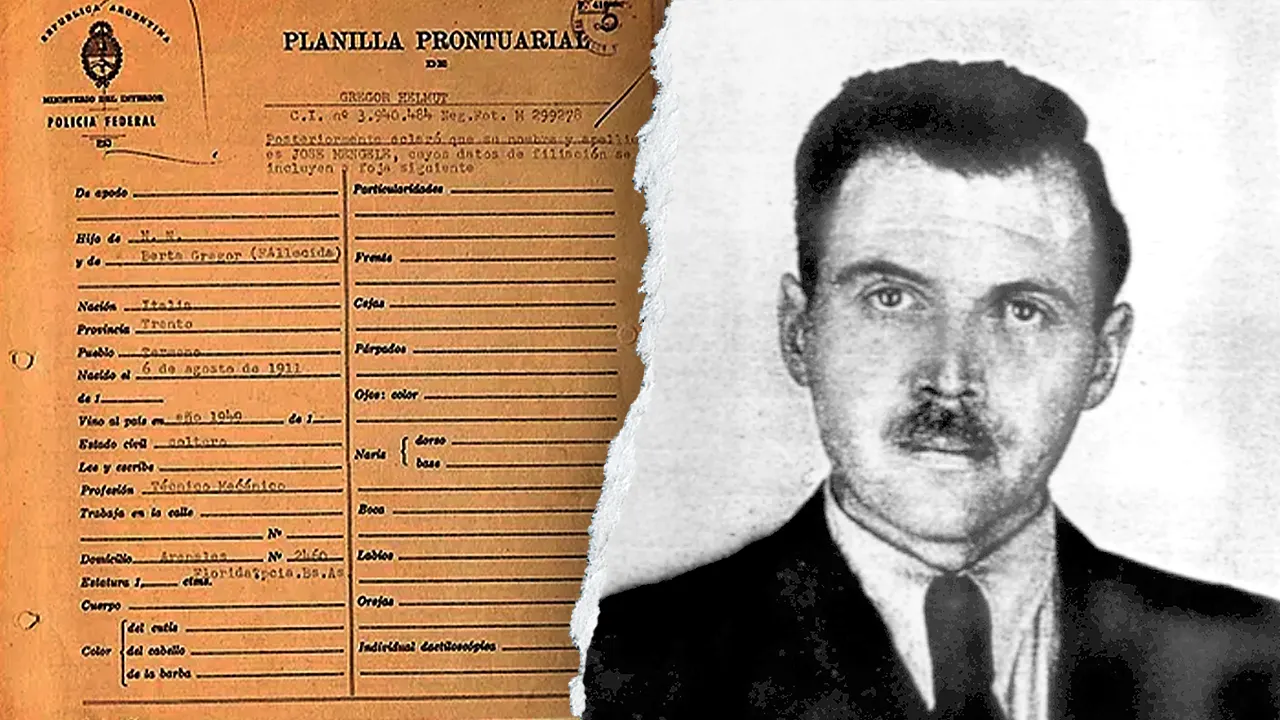
The documents reveal that Argentine authorities clearly understood who Mengele was by the mid-1950s. They knew he had entered Argentina in 1949 using an Italian passport issued under the alias Helmut Gregor, which he used to obtain an official immigrant ID card in 1950.
What’s particularly striking in these files is how Mengele eventually felt so secure in Argentina that he began using his real name. In 1956, he obtained a legalized copy of his birth certificate from the West German Embassy in Buenos Aires and requested his ID be officially amended to reflect his true identity – a remarkable indication of how protected he felt.
“I met Mengele. I knew him well. I saw him many times in the Auschwitz camp, with his SS colonel’s uniform and, on top of it, the white doctor’s coat,” stated José Furmanski, an Argentine citizen born in Poland who had been a Mengele victim, in an interview contained within the files. Furmanski, a twin, provided vivid testimony of the horrific experiments performed on him and others.
“He gathered twins of all ages in the camp and subjected them to experiments that always ended in death. Between the children, the elderly, and women… what horrors. I saw him separate a mother from her daughter and send one to certain death. We will never forget,” Furmanski recounted.
The Argentine intelligence files also tracked Mengele’s business interests in the country. Reports cite a possible visit by Mengele’s father to Argentina to financially support his son by investing in a medical laboratory business in Buenos Aires. By 1958, Mengele had become a partner in “FADRO-FARM” laboratories, contributing 10,000 pesos in capital.
Despite mounting evidence and international pressure, Argentina’s response was hampered by fragmented information sharing among various agencies. The archives – containing Spanish, German, Portuguese, and English documents – reveal how intelligence was compiled but rarely acted upon effectively. A West German arrest warrant and extradition request issued in 1959 was denied by a local judge who claimed it was based on “political persecution.”
The documents also shed light on the networks that sheltered Mengele across South America. As pressure increased in Argentina, Mengele fled to Paraguay in 1959, where he gained citizenship and protection from dictator Alfredo Stroessner, whose family originated from the same Bavarian town as Mengele.
By 1960, Argentine intelligence was mostly tracking Mengele through press reports, noting he had clandestinely entered Brazil through the tri-border area near Paraná state. There, he was aided by German Brazilian farmers who were Nazi sympathizers, living under aliases including Peter Hochbichler and a Portuguese version of his real name, José Mengele.
The files corroborate Argentina’s ambiguous post-war position – officially cooperating with Western democracies while demonstrating reluctance to confront how deeply Nazi fugitives had embedded themselves within the country’s social and political landscape. The disconnected bureaucracy and lack of urgency regarding war criminals meant that arrest warrants, searches, and surveillance were often conducted too late, after Mengele had been tipped off.
Mengele ultimately died in 1979 after suffering a stroke while swimming in the coastal Brazilian town of Bertioga. He was buried under the false name Wolfgang Gerhardt, but his remains were exhumed and positively identified by Brazilian authorities in 1985, with DNA testing confirming the findings in 1992.
The declassified Argentine archives provide a disturbing glimpse into how one of history’s most wanted war criminals managed to live in relative freedom for decades after the war, protected by sympathetic networks and bureaucratic inaction across multiple South American countries.
Fact Checker
Verify the accuracy of this article using The Disinformation Commission analysis and real-time sources.

9 Comments
As shocking as this story is, I’m not entirely surprised. We’ve seen time and again how some Nazi criminals managed to escape punishment, often with the help of sympathetic officials. This underscores the importance of ongoing efforts to uncover the truth and seek justice, even decades later.
While the revelations about Mengele’s escape are disturbing, I’m glad these declassified files are finally shedding light on this dark chapter of history. It’s important that we confront the past, no matter how uncomfortable, to ensure such atrocities are never repeated.
I agree. Uncovering the truth, even decades later, is crucial. Perhaps these files will lead to a fuller reckoning and accountability for Mengele’s actions and the system that enabled his escape.
The fact that Mengele was able to evade justice for so long, even with authorities aware of his whereabouts, is deeply troubling. This case highlights the need for stronger international cooperation to bring war criminals to account, no matter how long it takes.
Mengele’s escape and subsequent life in Argentina raises serious questions about the complicity of authorities in harboring Nazi war criminals. The fact that he was able to obtain official documents and live openly is a damning indictment of the system at the time.
This is a chilling reminder of the horrors committed by Nazi war criminals and the failures of the international community to bring them to justice. The fact that Mengele was able to evade capture for so long is deeply troubling. Hopefully, these revelations will lead to a deeper understanding of this history and renewed efforts to hold such criminals accountable.
Fascinating to learn more about the escape of this notorious Nazi criminal. It’s disturbing to think of the atrocities Mengele committed under the guise of science. The documents reveal a shocking lack of coordination to bring him to justice.
This is a chilling story of how a monster like Mengele was able to evade capture for so long. The details about his sadistic experiments on prisoners are truly horrific. It’s appalling that the authorities knew his identity yet failed to act.
While the details of Mengele’s escape and subsequent life in Argentina are disturbing, I’m glad these documents have been declassified. Shedding light on such dark chapters of history is crucial, even if it’s uncomfortable. We must confront the past to ensure it’s never repeated.