


Listen to the article
Emergency crews across Southeast Asia are racing against time as the death toll from devastating floods and landslides has surpassed 1,300 people across Indonesia, Sri Lanka, Thailand, and Malaysia. Nearly 900 individuals remain missing as rescue efforts intensify in regions ravaged by days of heavy monsoon rains.
The catastrophe has left thousands stranded, with many desperately clinging to rooftops and trees awaiting rescue. According to official figures released Tuesday, the disaster has claimed at least 744 lives in Indonesia, 410 in Sri Lanka, 181 in Thailand, and three in Malaysia. Sri Lankan President Anura Kumara Dissanayake has cautioned that determining the exact death toll remains challenging at this early stage.
Indonesia, bearing the brunt of the disaster, faces significant challenges in its rescue operations. On Sumatra island, access to affected villages has been severely hampered by washed-out roads and collapsed bridges. The National Disaster Management Agency reports 551 people still missing. Despite deploying helicopters and boats, worsening weather conditions and damaged infrastructure continue to slow rescue efforts.
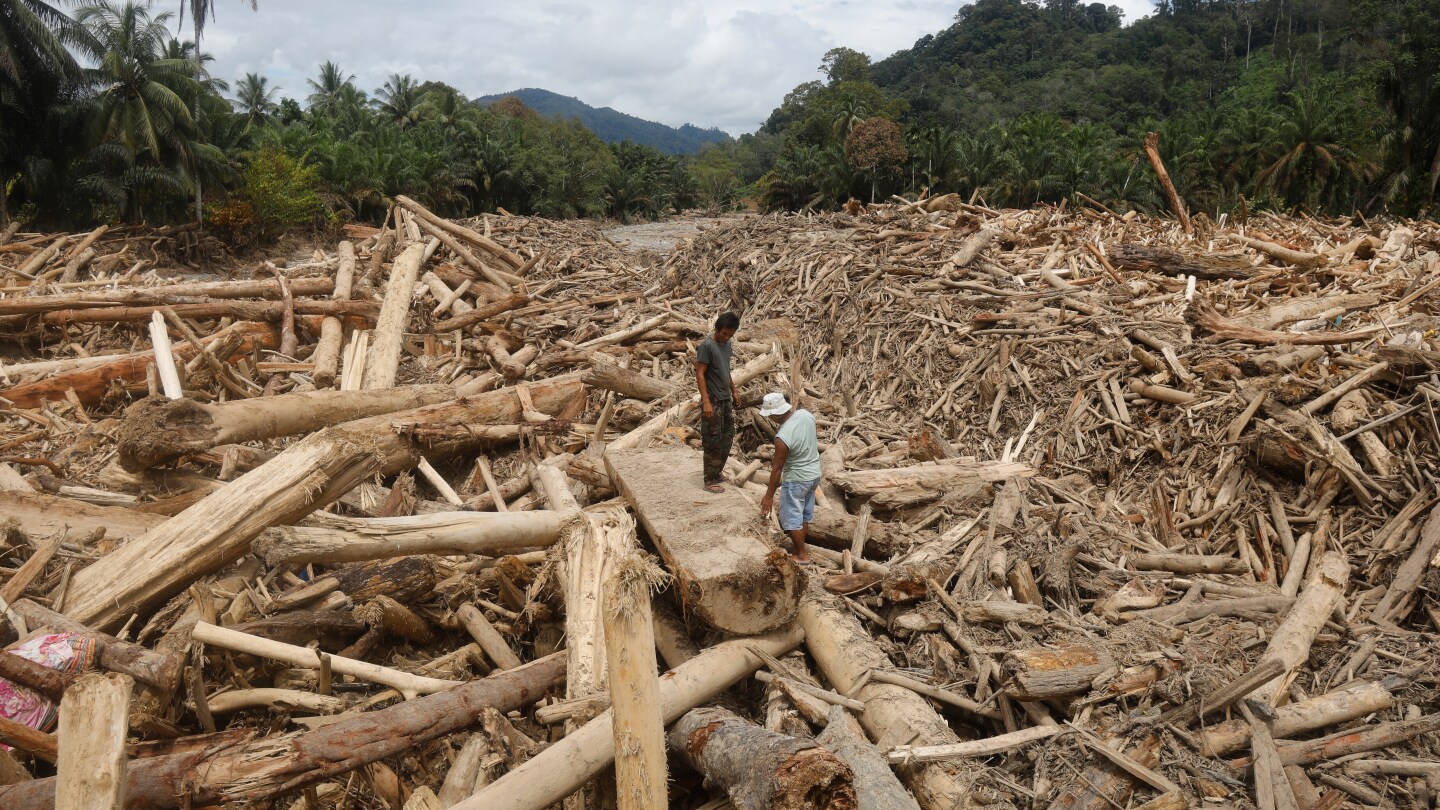
Environmental concerns have emerged alongside the humanitarian crisis. In North Sumatra’s Batang Toru region, once a lush forested area, floods and landslides have carried away millions of cubic meters of felled timber. This has sparked public outcry over potential links between the disaster’s severity and illegal logging activities. What was once verdant forest has been transformed into a wasteland of broken logs, shattered homes, and roads replaced by rivers of mud.
“This is not just a natural disaster, it’s a manmade crisis,” warned Rianda Purba from the Indonesian Environmental Forum. “Deforestation and unchecked development have stripped Batang Toru of its resilience. Without urgent restoration and stricter protections, these floods will become the new normal.”
The human toll continues to mount as survivors desperately search for missing loved ones. In Sikumbang village in Indonesia’s Agam district, 38-year-old farmer Zahari Sutra clutched photos of his missing wife and two young daughters as he pleaded with rescuers for help. “Other victims have been found… why not my family?” he asked, recounting how rising waters had forced him to abandon his motorbike and run for higher ground, unable to reach his home before it was swept away.
Sutra described finding his eldest daughter, a 5-year-old, covered in mud but alive. The pair spent the night clinging to a lychee tree until dawn revealed the full devastation – all homes in the area either vanished or buried under mud. “My only prayer is to find my wife and children,” he said, his voice breaking with emotion.
In Sri Lanka, military-led rescue teams are searching for 336 people still missing following Cyclone Ditwah. Access remains difficult with roads blocked by landslides and collapsed bridges. Residents in the central city of Kandy are struggling without running water, relying on bottled supplies collected from natural springs. Authorities have warned that conditions could deteriorate further with more rain forecast in coming days.
President Dissanayake described the disaster as the worst in Sri Lanka’s recent history, emphasizing that the full scale of casualties remains impossible to determine. The human cost is reflected in stories like that of Selladurai Yogaraj, a 35-year-old resident of Sarasavigama who lost his entire family – mother, wife, and two children. “I can’t even think what life is going to be like,” he said.
In southern Thailand, cleanup operations have begun after massive floods affected more than 1.5 million households and 3.9 million people. Authorities are working to restore water and electricity infrastructure. Thailand’s Interior Ministry has announced plans to set up public kitchens providing freshly cooked food to affected residents, while the government prepares to distribute the first batch of compensation payments totaling 239 million baht ($7.4 million) to 26,000 people.
Malaysia reported three confirmed deaths in northern Perlis state, where flooding has forced approximately 6,000 people to seek shelter in emergency centers.
The disaster has also highlighted regional tensions, with Pakistan accusing India of blocking a military aircraft carrying humanitarian aid to Sri Lanka – allegations India promptly rejected as baseless. According to Indian officials, they approved Pakistan’s overflight request within four hours on humanitarian grounds.
United Nations Secretary-General António Guterres has expressed condolences to victims’ families and stated that the UN is “in close contact with authorities in all four countries and stands ready to support relief and response efforts,” according to spokesperson Stéphane Dujarric.
As rescue operations continue, the full impact of this regional catastrophe is still unfolding, with authorities warning that both death tolls and damage assessments may rise further in the coming days.
Fact Checker
Verify the accuracy of this article using The Disinformation Commission analysis and real-time sources.

12 Comments
Kudos to the emergency crews working tirelessly to rescue people and provide aid. It must be incredibly challenging given the destroyed infrastructure. I hope the international community rallies to support the affected countries during this difficult time.
Yes, the rescue efforts sound absolutely crucial right now. I hope the affected nations receive all the resources and assistance they need to save lives and begin the recovery process.
This is a devastating tragedy unfolding in Southeast Asia. My heart goes out to all those impacted by these terrible floods and landslides. The rescue efforts must be incredibly challenging given the scale of the damage and loss of life.
You’re right, the rescue operations sound incredibly difficult with the washed-out roads and bridges. I hope the teams on the ground are able to reach and assist all those stranded as quickly as possible.
The scale of the flooding and landslides is just devastating. I’m concerned about the long-term impacts on the affected regions, both in terms of the immediate humanitarian crisis and the potential environmental damage. Rebuilding efforts will surely be immense.
You raise a good point. The environmental toll of these disasters is often overlooked in the initial response. Protecting natural habitats and addressing root causes like deforestation will be crucial for the recovery process.
This is a heartbreaking situation. My deepest condolences go out to the families and communities grappling with the loss of life and devastation. I hope the missing persons are found safe, and that the rescue operations are able to reach all those in need.
Absolutely, the priority now must be on search and rescue to save as many lives as possible. The sheer scale of the disaster is staggering. I sincerely hope the death toll does not continue to rise.
It’s alarming to see the death toll continue rising across multiple countries. I can’t imagine the anguish the affected communities must be experiencing. This serves as a stark reminder of the immense power and destructive force of extreme weather events.
Absolutely, these natural disasters highlight the urgent need to address climate change and build more resilient infrastructure. My condolences go out to all those grieving loved ones lost in this tragedy.
The flooding and landslides sound catastrophic. I’m concerned about the long-term impacts on the region’s infrastructure, economy, and environment. This is a stark reminder of the urgent need to address climate change and build more resilient communities.
You make a good point. This disaster underscores the importance of investing in climate adaptation and disaster preparedness measures to mitigate the effects of extreme weather events. I hope the affected countries receive the support they need to recover and rebuild.