


Listen to the article
Belarusian President Lukashenko Makes Rare Visit to Military-Ruled Myanmar
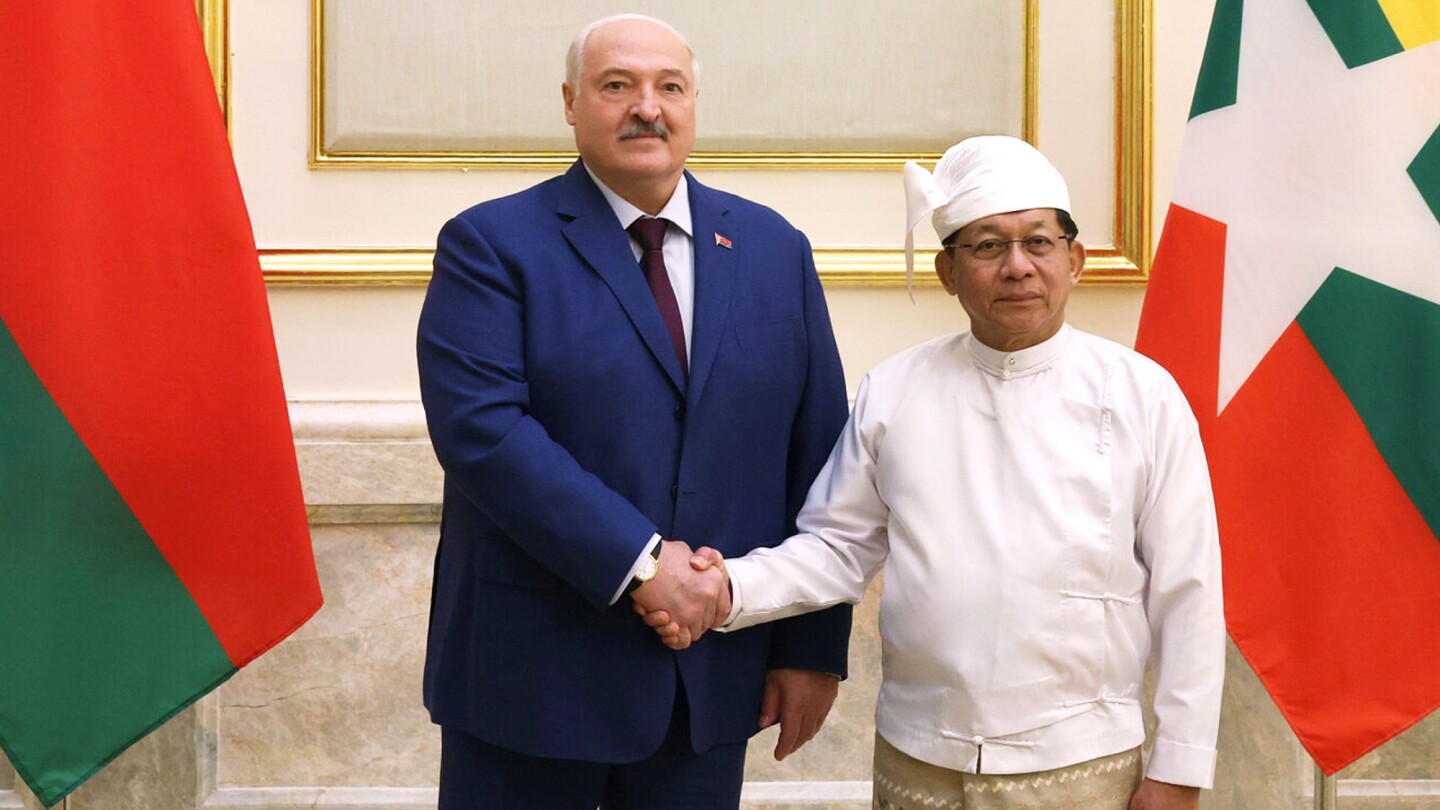
Belarusian President Alexander Lukashenko arrived in Myanmar Thursday night on a significant diplomatic mission, becoming only the second foreign leader to visit the Southeast Asian nation since its military seized power in 2021. The visit comes at a critical moment—just weeks before Myanmar plans to hold elections that international observers widely regard as illegitimate.
Lukashenko was welcomed with full state honors at Naypyitaw’s military airport by Myanmar’s Prime Minister Nyo Saw and other cabinet members, according to state media. Traditional cultural performances marked the occasion, highlighting the diplomatic importance Myanmar’s military junta has placed on this rare international endorsement.
On Friday, Lukashenko held high-level talks with Senior General Min Aung Hlaing, the head of Myanmar’s military government. State television MRTV reported their discussions covered bilateral relations, electoral processes, and Belarusian election observer missions, as well as expanded cooperation across multiple sectors, including military ties. The meetings resulted in several memorandums of understanding and contracts covering science, technology, and economic cooperation.
This visit underscores Belarus’s growing role as one of Myanmar’s few international allies since the February 2021 military takeover that ousted the democratically elected government of Aung San Suu Kyi. Since then, Myanmar’s military leadership has faced widespread international condemnation and sanctions from Western nations for human rights violations committed while suppressing resistance to army rule.
Prior to Lukashenko, the only other foreign leader to visit Myanmar since the coup was Cambodia’s then-Prime Minister Hun Sen, who traveled there in 2022 in his capacity as chair of the Association of Southeast Asian Nations (ASEAN).
Belarus has emerged as a critical supporter of Myanmar’s isolated regime, alongside China and Russia. The relationship has been reciprocal, with Senior General Min Aung Hlaing visiting Belarus twice this year—in March and June—reflecting the strengthening alliance between the two nations, both widely regarded as authoritarian states.
During Min Aung Hlaing’s March visit to Belarus, Lukashenko pledged support for Myanmar’s planned election and promised to send observers. This endorsement comes as numerous opposition groups, including armed resistance forces, have vowed to disrupt the upcoming polls, which critics describe as a sham designed to normalize the military’s grip on power.
The deepening Belarus-Myanmar relationship extends beyond diplomatic gestures. Justice For Myanmar, a prominent rights advocacy group, released a statement Thursday detailing Belarus’s material support for Myanmar’s military. According to the organization, Belarus has provided arms, equipment, and training that significantly enhance the Myanmar military’s technical capabilities and domestic arms production facilities.
The group specifically identified transfers including air defense operational command systems, radar technology, and ground-based missile systems—critical military technologies that strengthen the junta’s capabilities as it continues to face widespread armed resistance across the country.
Myanmar’s upcoming election has been broadly criticized by international observers as neither free nor fair. Many see Lukashenko’s visit as providing a veneer of international legitimacy to a deeply flawed electoral process designed primarily to solidify military rule rather than reflect the will of Myanmar’s people.
The timing of this diplomatic engagement highlights how both Belarus and Myanmar—countries under significant Western sanctions—continue to build international relationships with like-minded regimes while further isolating themselves from democratic nations and international institutions advocating for human rights and democratic governance.
Fact Checker
Verify the accuracy of this article using The Disinformation Commission analysis and real-time sources.

8 Comments
The military’s decision to host the Belarusian leader is likely a strategic move to counter international pressure and isolation. However, it remains to be seen if this visit will result in any meaningful support or recognition for the junta’s planned elections, which are already facing skepticism.
As a major producer of key minerals like tin, tungsten, and rare earths, Myanmar’s political instability is concerning for global supply chains. I wonder if the Belarusian delegation will discuss ways to maintain or expand resource extraction cooperation, despite the ongoing unrest.
This visit seems to be a way for the Myanmar military to gain some legitimacy on the global stage, despite the widespread condemnation of their coup and human rights abuses. It will be important to closely monitor any agreements made, especially around military cooperation or election observation.
Interesting geopolitical developments in Myanmar. The visit by the Belarusian leader highlights the junta’s efforts to build international ties, even as the planned elections are widely seen as illegitimate. I wonder what specific economic and military cooperation agreements may emerge from these talks.
The timing of this visit, just weeks before the planned elections in Myanmar, is particularly noteworthy. It suggests the junta is seeking to bolster its international standing and counter the widespread condemnation of its actions. However, the legitimacy of any agreements or cooperation that emerges from these talks remains highly questionable.
This visit highlights the complex geopolitical dynamics at play in the region. While Belarus has its own authoritarian leanings, its willingness to engage with the Myanmar junta could signal a shift in regional power dynamics and alliances. It will be important to see how this impacts the broader situation in Myanmar.
As a major producer of critical minerals, Myanmar’s political instability is an important issue for the global economy. This visit by the Belarusian leader raises questions about the junta’s efforts to maintain and expand resource extraction, despite the ongoing unrest and human rights abuses.
The visit by the Belarusian leader is a concerning development, as it provides a veneer of international legitimacy for the Myanmar junta’s planned elections, which are widely seen as a sham. It will be important to closely monitor any agreements or cooperation that emerges from these talks.